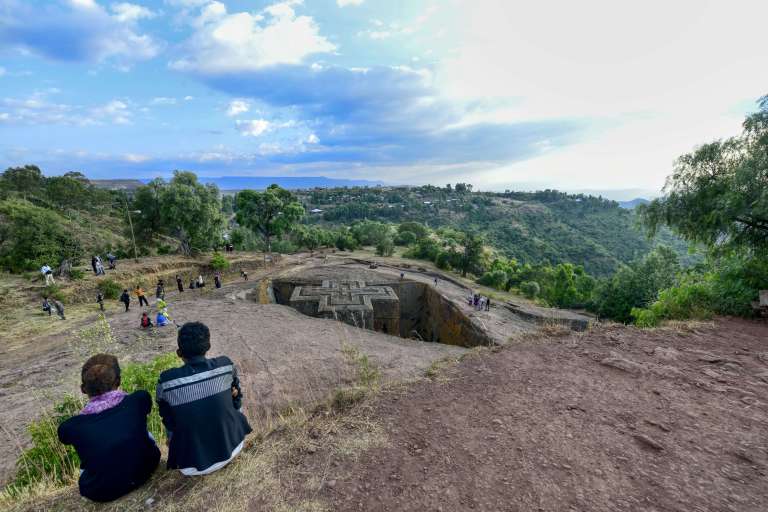
This isn’t fiction. It’s called the African Jerusalem.
People there don’t need clocks. The bees tell the time.
As my readers know, I’m vegan, so I don’t take from animals, not even honey. That hasn’t changed. But in the highlands around Lalibela, I noticed a different way of living with them, one rooted in respect and faith.
I spent four years of my teenage life in Ethiopia, then returned again at 22. Some places stay with you in a way that doesn’t fade, and for me, this is one of them.
Not far from Lalibela, in rural areas often referred to locally as Gueorgis, beekeeping isn’t just a livelihood. It’s something older, something spiritual. Among Ethiopian Orthodox Christian communities, bees are not seen as simple insects. They’re often regarded as pure creatures, sometimes described as reflecting the discipline and harmony of angels. Not because they’re divine, but because they’re part of a creation that follows a precise order, one that humans are meant to observe and respect.
That idea of order shows up everywhere, especially in how people relate to time.
- The concept of time
There’s a belief I heard more than once while I was there. The bees give the time three times a day. In the morning around what we would call 10, then at midday, and again in the afternoon around 3. These are the moments when their activity peaks, when they leave in visible waves to gather nectar. It’s not a clock in the modern sense, but it becomes one in daily life.
And in many of these rural areas, that matters more than any watch.
Because the reality is that in remote parts of Ethiopia, especially around Lalibela, people have historically lived without precise, mechanical timekeeping. Time is read through the sun, through patterns. Morning begins when the light settles a certain way. Midday is when the sun stands above you. Evening arrives when shadows stretch and the air cools.
People don’t meet at exact hours. They meet in moments. And everyone understands those moments.
There’s a cliché you hear often about Africans being fashionably “late,” about Ethiopians not caring about time. I don’t take that at face value. Without claiming it as a proven explanation, I think it says more about the observer than the people being described.
If your entire system is built around minutes and precision, then anything outside of that looks like disorder. But what if it’s just a different structure?
For instance, in Islamic cultures, time is extremely precise. Daily prayers are tied to exact solar positions. Fasting begins and ends at defined moments. The lunar calendar governs entire cycles of life. Time there is something to be measured carefully and adhered to strictly.
In contrast, in many rural societies, time is lived before it’s measured. It flows with what God has set in motion, rather than being cut into exact units. So what looks like “lateness” might simply be life unfolding without the pressure of the clock.
And Ethiopia takes that even further in a way most people don’t even realize.
It doesn’t just live time differently. It counts it differently.
There’s what we call international time, and then there’s Ethiopian time. In Ethiopia, the day starts at what we would call 6 AM, roughly sunrise. That’s hour one. So what we call 7am becomes 1 o’clock. Noon becomes 6. What we call 6 PM becomes 12. It’s not confusion. It’s consistency with the sun. The first hour begins when light begins.
It’s a system that actually makes a lot of sense. It aligns the clock with lived reality rather than abstract convention.
The calendar follows the same logic.
Ethiopian calendar has 13 months, not 12. Twelve months of 30 days, and a thirteenth month of 5 days, or 6 in a leap year. That last month, Pagume if my memory hasn’t failed me, is short, almost like a pause between cycles.
Thus, the new year doesn’t begin on January 1st. It begins around September 11th. Right after the heavy rainy season, when the land resets, when the skies clear, when life begins again. It’s agricultural, but also spiritual. A renewal that actually follows the environment people live in.
And because of how this calendar was preserved, based on older Christian calculations of the Annunciation, Ethiopia is about 7 to 8 years “behind” the Gregorian calendar. So while much of the world is in 2026, Ethiopia is in 2018.
It’s not that one is right and the other is wrong. It’s that one remained rooted in its own continuity, and I love and salute that.
- Beekeeping in the African Jerusalem
That continuity matters when you look at places like Lalibela, often called the African Jerusalem. Tied to Gebre Mesqel Lalibela, whose name is understood to mean “the bees recognize his greatness/sovereignty”, it reflects one of the oldest continuous Christian traditions in the world. Christianity has been practiced in Ethiopia since at least the 4th century, long before much of Europe fully adopted it.
So when people bring honey to churches, when priests bless bees and beekeepers, it’s not symbolic in a modern sense. It’s continuity across centuries.
And that continuity is visible in movement too.
During honey harvesting seasons, some people from extremely remote villages set out for the markets of Lalibela, carrying honey in hand-crafted clay jars to sustain their families. They walk for days, not hours, days!
They move across the highlands, guided by the sun, by memory, by instinct. No maps, no schedules. Just direction.
Along the way, they stop at churches. Some of them centuries old, carved into rock. They offer part of their honey. Priests receive it, bless it, sometimes bless the bees themselves. It’s not commerce. It’s passage.
When night falls, they stop.
No tents. No inflatable beds. No modern equipment. They sleep outside, on the ground, with whatever they carry. Then at sunrise, they continue. Dozens of kilometers, step after step, until they reach the central market.
And this still happens today.
Part of what makes this possible is the geography of the Ethiopian highlands, historically known as Abyssinia. Compared to neighboring regions in Kenya or Tanzania, which are home to large populations of dangerous wildlife, the high plateaus around Lalibela are relatively safer. Fewer large predators, different ecosystems. It doesn’t mean there’s no risk, but it makes long-distance walking without protection far more viable.
The beehives themselves are adapted to this environment. Made from hollowed logs, woven fibers, and natural seals, they protect the bees from temperature swings and pests, and can survive in remote areas with minimal attention. Over generations, this system has allowed Ethiopian beekeeping to continue for at least 1500 years, deeply tied to the rhythms of the land.
The climate shapes everything too. Much of Ethiopia doesn’t follow four seasons, but cycles of rain and dryness that vary by altitude. Life organizes itself around what is given, and when it’s given, whether for people or for bees. In this context, priests play a role. Honey and candles are brought to churches, blessed, and prayers are offered for people and their bees.
Provision ultimately comes from God, and humans participate within limits they cannot control.
Even so, tension remains. People treat the bees with care and respect, but taking honey is still taking. Even when done carefully, it remains a form of exploitation. It may be necessary, it may be balanced, but it must also be acknowledged.
What stayed with me after all these years and despite how much I traveled was the alignment. A place where time is not just counted differently, but felt differently. Where a day doesn’t begin at midnight because a clock says so, but when light actually appears. Where a year resets not in the middle of winter, but after the rains have passed. Where journeys are measured in effort, not in minutes.
In a place like Lalibela, you start to question what we consider “normal.”
Maybe precision isn’t always clarity.
Maybe being “on time” isn’t always being in sync.
And maybe there are ways of living, still existing today, that haven’t forgotten that time was never meant to be owned, only followed.
Thanks for reading.
Teekay
Discover more from Teekay Rezeau-Merah
Subscribe to get the latest posts sent to your email.
 Teekay Rezeau-Merah