Climat action

Eat local is a comforting lie

Carbon offsetting, food choices and eating local

Walk into any farmers’ market or go to any “climate protest” and you’ll hear the same advice: eat local.

It’s sold as one of the simplest ways to reduce your carbon footprint. Buy beef from the farm down the road instead of the one shipped across the world and you’ve supposedly made an environmentally responsible choice.

You haven’t.

The phrase eat local has become one of the most successful pieces of green marketing ever created. Not because it’s entirely wrong, but because it distracts people with one of the smallest parts of the problem while protecting one of the largest.

Note: I use the same terminology as the studies I cite for consistency. That doesn’t mean I endorse it. Terms like beef and chicken are industry labels. They refer to the flesh of cows and hens who were killed, not something separate from the animals themselves.

The 6% illusion

Here’s the number almost nobody mentions.

Transport accounts for just 6% of global food emissions.

The other 94% comes from land use, farming, animal feed, methane, fertilizers and production itself. The truck is rarely the problem. The product is.

But not all products.

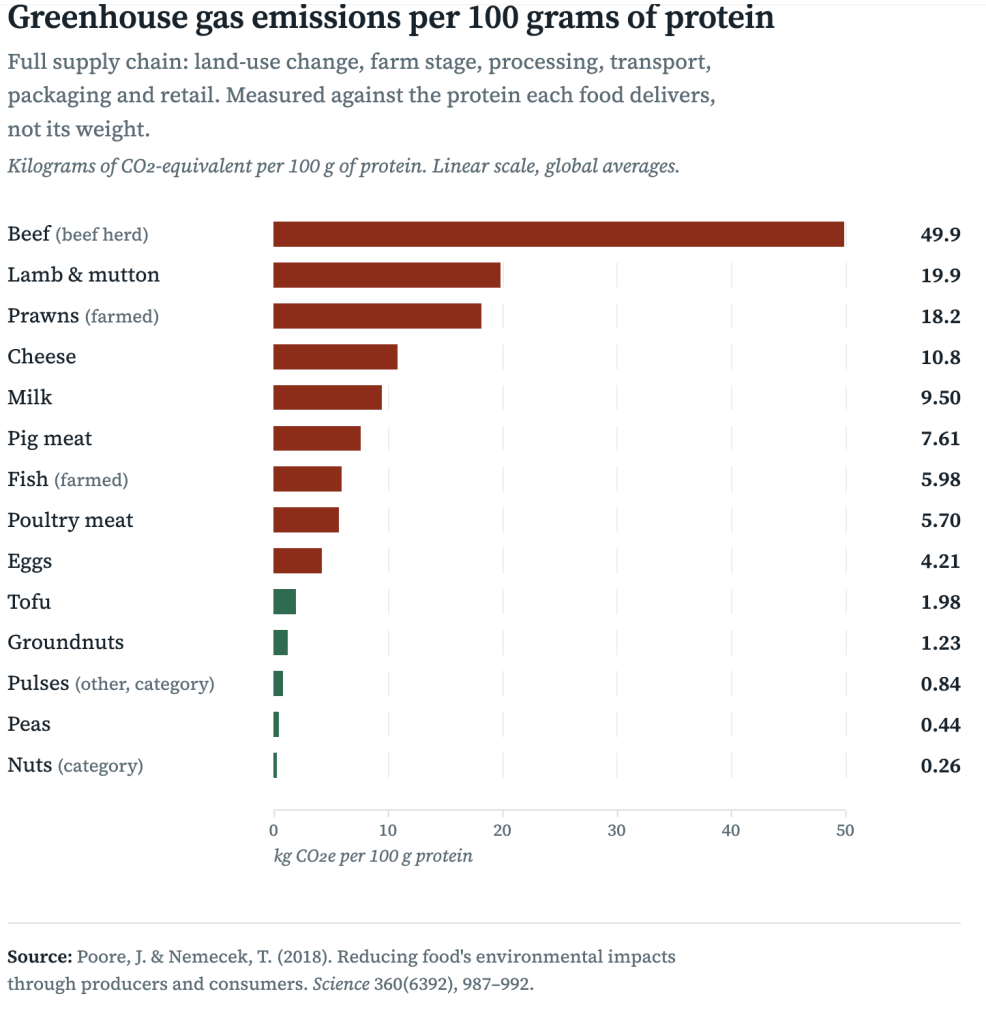
A kilogram of locally raised beef produces around 99 kg of greenhouse gases. Imported beans, lentils and peas produce between 1 and 2 kg.

That’s up to a 100-fold difference, even after crossing an ocean.

The climate doesn’t care whether the cow lived five kilometers away. It cares that it was a cow.

Transport accounts for just 6% of global food emissions, and roughly 1.5 to 2% of global emissions. In comparison, food waste alone is responsible for around 6% of all global greenhouse gas emissions.

Methane changes everything

Animal agriculture isn’t only a carbon problem.

Cattle release methane, a greenhouse gas that’s about 80 times more powerful than CO2 over a 20-year period. It remains in the atmosphere for a much shorter time than carbon dioxide, but its short-term warming effect is devastating, making livestock one of the fastest sectors where emissions should be reduced.

When people argue about food miles while ignoring methane, they’re arguing over the receipt instead of the bill.
The resources we’re running out of

Climate is only one consequence.

Livestock occupies 77% of the world’s farmland and gives back 18% of its calories and 37% of its protein. Most of that land isn’t feeding people. It’s feeding animals that were raised for the wrong reasons.

The cost is easier to see in reverse. If the world shifted to plant-based diets, agricultural land use would fall by about 75%, from roughly 4 billion hectares to 1 billion. Three quarters of all the farmland on Earth could go back to forest, wetland and grassland.

In simpler words, producing a gram of protein from beef or lamb takes up to 100 times the land that peas or tofu do. It also consumes staggering amounts of freshwater.
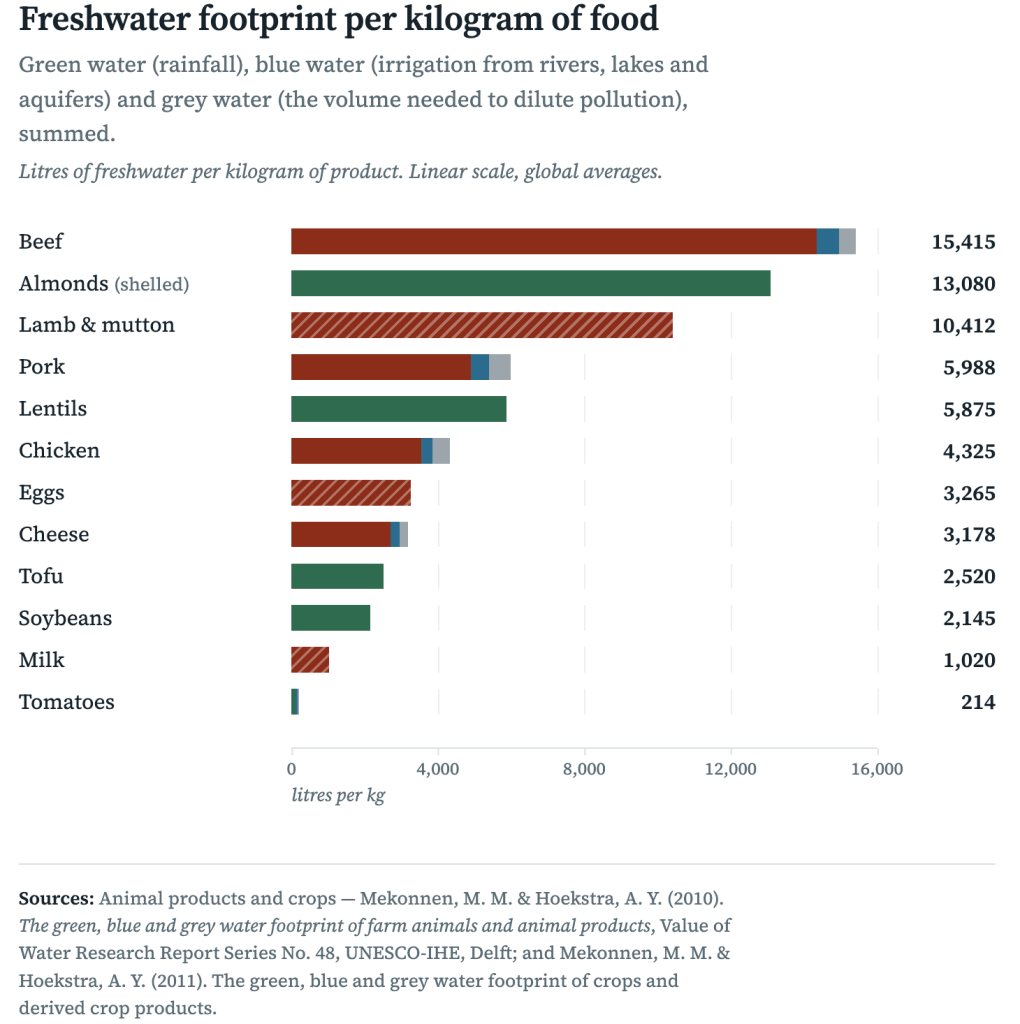
Producing one kilogram of beef requires around 15000 liters of water, while lentils require around 5900.

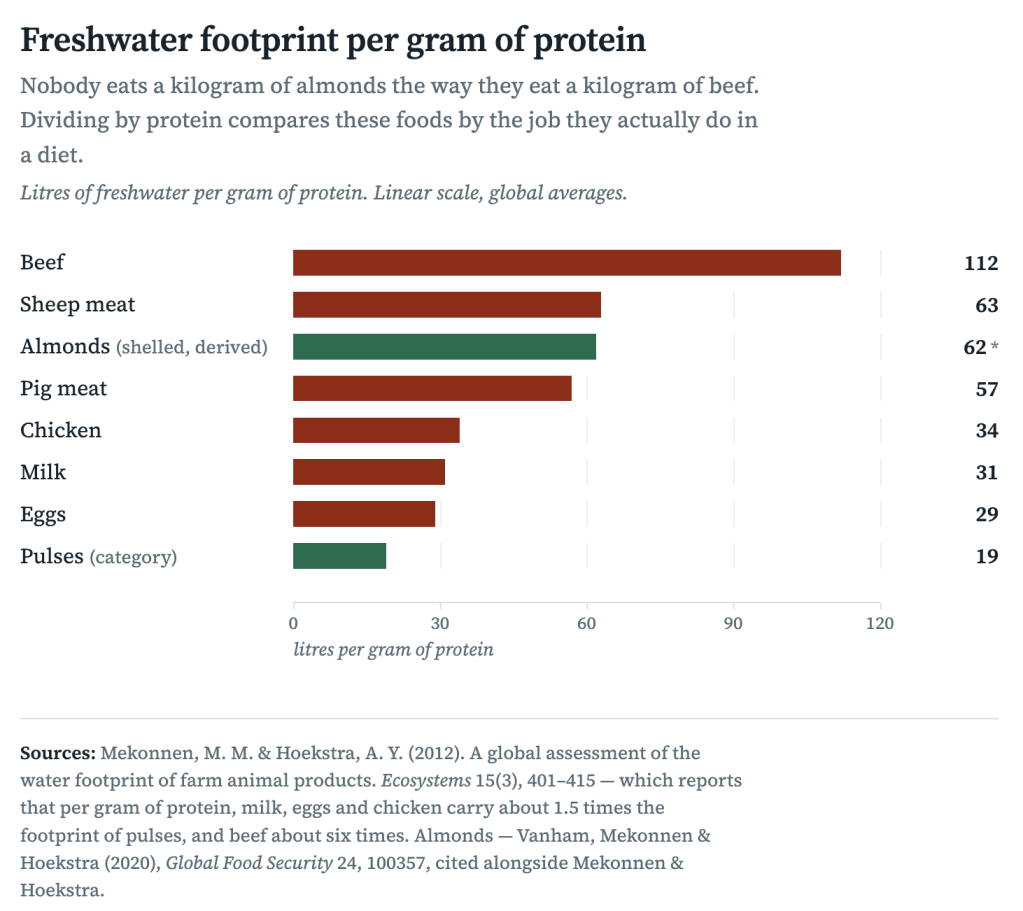
As such, per gram of protein, beef’s footprint is about six times that of pulses (legumes etc). At a time when droughts are intensifying and freshwater is becoming one of humanity’s most valuable resources, wasting it on livestock is becoming increasingly irrational and borderline suicidal.

Water should sustain people and ecosystems, not industrial animal farming.

It destroys our carbon sinks

The greatest (growing) hypocrisy is this: lots of people obsess over reducing transport emissions while defending the industry that destroys the very systems that absorb them.

I’m not saying we don’t need better transportation systems, but healthy oceans absorb about a quarter of humanity’s CO2 emissions every year already. Forests and other land ecosystems absorb close to a third. Together, they are Earth’s two largest natural carbon sinks. Maybe our focus must go to the right causes first, and it all starts with the same industry.

Then comes an even greater loss.

Mangroves, seagrass meadows and salt marshes, known as blue carbon ecosystems, store up to five times more carbon per square meter than tropical forests. Yet they’re disappearing through coastal development, agricultural pollution and increasingly severe droughts that dry out wetlands and accelerate their collapse.

Animal agriculture doesn’t only emit greenhouse gases. It replaces forests with pasture, pollutes rivers with billions of tonnes of manure, fuels green algae blooms that suffocate coastal waters and degrades wetlands that have protected our climate for thousands of years.

We’re not just adding carbon to the atmosphere, we’re destroying the planet’s ability to remove it.

The avocado argument

This is where the conversation becomes laughable.

Critics love pointing at avocados and almonds as if they’ve uncovered some fatal flaw in veganism.

It’s absurd for two reasons.

First, you don’t need to eat any of them to be vegan. Avocados and almonds are optional foods, not pillars of a plant-based diet. Lentils, beans, peas, potatoes, oats and countless other staples make the argument collapse before it even begins.

Second, even the numbers destroy the criticism.

A kilogram of beef requires around 15000 liters of water. Avocados use roughly 2000 liters. But sure, almonds are among the thirstiest plant foods on Earth at about 13000 liters, except nobody eats almonds by the kilogram.

Per gram of protein, beef still costs nearly twice as much water as almonds, and six times as much as pulses.

That said, not every animal product loses on every measure. Chicken uses less water per kilogram than lentils, and pointing that out doesn’t make a chicken farm a solution to anything.
So the comparison isn’t between perfect and imperfect.

It’s between one of the most resource-intensive plant foods and one of the most environmentally destructive foods on Earth.

Pointing at avocados while defending beef isn’t environmentalism. It’s deflection.

Stop confusing proximity with sustainability

None of this means local food has no value.

Supporting nearby farmers can strengthen rural communities, improve food resilience and reduce dependence on fragile global supply chains. Those are legitimate political and economic arguments.

Climate isn’t one of them.

If we’re serious about reducing environmental damage, the priorities are obvious:

  • Replace animal products with plants.
  • Restore forests, wetlands and mangroves.
  • Protect healthy oceans from pollution and overexploitation.
  • Move freight from roads to rail wherever possible.
  • Build reliable and affordable public transport.
  • Design walkable cities with safe cycling infrastructure.
  • Construct buildings that consume far less energy.

These solutions don’t compete. They reinforce one another.

The real environmental question was never how far did my food travel?

It was always what did it cost the planet to produce it?

P.S.: This essay focuses exclusively on the environmental impact of animal agriculture and carbon offsetting. The ethical question of animal wellbeing deserves its own discussion, and reducing living beings to emissions data alone misses a much deeper issue.

Thanks for reading.

Teekay
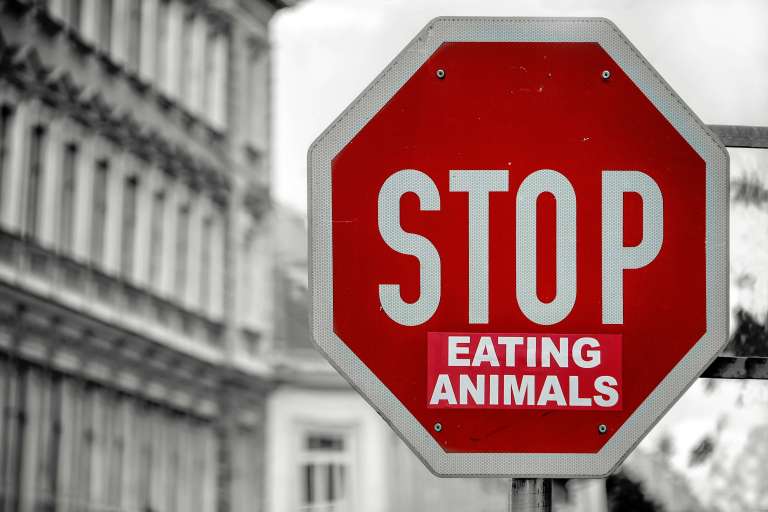
stop eating animals

Every road leads to the same slaughterhouse

Why are you vegan?

People ask me why I’m vegan more than almost any other question.

They expect a simple answer, one reason. The animals. The climate. Health.

The truth is less convenient.

A documentary started it. I watched Cowspiracy expecting to feel informed for an evening and come out the other side unchanged. That’s not what happened. Something in me actually shifted, and it didn’t shift back. It’s not a perfect film, a few of its numbers got oversimplified to the point of losing context, but the core of what it lays out is factual and well researched, and it did enough to make me curious.

It was the door. I went down the rabbit hole, and every subject I cared enough to study kept leading me to the same place. Climate change, ocean conservation, water scarcity, public health, colonial exploitation, every one of them led there.

The more I learned, the harder it became to justify participating in an industry that sits at the center of so many crises at once.

Sentience isn’t a seasoning

Everything else comes second.

A cow doesn’t want to be slaughtered. A pig fights for its life. Chickens recognize dozens of individuals and form complex social hierarchies. Octopuses solve puzzles. Fish remember routes, cooperate, and avoid painful experiences. The scientific debate is no longer whether many animals are sentient. It’s how rich their inner lives actually are.

An estimated 80 billion land animals are slaughtered every year for food. That number doesn’t include fish, whose deaths are measured in the trillions because they’re counted by weight rather than as individuals.

Modern language hides this. We say beef instead of cow, pork instead of pig, seafood instead of animals. We call slaughterhouses processing plants and carcasses products. The vocabulary exists to make violence feel industrial instead of personal.

If another being can suffer, the burden of proof should never sit on compassion. It should sit on exploitation.

The net effect

The ocean made me rethink everything.

I dive, and most of the people I dived with aren’t vegan. Ask them and they’ll tell you they love the ocean, and I don’t doubt they mean it. But loving an ecosystem while still funding the industries gutting it is a contradiction worth sitting with, not a small one, and it’s one very few divers ever examine.

We often imagine plastic bottles floating on the surface as the defining image of marine pollution. They matter, but they’re not the whole story. A large share of the plastic mass in the Great Pacific Garbage Patch, by most estimates close to half, is abandoned or discarded fishing gear. Nets keep killing animals for years after being lost, a phenomenon known as ghost fishing.

Then there’s bottom trawling.

Imagine dragging a weighted net across an ancient forest, flattening everything in its path, then throwing most of the wildlife back dead because it has no commercial value. That’s essentially what industrial trawling does to the seabed. Coral gardens, sponges, and countless species disappear beneath steel chains because efficiency demands it.

Every year, an estimated hundreds of thousands of dolphins, turtles, sharks, and seabirds die as bycatch. They were never the target. They’re collateral damage.

The ocean isn’t being emptied because billions of ordinary people fish with small boats. It’s being emptied because industrial fleets have turned living ecosystems into extraction zones.

Catch of the day

Fishing is also a story about power.

Countries with enormous industrial fleets don’t limit themselves to their own waters. They travel thousands of kilometers into the waters of poorer nations through unequal agreements, weak enforcement or outright illegal fishing.

In Senegal, fish has long been the foundation of both culture and nutrition. Yet many local fishers return with smaller catches than previous generations because industrial vessels remove fish on an entirely different scale. The result isn’t simply environmental decline. It’s food insecurity, unemployment, and ultimately migration.

When communities that have fished sustainably for centuries start struggling to feed themselves while foreign ships export their catch across continents, it’s hard to call that free trade. It looks much closer to colonial extraction wearing a modern suit.

The ocean belongs to no empire.

Empire and industry run on the same logic. Whoever holds power decides which lives count as resources and which don’t. That logic doesn’t start with the ocean. It starts with the animal on the plate, the first life reduced to a commodity, the template every later extraction gets copied from. Stop treating animals as property and the whole chain of domination loses the argument it was built on.

But soy

People still blame vegans for soy.

It’s one of the most successful and ridiculous myths ever created.

Every estimate lands well north of three quarters of the world’s soy grown to feed livestock, not people eating tofu or soy milk.

Chickens, pigs, and cattle consume astonishing quantities of crops before becoming meat. We don’t destroy forests because humans suddenly developed a love for edamame. We destroy them because billions of farmed animals need feeding.

The Amazon illustrates this perfectly.

Cattle ranching remains the largest driver of deforestation there. Forests are cleared for pasture, while surrounding land increasingly becomes monoculture growing feed for animals. Fire is often the cheapest way to erase thousands of years of biodiversity in a matter of hours.

The images are almost unbearable. Trees burning. Birds unable to escape. Mammals trapped by flames moving faster than they can run. Entire ecosystems reduced to ash so empty grass can replace living forest.

We call it development.

I call it extinction.

Green algae

People often argue over percentages. Was livestock responsible for 14 percent of emissions or 18 percent?

Here’s what the argument over the exact number misses. Whichever figure turns out to be more accurate, both put livestock among the two largest contributors to global emissions, alongside fossil fuels. Fighting over four percentage points doesn’t change which industries need to shrink.

Food systems account for roughly a third of global greenhouse gas emissions, and livestock is one of the largest pieces of that share through methane, deforestation, feed production and land use. Methane matters especially because it traps heat far more effectively than carbon dioxide in the short term.

The damage doesn’t stop at the atmosphere. It ends up in the water too.

Industrial farms produce mountains of manure. When nitrogen and phosphorus run into rivers, lakes, and coastal waters, algae multiply out of control. As they decompose, oxygen disappears and aquatic life suffocates.

Few places show this as clearly as Brittany, in France. Every summer, vast blooms of green algae cover its beaches. As the algae rot, they release hydrogen sulfide, a toxic gas that has been linked to the deaths of wild animals and, in a small number of documented cases, humans. This isn’t a natural disaster. It’s the predictable consequence of decades of intensive livestock farming and fertilizer runoff.

And the warming comes back around to the animals themselves. During recent heatwaves across Europe, thousands of farm animals died trapped inside industrial sheds and trucks before reaching slaughter. They survived neither nature nor the system built to profit from them.

The victims of climate change increasingly include those forced to produce it.

The side effects

I didn’t become vegan for my health.

It became an unexpected consequence.

The strongest scientific evidence is remarkably consistent. Diets centered on legumes, whole grains, fruits, vegetables, nuts, and seeds are associated with lower risks of cardiovascular disease, hypertension, and type 2 diabetes. Consumption of processed meat increases the risk of several cancers.

That doesn’t mean every vegan is healthy. French fries are vegan. Some donuts are vegan. Ethics and nutrition are different conversations.

The point isn’t that plants are magic. It’s that our healthiest dietary patterns consistently lean more on them and less on animals.

The next pandemic has a farm address

Humanity keeps building the perfect laboratory for new diseases.

When thousands of genetically similar animals are confined together, viruses evolve more easily. The closer the contact between stressed animals and humans, the greater the chance for pathogens to jump species.

Many of history’s most significant infectious diseases are zoonotic. They originated through animal to human transmission, even if each followed a different path.

Alongside this sits a quieter crisis. Antibiotics are routinely used in livestock around the world, not only to treat disease but often to prevent it in intensive systems. This accelerates antimicrobial resistance, letting bacteria evolve past medicines that once saved millions of lives.

We talk about the next pandemic as if it will arrive from nowhere. Often, we’re building it ourselves.

Burning calories to make calories

Perhaps the strangest part of all this is how inefficient it is.

We grow enormous quantities of edible crops, feed them to animals, lose most of the calories and protein during that biological conversion, then wonder why feeding humanity keeps getting harder.

Animal protein is one of the least efficient ways to produce food from land, water and crops. Producing protein directly from plants generally takes dramatically fewer resources while leaving more room for forests, wildlife and carbon storage.

Hunger has never been purely an agricultural problem. It’s always been a political one.

Life, itemized

The deeper I looked, the more one pattern kept repeating.

A forest became timber.

An ocean became a resource.

A river became a waste channel.

A cow became a machine for milk.

A chicken became a production unit.

A fish became tonnage.

Capitalism has an extraordinary ability to rename living beings until they sound like inventory. Once something becomes a commodity, its suffering disappears behind spreadsheets, shipping containers and quarterly profits. Dead bodies cross continents refrigerated inside trucks and cargo ships while consumers rarely think about the individual lives those numbers once represented.

The system depends on distance.

Distance between the slaughterhouse and the supermarket.

Distance between the fishing fleet and the village it impoverishes.

Distance between the burning forest and the burger.

Distance makes almost anything feel normal.

All roads lead to veganism

People still ask why I’m vegan.

I could say it’s for the animals, and that would be true.

I could say it’s for the climate, and that would also be true.

I could say it’s for cleaner rivers, living oceans, public health, or the communities losing their fisheries to industrial extraction. Every answer would be incomplete on its own.

Because veganism was never one road.

It was the destination where all the roads met.

The more I learned about suffering, the more impossible it became to justify taking part in it when another choice existed.

That’s why I’m vegan.

Teekay

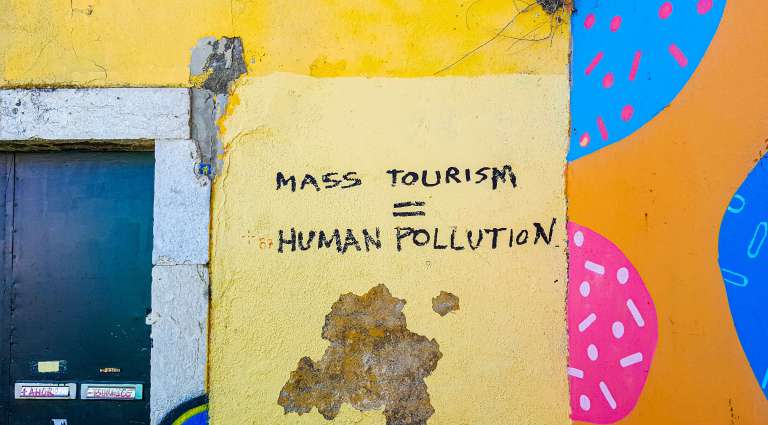
Mass tourism = human pollution

Why Overtourism Is a Capitalist Crisis

The tourist didn’t design the system that made travel a substitute for a life worth living.

A new form of environmental propaganda has quietly become mainstream.

Every week, another headline appears telling ordinary people they are responsible for climate change, then hands down the same list of penances. Drive less. Fly less. Stop buying this. Stop enjoying that. Recently, Le Monde highlighted that tourism accounts for around 9% of global CO2 emissions.

The number itself bothers me. It’s huge, and mass tourism is something I have no patience for.

The framing bothered me even more.

Once again, the spotlight was placed on ordinary people instead of the system that shapes almost every decision they make.

It’s becoming increasingly common to hear the same message.

You’re responsible.

You’re the polluter.

You’re destroying the planet.

Study. Work. Pay your bills. Repeat. But if you finally manage to save enough money for a vacation, you’re suddenly made to feel guilty for that too.

That is not environmentalism.

That is misdirection.

Anyone who reads my essays knows I take my environmental footprint seriously. The choices behind that, the minimalism, going vegan, the way I get around, weren’t picked up to look good or fit in. They came out of years of reflection.

I’ve been a minimalist for nearly a decade because endless consumption makes neither people nor the planet happier.

I’m vegan because I care about animals. I also recognize the immense environmental cost of industrial animal agriculture, from habitat destruction to food waste and greenhouse gas emissions.

I buy second hand exclusively and repair things before replacing them. I don’t buy new clothes. I’d rather walk or take public transportation than drive, and I’d rather borrow or share something than own it outright, because half the stuff we buy individually just sits there waiting to be used once a year. I’ve taken a nine hour bus instead of a forty five minute flight to the same destination, more than once, because the extra hours felt like a small price for the difference in footprint. I believe we should leave this world better than we found it.

None of that makes me exceptional. It just means I got lucky, or stubborn, enough to question habits most people never get the chance to question, because those habits get taught before we’re old enough to notice them.

Unlike wild animals, humans cannot realistically leave no trace at all. We build, consume, and transform our surroundings. But we can choose to leave as little trace as possible.

That responsibility matters.

What I reject is the idea that environmental collapse is primarily the consequence of millions of individuals making bad personal choices, as if those choices appeared out of nowhere.

They didn’t.

We’re born into a world that treats consumption as the default. Questioning it comes later, if at all, because most people spend their lives just trying to survive rent, survive the cost of food and shelter. Then, once that survival eases up even a little, we try to make up for lost time. We overconsume to compensate for what we never had, the same way anyone leaving poverty tends to, emulating the people who always had the means. “Treat yourself. You earned it. You worked hard for it.”

Individualism finishes the job from there. Look after your own happiness first, leave everyone else’s problems to someone else. That isn’t a flaw people are born with. It’s a job someone trained us for.

So yes, individuals are responsible for what they do. But the system is responsible for how most individuals were shaped to behave in the first place, and pretending otherwise lets the actual architects of the mess off the hook.

The system was built so individuals would fit inside it, and it worked well enough that the individual is now a piece of the machine that keeps breaking us. That’s what makes escape so hard. It isn’t one bad law or one greedy company standing in the way. It’s advertising, employers, housing, food systems, culture, and habit all pulling the same direction at once, thousands of small parts that don’t need to coordinate because they all reward the same behavior. No amount of individual willpower gets the masses out of a system built from that many interlocking pieces. You can opt out personally. The system barely notices.

Now, does tourism have environmental impacts?

Absolutely.

Mass tourism damages ecosystems. It strains local infrastructure. It raises housing prices. It pollutes coastlines. It turns historic neighborhoods into amusement parks. Entire cities are transformed into products designed for visitors instead of homes for residents.

These are real problems.

But they’re not caused by tourists wanting to see the world. They’re caused by an industry that’s turned that desire into something to sell as much of as possible, to as many people as possible, regardless of what the planet or the destination can absorb.

That distinction matters.

And here’s the part that should actually worry us. Right now, only a small share of the world’s population can afford to travel the way tourism gets discussed in Le Monde or anywhere else. If everyone on earth consumed the way the average French person does, we’d need close to three planets to sustain it. Live like the average American and the number climbs higher still.

The uncomfortable truth is that the planet is only holding together because most of humanity is still too poor to consume like the wealthy world does. As more of that population gets richer, and some of it will, that 9% doesn’t stay at 9%. It grows, the same way every other consumption metric grows when purchasing power spreads. We’re not looking at a stable number. We’re looking at a preview.

I also have for a long time questioned whether much of what we call tourism today is even about travel anymore. My work attests to that.

For many people, traveling is just another form of consumption.

They fly somewhere, stay in the same spots, eat at the same chain restaurants, shop in the same luxury stores, and return home with thousands of photos that exist mainly to prove they were there.

The destination changes.

The lifestyle doesn’t.

Social media has accelerated this transformation. Many destinations are no longer visited because they offer something meaningful. They’re visited because their images perform well online.

Travel becomes content.

Experiences become status symbols.

Places become backdrops.

This isn’t the industry malfunctioning. It’s the industry working exactly as designed. Travel companies exist to grow. Growth means selling more trips to more people more often, and the easiest way to do that is to sell travel as a reward, a treat, a thing you’ve earned and deserve, the same script used to sell everything else. Advertise the escape, not the destination. Call it self care. Call it living your best life. The vacation guilt the headlines produce and the vacation obsession the industry produces come from the same machine. One hand points the finger, the other hand keeps the conveyor belt running.

I think it reflects something much deeper than the shallowness of the masses.

Many people feel disconnected from their work, their communities, and even themselves. Life often revolves around earning enough money to repeat the same routine next week. Under these conditions, vacations become less about discovery and more about escape.

People aren’t always searching for another country.

They’re searching for relief.

Give people meaningful work. Give them stronger communities. Give them time with family. Give them parks, culture, nature, and purpose close to home.

Many would feel far less pressure to chase an escape valve on the other side of the planet every summer.

There will always be genuine explorers.

Some people are naturally driven to understand different cultures, ecosystems, languages, and ways of living. They travel to learn, to question their assumptions, and to return home with ideas worth sharing.

I’d guess that’s a minority. Watch how travel actually gets consumed, the itineraries, the photo spots, the same five restaurants recommended to everyone, and it’s hard to conclude that curiosity is the main thing driving most of it.

Historically, travel served the purpose of learning through exploration rather than consumption. People left home to study, exchange knowledge, observe other societies, and bring back innovations that improved their own communities.

Travel wasn’t simply about extracting something from a place.

It was about growing through them.

Today, too much tourism encourages the opposite. It treats landscapes the way it treats products, something to use up and move on from. It’s also flattening a diverse world into sameness.

That isn’t a failure of human nature.

It’s a predictable outcome of an economic system that turns everything into something to be bought and sold.

So yes, I oppose mass tourism. I absolutely do.

I oppose cruise ships that poison the oceans they sail through before dumping their waste in port cities and leaving.

I oppose short weekend flights taken simply because they’re cheap.

I oppose cities being redesigned for visitors while residents are priced out.

I oppose zoos and circuses that trade animal suffering for entertainment.

I oppose beachfront developments that sell the view and never mention what it cost to build.

I even oppose ecotourism, most of the time it’s just greenwashed tourism for the rich, another way to price out ordinary people while the outcome stays the same.

None of that makes the tourist the offender. An industry built to sell escape, and paid handsomely for doing it, is the one that turned a personal desire into an ecological liability.

The system is the culprit.

The environmental crisis will not be solved by making people feel guilty for taking a vacation. Most don’t even care.

It starts with education, teaching people to question the conditioning instead of just living inside it.

From there, it will be solved by degrowth. Not for the nation building its first hospitals or its first clean water system, that’s need. Degrowth is for the societies that already have what they need and keep manufacturing new needs anyway, the Emirates building another amusement park in the desert, Nevada building another casino with a golf course attached. One is need. The other is appetite dressed up as progress.

We already own enough clothes to dress the world for generations. The pile sitting in circulation right now would outlast most of us several times over, yet the fashion industry keeps manufacturing seasonal trends to convince us otherwise. That’s the target. That’s where degrowth should appear.

Less consumerism. Less unnecessary work. Eating plant based, living with less, minimalism as a norm rather than a lifestyle choice for the few. More shared economy and less of the individualism that trains us to treat our own comfort as the only thing worth protecting.

Degrowth looks like communities that function without a car and a credit card for every errand, hobbies that give something back instead of costing something, planting trees and cleaning rivers instead of shopping malls and card tables in casinos.

It looks like people who no longer need two weeks a year on the other side of the planet to remember they’re alive, because the other fifty weeks stopped feeling like a sentence.

Until we are willing to confront that reality, the headlines will keep telling you to fly less while the industry keeps telling you to fly more, and both of them profit from you never noticing it’s the same voice. Guilt won’t shrink a system built to keep expanding. Only pulling its foundations out will.

That’s the trip actually worth taking. And unlike the one on the brochure, nobody’s selling it to you.

Teekay

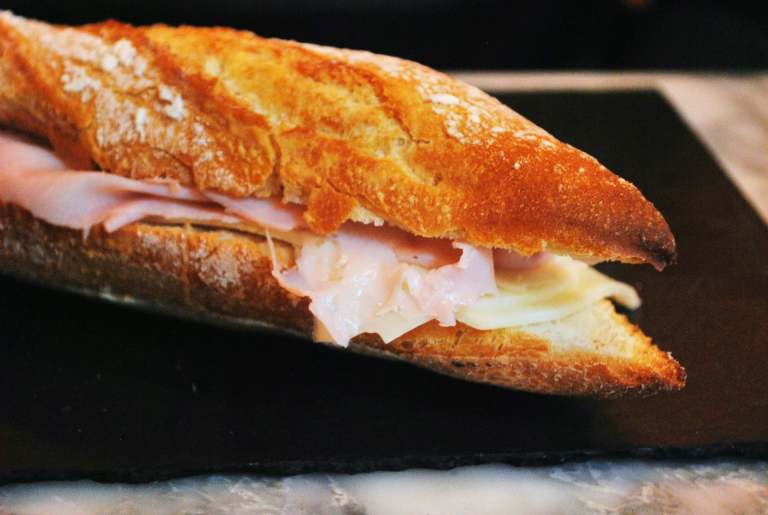
ham sandwich in a baguette

Every Wildfire Begins with a Sandwich

France braces for 5th heat wave since June.

France has barely extinguished one of its largest wildfires in decades. An area roughly the size of Hong Kong has burned, and we’re only halfway through the summer. But another heatwave is already here.

People ask how this keeps happening.

I think we’re asking the wrong question.

Every wildfire begins with a sandwich.

Not because a ham sandwich can physically ignite a forest, but because it represents the countless ordinary decisions that build the world in which forests burn.

The sandwich.

The cigarette.

The dairy ice cream we hand to our children without a second thought.

The Shein order arriving tomorrow.

The new backpack and notebooks bought every September even though last year’s are still perfectly usable.

Each decision appears harmless. Each is too small to matter. That is exactly how systems survive. It’s recreated every morning when we choose convenience over necessity, novelty over sufficiency, habit over reflection.

Every purchase is a vote. Not because one purchase changes the world overnight, but because billions of purchases, repeated every day, determine which industries grow, which disappear, and what kind of civilization we continue to finance.

One Amazon order won’t send a billionaire and his friends into space. One dairy ice cream won’t destroy a forest. One unnecessary notebook won’t fill a landfill.

But none of those things happens only once. They happen millions of times, every single day. Eventually those “insignificant” decisions become greenhouse gases, deforestation, polluted rivers, shrinking biodiversity, exhausted soils, expanding infrastructure and ecosystems pushed beyond their limits.

Then comes the heat. Then the drought. Then the spark.

And suddenly everyone becomes an environmentalist.

Hundreds of volunteers leave their homes to protect forests from the flames. They carry water, clear vegetation, do everything they can to stop the fire from reaching nearby villages. Most people see humanity at its finest.

I see humanity desperately trying to repair yesterday while continuing to finance it this morning.

The same people who volunteer their time and energy to protect the forest are then handed tables full of ham and butter sandwiches, soft drinks, sometimes cigarettes.

Volunteering is great. These people are giving their time to protect their homes, their communities, the forest around them. That matters. What bothers me is how easily we separate the emergency from everything that preceded it. We celebrate the person who runs toward the flames while treating the quieter forms of prevention as optional, eccentric, even ridiculous.

Refusing unnecessary consumption isn’t celebrated.

Reusing old supplies isn’t celebrated.

Eating less meat and dairy isn’t celebrated.

Living with less isn’t celebrated.

Those choices rarely earn applause because they happen long before the crisis, when there is no fire to fight and nobody watching. Yet they may matter far more than the dramatic moments that make the evening news.

We have confused loving the way nature makes us feel with caring about nature itself.

We hike through forests while eating products that contribute to the destruction of ecosystems. We photograph mountains while wrapped in disposable consumption. We defend a burning forest while continuing to finance the industries that place increasing pressure on forests around the world. We rush to fight the fire while throwing fuel onto it for the rest of the year. Economic fuel. Cultural fuel. Political fuel.

None of this means every choice weighs the same. A handful of industries and a handful of governments make decisions that outweigh what any individual could do in a lifetime, and no amount of reused notebooks cancels out a pipeline. But that asymmetry is not an excuse. It’s the reason our purchases are also our politics. Every dollar we hand to an industry is a small vote for its continued expansion, and the industries we’re describing don’t grow without millions of us feeding them first.

People often ask who is responsible for ecological collapse. The government? Corporations? Consumers? The uncomfortable answer is that there isn’t a single culprit. There is a chain, a chain in which every link seems too small to matter until the whole thing snaps.

That’s the butterfly effect.

A civilization is not destroyed by one catastrophic decision. It’ss destroyed by millions of ordinary ones.

And every wildfire begins with a sandwich.

Food for thought.

Teekay

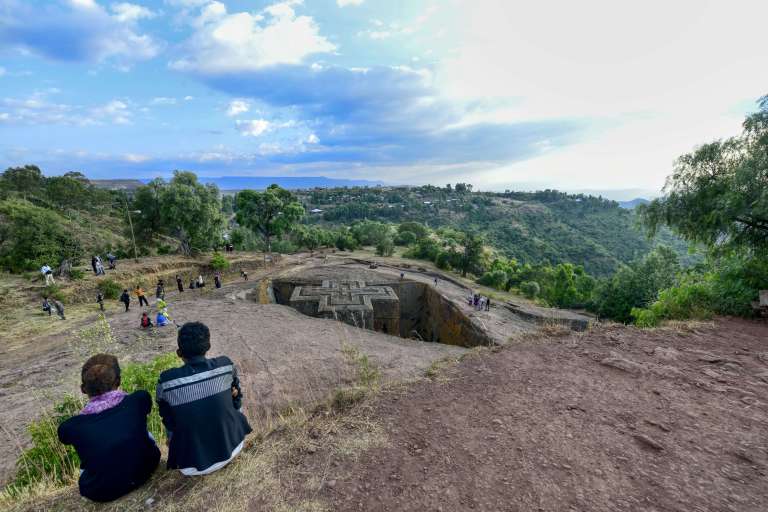
Lalibela by Teekay RM

A place without clocks

This isn’t fiction. It’s called the African Jerusalem.

People there don’t need clocks. The bees tell the time.

As my readers know, I’m vegan, so I don’t take from animals, not even honey. That hasn’t changed. But in the highlands around Lalibela, I noticed a different way of living with them, one rooted in respect and faith.

I spent four years of my teenage life in Ethiopia, then returned again at 22. Some places stay with you in a way that doesn’t fade, and for me, this is one of them.

Not far from Lalibela, in rural areas often referred to locally as Gueorgis, beekeeping isn’t just a livelihood. It’s something older, something spiritual. Among Ethiopian Orthodox Christian communities, bees are not seen as simple insects. They’re often regarded as pure creatures, sometimes described as reflecting the discipline and harmony of angels. Not because they’re divine, but because they’re part of a creation that follows a precise order, one that humans are meant to observe and respect.

That idea of order shows up everywhere, especially in how people relate to time.

  • The concept of time

There’s a belief I heard more than once while I was there. The bees give the time three times a day. In the morning around what we would call 10, then at midday, and again in the afternoon around 3. These are the moments when their activity peaks, when they leave in visible waves to gather nectar. It’s not a clock in the modern sense, but it becomes one in daily life.

And in many of these rural areas, that matters more than any watch.

Because the reality is that in remote parts of Ethiopia, especially around Lalibela, people have historically lived without precise, mechanical timekeeping. Time is read through the sun, through patterns. Morning begins when the light settles a certain way. Midday is when the sun stands above you. Evening arrives when shadows stretch and the air cools.

People don’t meet at exact hours. They meet in moments. And everyone understands those moments.

There’s a cliché you hear often about Africans being fashionably “late,” about Ethiopians not caring about time. I don’t take that at face value. Without claiming it as a proven explanation, I think it says more about the observer than the people being described.

If your entire system is built around minutes and precision, then anything outside of that looks like disorder. But what if it’s just a different structure?

For instance, in Islamic cultures, time is extremely precise. Daily prayers are tied to exact solar positions. Fasting begins and ends at defined moments. The lunar calendar governs entire cycles of life. Time there is something to be measured carefully and adhered to strictly.

In contrast, in many rural societies, time is lived before it’s measured. It flows with what God has set in motion, rather than being cut into exact units. So what looks like “lateness” might simply be life unfolding without the pressure of the clock.

And Ethiopia takes that even further in a way most people don’t even realize.

It doesn’t just live time differently. It counts it differently.

There’s what we call international time, and then there’s Ethiopian time. In Ethiopia, the day starts at what we would call 6 AM, roughly sunrise. That’s hour one. So what we call 7am becomes 1 o’clock. Noon becomes 6. What we call 6 PM becomes 12. It’s not confusion. It’s consistency with the sun. The first hour begins when light begins.

It’s a system that actually makes a lot of sense. It aligns the clock with lived reality rather than abstract convention.

The calendar follows the same logic.

Ethiopian calendar has 13 months, not 12. Twelve months of 30 days, and a thirteenth month of 5 days, or 6 in a leap year. That last month, Pagume if my memory hasn’t failed me, is short, almost like a pause between cycles.

Thus, the new year doesn’t begin on January 1st. It begins around September 11th. Right after the heavy rainy season, when the land resets, when the skies clear, when life begins again. It’s agricultural, but also spiritual. A renewal that actually follows the environment people live in.

And because of how this calendar was preserved, based on older Christian calculations of the Annunciation, Ethiopia is about 7 to 8 years “behind” the Gregorian calendar. So while much of the world is in 2026, Ethiopia is in 2018.

It’s not that one is right and the other is wrong. It’s that one remained rooted in its own continuity, and I love and salute that.

  • Beekeeping in the African Jerusalem

That continuity matters when you look at places like Lalibela, often called the African Jerusalem. Tied to Gebre Mesqel Lalibela, whose name is understood to mean “the bees recognize his greatness/sovereignty”, it reflects one of the oldest continuous Christian traditions in the world. Christianity has been practiced in Ethiopia since at least the 4th century, long before much of Europe fully adopted it.

So when people bring honey to churches, when priests bless bees and beekeepers, it’s not symbolic in a modern sense. It’s continuity across centuries.

And that continuity is visible in movement too.

During honey harvesting seasons, some people from extremely remote villages set out for the markets of Lalibela, carrying honey in hand-crafted clay jars to sustain their families. They walk for days, not hours, days!

They move across the highlands, guided by the sun, by memory, by instinct. No maps, no schedules. Just direction.

Along the way, they stop at churches. Some of them centuries old, carved into rock. They offer part of their honey. Priests receive it, bless it, sometimes bless the bees themselves. It’s not commerce. It’s passage.

When night falls, they stop.

No tents. No inflatable beds. No modern equipment. They sleep outside, on the ground, with whatever they carry. Then at sunrise, they continue. Dozens of kilometers, step after step, until they reach the central market.

And this still happens today.

Part of what makes this possible is the geography of the Ethiopian highlands, historically known as Abyssinia. Compared to neighboring regions in Kenya or Tanzania, which are home to large populations of dangerous wildlife, the high plateaus around Lalibela are relatively safer. Fewer large predators, different ecosystems. It doesn’t mean there’s no risk, but it makes long-distance walking without protection far more viable.

The beehives themselves are adapted to this environment. Made from hollowed logs, woven fibers, and natural seals, they protect the bees from temperature swings and pests, and can survive in remote areas with minimal attention. Over generations, this system has allowed Ethiopian beekeeping to continue for at least 1500 years, deeply tied to the rhythms of the land.

The climate shapes everything too. Much of Ethiopia doesn’t follow four seasons, but cycles of rain and dryness that vary by altitude. Life organizes itself around what is given, and when it’s given, whether for people or for bees. In this context, priests play a role. Honey and candles are brought to churches, blessed, and prayers are offered for people and their bees.

Provision ultimately comes from God, and humans participate within limits they cannot control.

Even so, tension remains. People treat the bees with care and respect, but taking honey is still taking. Even when done carefully, it remains a form of exploitation. It may be necessary, it may be balanced, but it must also be acknowledged.

What stayed with me after all these years and despite how much I traveled was the alignment. A place where time is not just counted differently, but felt differently. Where a day doesn’t begin at midnight because a clock says so, but when light actually appears. Where a year resets not in the middle of winter, but after the rains have passed. Where journeys are measured in effort, not in minutes.

In a place like Lalibela, you start to question what we consider “normal.”

Maybe precision isn’t always clarity.

Maybe being “on time” isn’t always being in sync.

And maybe there are ways of living, still existing today, that haven’t forgotten that time was never meant to be owned, only followed.

Thanks for reading.

Teekay

WATCH: 31 Documentaries that will change your perception of food (with trailers)

You are what you eat.

An Updated Guide to Must-Watch Documentaries on Health, the Environment, and Animal Welfare

A few years ago, I compiled a list of powerful documentaries that opened eyes and sparked conversations about the connections between our diets, personal health, the planet, and animal welfare. Since then, new documentaries have emerged, offering fresh perspectives and deeper insights into these critical topics.

This updated list features 31 must-watch documentaries that will inspire you to rethink your choices, understand the broader impact of what’s on your plate, and consider the powerful role food plays in shaping our world.

Whether you’re passionate about health, sustainability, or ethics, these films are a compelling call to action, and a perfect way to kickstart meaningful change.

You Are What You Eat: The Twin Experiment (2024)
A twin-focused dietary experiment exploring the effects of different eating habits on health.
Notable Figures: None known.

Earthlings (2005)
A groundbreaking documentary examining humanity’s reliance on animals for food, clothing, and entertainment.
Notable Figures: Narrated by Joaquin Phoenix.

Dominion (2018)
Exposing the darker side of animal agriculture through hidden-camera footage.
Notable Figures: Narrated by Joaquin Phoenix, Rooney Mara, and Sia.

Forks Over Knives (2011)
A case for adopting a plant-based diet to combat chronic diseases.
Notable Figures: Dr. T. Colin Campbell, Dr. Caldwell Esselstyn.

What the Health (2017)
Investigating the link between diet, disease, and corporate influence in health organizations.
Notable Figures: Kip Andersen, Keegan Kuhn.

Cowspiracy: The Sustainability Secret (2014)
Revealing the environmental impact of animal agriculture.
Notable Figures: Directed by Kip Andersen.

Seaspiracy (2022)
A critique of the fishing industry’s devastating impact on marine ecosystems.
Notable Figures: Directed by Ali Tabrizi and Kip Andersen

Christpiracy (2024)
Examining the intersection of religion and ethical food choices.
Notable Figures: Directed by Kip Andersen and Kameron Waters.

The Game Changers (2018)
Debunking myths about plant-based diets and athletic performance.
Notable Figures: Produced by James Cameron, Arnold Schwarzenegger.

I Could Never Go Vegan (2024)
Addressing common excuses and challenges against veganism.
Notable Figures: None known.

Vegucated (2011)
Following three people as they attempt to adopt a vegan lifestyle.
Notable Figures: Directed by Marisa Miller Wolfson.

Milked (2021)
A deep dive into the dairy industry and its global implications.
Notable Figures: Created by Chris Huriwai.

Pignorant (2024)
Exploring the psychology behind ignoring the ethics of animal consumption.
Notable Figures: Created Joey Carbstrong.

Eating Animals (2018)
An exposé of industrial farming and its impact on food systems.
Notable Figures: Based on Jonathan Safran Foer’s book, narrated by Natalie Portman

Carnage: Swallowing the Past (2017)
A satirical take on a future where veganism is the norm and meat-eating is taboo.
Notable Figures: Directed by Simon Amstell.

The Smell of Money (2022)
Investigating the environmental racism tied to industrial pig farming.
Notable Figures: Guess appearance: Cory Booker

The End of Meat (2017)
Imagining a world where meat consumption has ended.
Notable Figures: Directed by Marc Pierschel.

The Invisible Vegan (2019)
A focus on the often-overlooked contributions of Black communities to veganism.
Notable Figures: Directed by Jasmine Leyva, guest appearance by John Salley

Mission Blue (2014)
Chronicling Dr. Sylvia Earle’s mission to protect ocean habitats.
Notable Figures: Featuring Sylvia Earle.

Eating Our Way to Extinction
Exploring how our diets are destroying ecosystems and biodiversity.
Notable Figures: Narrated by Kate Winslet.

Eating You Alive (2018)
Highlighting the health benefits of a whole-food, plant-based diet.
Notable Figures: Featuring Samuel L. Jackson, James Cameron.

H.O.P.E. What You Eat Matters (2018)
Demonstrating the health, environmental, and ethical reasons for eating consciously.
Notable Figures: Guests;  Jane Goodall, Vandana Shiva

Food Choices (2016)
A comprehensive look at how dietary choices impact health and the planet.
Notable Figures: Directed by Michal Siewierski.

Peaceable Kingdom: The Journey Home (2009)
Farmers recount their journeys from animal agriculture to veganism.
Notable Figures: Directed by Jenny Stein.

Simply Raw: Reversing Diabetes in 30 Days (2009)
Following individuals reversing diabetes through a raw vegan diet.
Notable Figures: Featuring Gabriel Cousens.

The Cove (2009)
Unveiling the horrors of dolphin hunting in Japan.
Notable Figures: Featuring Ric O’Barry.

Speciesism: The Movie (2013)
Challenging societal norms about animal exploitation.
Notable Figures: Directed by Mark Devries.

73 Cows (2018)
The journey of a farmer transitioning from cattle farming to sustainable living.
Notable Figures: Directed by Alex Lockwood.

Live and Let Live (2013)
Examining ethical veganism and its implications.
Notable Figures: Directed by Marc Pierschel.

Land of Hope and Glory (2017)
An exposé on UK factory farming practices.
Notable Figures: Directed by Ed Winters.

Rowdy Girl (2023)
A former cattle rancher turns her farm into an animal sanctuary.
Notable Figures: Featuring Renee King-Sonnen.

Why We Love Nature but Keep Destroying It

How can we do better, collectively?

My self-professed love for nature is no secret to my readers.

Being close to nature is and has always been my thing.

Nature is wondrous, full of beauty and peace.

Hiking photo by Teekay Rezeau-Merah
Hiking photo by author Teekay Rezeau-Merah

The reason I became a vegan minimalist was mainly to protect it and its inhabitants.

But doing so opened my eyes on a fascinating paradox, especially in the vegan and vanlife communities; a paradox I ponder upon on a daily basis.

Spending more time in the great outdoors allowed me to come to a poignant realization: The very nature that we, avid nature enthusiasts and animal lovers, hold dear to our hearts, is the very same nature we often unwittingly damage with our bad habits.

How can we enjoy something so much while simultaneously participate in its destruction?

Teekay @teekayrezeaumerah
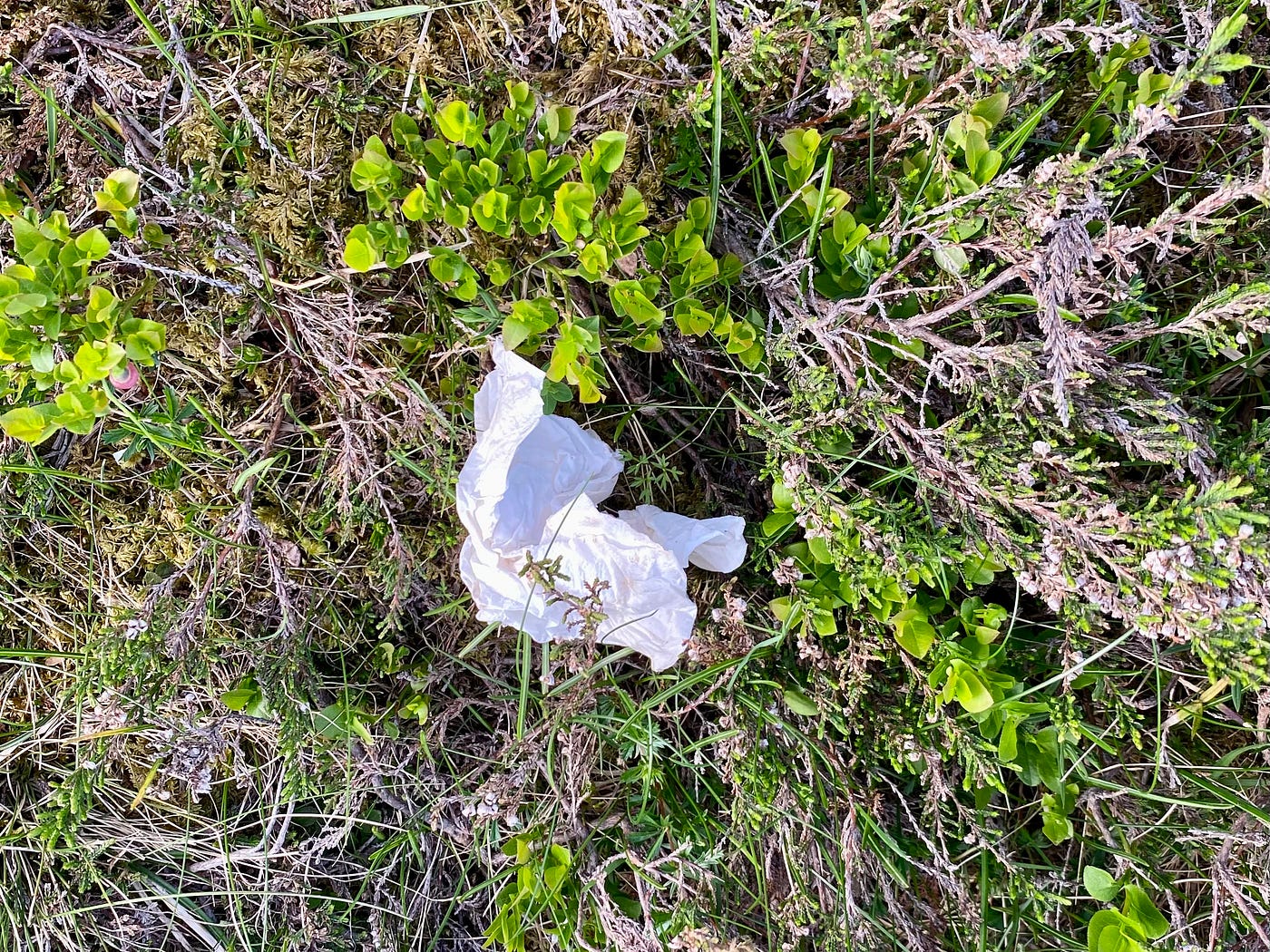
Please don’t leave toilet paper in nature (photo by author)

Well, here’s where my thinking is at the moment.

  • Reasoning

First of all, I want to make something clear: As pragmatic as I can be, my personal belief is that human beings are born good.

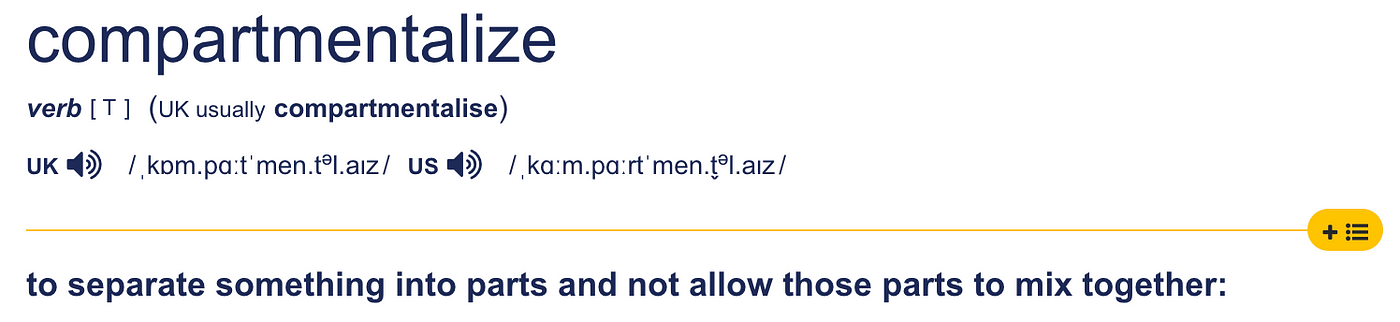
However, human beings are also amazing at compartmentalizing.

meaning of compatmentalize by Teekay Rezeau-Merah
Screenshot by author

A fitting illustration of my point is that of individuals who profess to be staunch advocates for human rights, yet they contradictorily sport Nike shoes, H&M dresses and Zara pants.

Note: If you don’t know what I’m hinting at, read this.

The same can be said about vegans who consume palm oil, or vanlifers who consume animal products (that destroy the very nature we want to be surrounded by).

Now look, I always say life is all about balance, and I believe it is, but sometimes — often times — rocking something ethically sourced won’t hurt you in any way, shape or form. Perhaps you’ll pay more for it, but you don’t have to if you buy second hand.

This applies to almost all consumables.

So the first takeaway from this piece is to think twice before your next purchases. Always consider the added value of what you buy, its environmental impact and whether there are other alternatives.

That’s one way to tackle this paradox.

Another reason we engage in actions that cause harm to nature is our toxic sense of entitlement, or deservingness.

This manifests itself in different forms: Arrogance, greed, boastfulness or in some cases, negative narcissism.

Some of us behave as if the world owes us. This sense of entitlement emanates from a lack of self-awareness and gratitude, which itself is the result of a Godless, non-religious and non-spiritual society.

Many people believe, wholeheartedly and arrogantly, that everything they have was owed to them.

Hustle culture prescribes “hard work and determination” as the ultimate solution for success, often discarding external factors that also contribute to one’s accomplishments.

Unfortunately, such attitude blinds us from seeing the bigger picture: That none of what we have, none of what we achieve is truly ours, and that it can be taken away from us at any time. It will be when we die.

More humility would do us all a world of good, and without it, we will continue indulging in things that harm us and everything we love.

When the last tree has been cut down, the last fish caught, the last river poisoned, only then will we realize that one cannot eat money. — Native American saying

The third reason behind this great paradox is our lack of concern for the future.

In other words, selfishness.

Social Media may have exasperated this, but many people believe they MUST prioritize their own pleasures and conveniences over the well-being of the environment and future generations.

It’s sickening when you think about it.

But I don’t blame us, not entirely. If anything, we were programmed and brought up this way, but it’s time for a change, a big one.

As a matter of fact, we can’t live like we did 30 years ago, times are changing and so should we, evolution and all.

Indeed, our planet can’t sustain our greed and selfishness for too long, and the time to turn things around is now.

I would never advocate for anything radical, life is all about balance once again.

As such, we don’t have to move to self-built huts, nor do we have to wear banana leaves, but it’s our duty to watch what we consume, how we consume it, and what we want to support.

Your dollars are more potent than your vote and your words. So put your money where your mouth is.

  • How

You see, I often write about boycotting certain products: Palm oil, white sugar, animal products, single use plastic, brands that pollute our water and source their products in Chinese slave camps and Bengali/Indian sweatshops, brands that support wars, so on and so forth.

To take part of this would make the world significantly better. To do so and to raised our collective awareness is as close to perfection as we can get.

That and reversing consumerism. Remember, minimalism (and essentialism) isn’t just an aesthetic, it’s a philosophy.

In 1927, a Boston-born, Harvard educated son of immigrants went to work for Lehman Brothers. His name was Paul Mazur and his interest in the economics of consumption and retailing made him a rising star in the investment banking establishment for more than 50 years.

Mostly he was responsible for manipulating the psyche of the American consumer. — Sherry Truitt

His philosophy in a nutshell:

“We must shift America from a needs, to a desires culture,” He wrote. “People must be trained to desire, to want new things even before the old had been entirely consumed. We must shape a new mentality in America. Man’s desires must overshadow his needs.”

“Man’s desires must overshadow his needs.” That’s a powerful statement, and a scary one.

So you see, as stated above, human beings are born good, but we were led astray for many decades.

Indeed, our actions are often shaped by cultural and societal norms. Unfortunately, said norms favor efficiency and convenience over wellbeing and ethics. They also favor desires over altruism and consumerism over self-awareness.

We all follow patterns and attitudes considered “normal” in our society, hence why we hardly question anything.

With that being said, let’s not forget that we’re still human, and luckily for us, God bestowed upon us reason and logic.

God gave us free will too, so it’s on us to outgrow our biases and harness original thinking.

  • Final word

All in all, the paradox of enjoying and destroying nature at the same time is a complex and deeply ingrained issue.

It’s not just about individual behavior, it’s rooted in our cultural, political, and economic systems, making it extremely difficult to shake off.

The one thing I want to leave you with is to question things and at least make sure your actions are aligned with your values, that’s it.

Perhaps some of us have a stronger moral obligation to protect nature, while others don’t. That’s okay, life can’t be perfect and neither can we, but does that mean we should stop trying?

Peace!

Tee.

Clarity with Teekay Podcast Guest-list

Clarity with Teekay is where I unpack life’s weirdness, one conversation at a time.

Since 2019, I’ve been recording from the cozy space of my home in Bordeaux, digging into culture, society, and whatever else catches my curiosity. Sometimes solo, sometimes with insanely cool guests.

I’ve had all kinds of people on the show: Hollywood execs, international movie stars, doctors, explorers, neuroscientists, microbiologists, pro athletes, writers, marketers, authors, architects, professors, podcasters. They bring their perspectives, I bring my questions, and together, we break things down in ways that (hopefully) make sense.

This podcast is about real, useful ideas, the kind you’d usually pay thousands for in coaching or courses. But I’m putting it out there for free, because why gatekeep good stuff, right? Whether it’s breaking habits, questioning norms, or figuring out how to make life less of a mess, I’m here to help you unlearn, rethink, and build something better.

What to Expect

🔹 [FULL] Episodes – Deep-dive conversations (45 mins), dropping 1-2 times a month.
🔹 [CLIP] Episodes – Short, straight-to-the-point answers (<10 mins), every week.
🔹 [SOLO] Episodes – Just me, rambling about a topic for 7-15 mins, once a month.

You can listen on Apple Podcasts, Spotify, Amazon Music, Google Podcasts, and Stitcher.

The podcast has a bunch of accounts on major social media platforms but to be honest, I don’t use Social media anymore, so if you want to reach out to me, do it here.

If you like the show and want bonus content, you can support it here:
🔗 Subscribe here

Press play and let’s get into it. 🎧

(Guest list below! 👇)

  1. Alejandra P. Arenas, Assistant director and production stage manager – Queretaro, MX
  2. Natalie Christensen, Psychotherapist turned published photographer – Santa Fe, USA
  3. Isabella R. Lash, Actress and acting coach – Virginia, USA
  4. Grace Treutel, Manager of culture and content – Alabama, USA
  5. Miruna Dragomir, Head of marketing at Planable – NYC, USA
  6. Fabian Chegoya, Healthcare IT and revenue cycle management consultant, founder of Chaminger and diplomat kid – Denver, Colorado, USA
  7. Fabe Mitchell, Business owner and coach – Florida, USA
  8. Lachlan Parker, Sport and exercise scientist, esports mental health counsellor, head performance coach for @Renegades, Melbourne, AUS
  9. Brian James, Author of  “The Wolf Among Sheep“ – New Orleans, USA
  10. Alexander Tankou, Electric vehicles research associate at the international council on clean transportation – Washington DC, USA
  11. Mardet Guebreyesus, Architect and bestfriend – Addis Ababa, Ethiopia
  12. Deborrah Cooper, Advice columnist, author and Top Female blogger, Southern California, USA
  13. Keith Hutchings, Founder of The Comfortable Home project and sustainability enthusiast – Perth, Australia
  14. Joseph “Joey” Drolshagen, Founder of IFGT Life Coaching LLC, featured in FOX, NBC, CBS and as Top 20 Business Coaches in America in the NYC Journal 2022 – Greenville, SC, USA
  15. Josh from Pursuit of Infinity podcast, Psychedelics expert – Pennsylvania, USA
  16. Craig Gavigan, CEO of the Unplugged brand and national park ranger, Scotland
  17. Lynne Bowman, Plantbased author of Brownies for Breakfast, California, USA
  18. Karen Knight, NPF coach and volunteer management consultant, Canada
  19. Jochen Thomas Grunbeck, Behavioral and consumer psychology expert, London, UK
  20. Megan Sam Holstein, Award-winning personal development, psychology, philosophy, science writer, Columbus, Ohio
  21. Shane Rogers, Stand up comedian, musician and author, California, USA
  22. Marcello Pasqualucci, Head of experimentation at SKY, ex YAM! and HSBC experimentation project manager and neuroscientist, London, UK
  23. Karolina Rzadkowolska, Alcohol-free life coach and author, San Diego, USA
  24. Jas Takhar, CEO, content creator and co-owner of REC Canada and FTGU Media, Toronto, Canada
  25. Michael Buzz Buzinski, President of Buzzworthy Integrated Marketing, Arizona, USA
  26. Richard Flint, Author of 19 books and Human Behavior expert, Washington DC, USA
  27. Andrea Osvart, International film actress and European Golden Globe winner, Budapest, Hungary
  28. John Kenny, The Relationship Guy, London, UK
  29. Dr. Johannes Mallow, PhD and two-time World Memory Champion, Germany
  30. Dave Wann, writer of multiple books and founder of Harmony Village, Golden, Colorado
  31. Brenden Kumarasamy, Public Speaking Coach, Montreal, Canada
  32. Juan Lee, CEO and founder of Clear Journey, Author of Love Made Simple, Maryland, USA
  33. Anne Claessen, MSc LLM, Podcast Host, Strategist & Monetization Expert, Arnhem-Nijmegen Region, Netherlands
  34. Tim Fitzpartrick, B2B Revenue Accelerator and Marketing Consultant, Denver, USA
  35. Connie (Lockhart) Ellefson, Professional Organizer, Aurora, Colorado, USA
  36. Phil B. Pelucha, TV Host & Network founder, Gros Islet, Saint Lucia
  37. Vinnie Potestivo, Emmy Award-winning Media Advisor, New York, USA
  38. Kelly L. Olson, Ph.D., Director, Clinical Affairs – Medical Affairs Specialist, Salt Lake City, Utah, USA
  39. Laurel Foley, Movement Analyst, Indianapolis, Indiana, USA
  40. Kit Huffman, Personal Branding strategist, CEO of Seneca, Jackson WY (now Bariloche, Argentina)
  41. Jen Blanchette
  42. Flobo “Flobito” Boyce, ex US Airforce, Live Entertainment Professional, Standup Comic, California, USA
  43. Yogi Aaron, Yoga teacher and creator of Applied Yoga Anatomy + Muscle Activation™, New York, USA
  44. Linda King, Travel Agent and Writer, Melbourne, Australia
  45. Amanda Kate, Self-Mastery Facilitator, Melbourne, Australia
  46. Kim Sorelle, Writer and Speaker about love, Grand Rapids, Michigan, USA
  47. John Mendez, Marketer & AI Integration Specialist For Real Estate Agents, Stamford, Connecticut, USA
  48. Bastien Siebman, ASANA consultant, Founder and Minimalist, Annecy, Auvergne-Rhône-Alpes, France
  49. Cora Kessler, Social Media & Marketing Consultant, Richmond, Virginia, USA
  50. Jerome Bethea, Aka JB The Wizard, Web 3.0 Alignment Branding™ Expert. Creator of The World of Futuring, Hollywood actor, Philadelphia, USA
  51. REV Gabriel Castillo, Lead Facilitator at Church Of The Sacred Spore and Psychedelic expert, Titusville, Florida, USA
  52. Dr. Elaine Ingham, Microbiologist and Founder of Soil Food Web Approach (Soil Regeneration), Oregon, USA
  53. Luke Titus, Creator of the Barefoot Challenge, Wisconsin, USA
  54. Geoff Palmer, Natural Bodybuilding and Natural Physique Masters Champion, Owner of Clean Machine Plant-Based Fitness Nutrition, author, national lecturer, vegan patent holder and 2 Time NEXTY Winner for “Best Supplement of the Year” 2016 & 2018, Pompano Beach, Florida, USA

Thank you for stopping by.

Teekay.

You Don’t Need to Trust the Media to See Climate Change

Global warming is here to stay.

Climate change has become one of the most polarizing topics of our time.

Depending on who you ask, it’s either the greatest challenge humanity has ever faced or a problem that’s been exaggerated beyond recognition. Politicians argue about it. Television debates it. Social media turns it into another battleground.

But what if we stepped away from all of that for a moment?

What if, instead of asking what politicians, journalists or commentators think, we simply looked around us?

Sometimes, reality speaks for itself.

Over the past few years, I’ve watched rivers shrink, forests burn and heatwaves become increasingly common in places where they once felt exceptional. Friends living in different parts of the world tell similar stories. Farmers talk about unpredictable seasons. Water restrictions have become more frequent. Wildfires have intensified across multiple continents.

You don’t have to agree with every headline to notice that something is changing.

You don’t have to trust every report to observe what’s happening around you.

Talk to older relatives.

Talk to people who work the land.

Talk to fishermen, hikers or anyone who spends significant time outdoors.

Ask them whether the seasons still feel the same as they did twenty or thirty years ago.

Whether you trust politicians, journalists or climate scientists isn’t actually the point I’m making.

Reality exists independently of who reports it.

Climate change doesn’t care whether we’re conservative or progressive, religious or secular, rich or poor.

The atmosphere doesn’t vote.

Nature doesn’t negotiate.

The real question isn’t whether the climate is changing.

It’s how we choose to respond.

For me, the answer has less to do with waiting for revolutionary technologies than with rethinking the way we live.

We consume far more than we need.

We replace products that still work.

We normalize waste.

We chase convenience even when it comes at a tremendous environmental cost.

Modern consumerism has taught us that happiness comes from buying more.

The planet is telling us otherwise.

That doesn’t mean giving up comfort or returning to life centuries ago.

It means consuming more intentionally.

Buying fewer but better things.

Repairing instead of replacing.

Walking when we can.

Using public transportation more often.

Supporting companies that take sustainability seriously.

Reducing food waste.

Sharing resources instead of duplicating them.

Holding companies like banks accountable.

Many of these habits don’t just reduce our environmental impact.

They also save money, reduce stress and improve our quality of life.

That’s one of the reasons I was drawn to minimalism in the first place.

The same choices that help us live with less clutter often happen to be the same choices that place less strain on the planet.

Perhaps that isn’t a coincidence.

Maybe we’ve spent so long looking for complicated solutions that we’ve overlooked the simple ones.

Throughout history, humanity has repeatedly adapted to new challenges.

This one is no different.

The question isn’t whether change is coming.

It’s whether we’re willing to change with it.

Thanks for reading.

Teekay.

WATCH: 18 Documentaries That Will Change the Way You Eat (with trailers)

Updated on December 31st 2022

This may come as a surprise to some, but prior to going vegan, I’d only met ONE vegan person in my entire life.

I was 25 years old when I went vegan.

The one thing that’s helped me (and many other vegans) learn about this lifestyle is documentary film.

Veganism was so underground back in the day. Before the Internet and Social Media, access to untampered data was quite a task.

People weren’t catered to, unlike what we’re seeing today.

So therein lies the importance of filmmakers and content creators, who are, IMHO, the real game changers.

I went vegan thanks to the first vegan documentary film I’ve ever seen. Cowspiracy was IT for me!

Thank you, Kip Andersen ! You’ve literally changed my life.

Below is a list of 15 eye-opening documentaries exposing the harms (and war) of animal agriculture, meat, dairy and fishing industries on the animal kingdom, on our health, culture and planet as a whole.

Let’s dive right in.

Dominion.

Probably the best one of all, Dominion shows the many ways in which animals are regularly abused. It thoroughly exposes the dark underbelly of modern animal agriculture through drones, hidden & handheld cameras. Available on Youtube.

Cowspiracy.

My personal favorite, along with next two on this list. Available on Netflix.

Seaspiracy.

Seaspiracy is the groundbreaking documentary which seeks to expose the fishing industries impact on the world’s oceans and overall environment. It tackles forced labor and animal rights in a never-before seen manner. A must watch ! Available on Netflix.

What The Health.

This film examines the link between diet and disease, and the billions of dollars at stake in the healthcare, pharmaceutical and food industries. Another must watch especially if you’re a health geek like me. Available on Netflix.

Forks Over Knives.

Forks Over Knives empowers people to live healthier lives by changing the way the world understands nutrition. Another masterpiece for health-conscious geeks. Available on Prime.

The Game Changers.

A documentary about plant-based eating, protein, and strength. Presented by James Cameron, Arnold Schwarzenegger, Jackie Chan and many more. Available on Netflix.

Eating Our Way to Extinction.

A cinematic feature documentary, narrated by Kate Winslet (2021). A masterpiece.

Milked.

A feature documentary that exposes the whitewash of New Zealand’s multi-billion-dollar dairy industry.

Kiss The Ground.

Narrated and featuring Woody Harrelson (I love that guy!), Kiss the Ground is an inspiring and groundbreaking film that reveals the first viable solution to our climate crisis. Available on Youtube.

Earthlings.

An animal rights documentary by activist and Oscar-winning actor Joaquin Phoenix.

Plantpure Nation.

A documentary that highlights the importance of a plant-based diet for a health life and longevity.

Eating You Alive.

A documentary about curing chronic disease with a whole food plant based diet. Features James Cameron.

The Milk System.

This documentary sheds light on one of the filthiest industries and the harms of dairy on our health.

Land of Hope and Glory.

A documentary that features never before seen undercover footage of what goes on behind closed doors, by Earthling Ed.

HOGWOOD: a modern horror story.

“Through careful marketing and misleading labels, we are led to believe that farmed animals are well cared for and that eating meat is natural, normal and necessary. It’s time to uncover the truth.”

Vegan 2022 – The film (full).

Meat The End (full).

Land of Hope and Glory.

Bonus: Rotten. (Netflix Series)

A series that exposes what goes on behind the scenes to cater to our selfish culinary needs. Absolutely worthwhile.

Are you vegan? Have you ever considered going vegan? Do you understand what veganism is all about?

Drop me a line below, I’d be more than happy to help you transition and answer all your questions as best I can.

This is a judgment-free zone, allow yourself to learn and grow.