The tourist didn’t design the system that made travel a substitute for a life worth living.
A new form of environmental propaganda has quietly become mainstream.
Every week, another headline appears telling ordinary people they are responsible for climate change, then hands down the same list of penances. Drive less. Fly less. Stop buying this. Stop enjoying that. Recently, Le Monde highlighted that tourism accounts for around 9% of global CO2 emissions.
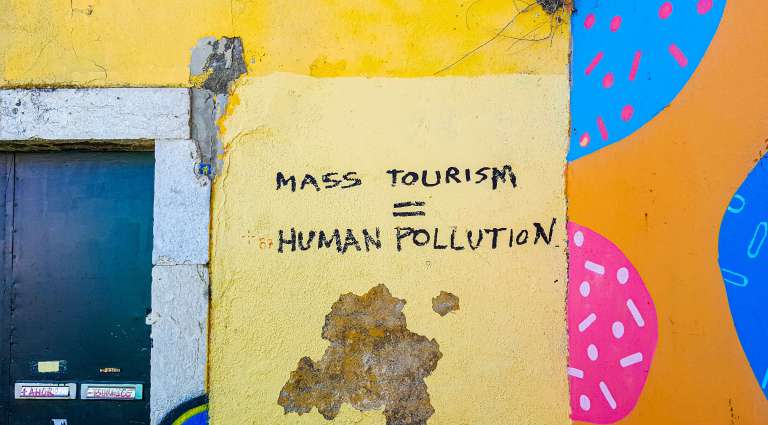
The number itself bothers me. It’s huge, and mass tourism is something I have no patience for.
The framing bothered me even more.
Once again, the spotlight was placed on ordinary people instead of the system that shapes almost every decision they make.
It’s becoming increasingly common to hear the same message.
You’re responsible.
You’re the polluter.
You’re destroying the planet.
Study. Work. Pay your bills. Repeat. But if you finally manage to save enough money for a vacation, you’re suddenly made to feel guilty for that too.
That is not environmentalism.
That is misdirection.
Anyone who reads my essays knows I take my environmental footprint seriously. The choices behind that, the minimalism, going vegan, the way I get around, weren’t picked up to look good or fit in. They came out of years of reflection.
I’ve been a minimalist for nearly a decade because endless consumption makes neither people nor the planet happier.
I’m vegan because I care about animals. I also recognize the immense environmental cost of industrial animal agriculture, from habitat destruction to food waste and greenhouse gas emissions.
I buy second hand exclusively and repair things before replacing them. I don’t buy new clothes. I’d rather walk or take public transportation than drive, and I’d rather borrow or share something than own it outright, because half the stuff we buy individually just sits there waiting to be used once a year. I’ve taken a nine hour bus instead of a forty five minute flight to the same destination, more than once, because the extra hours felt like a small price for the difference in footprint. I believe we should leave this world better than we found it.
None of that makes me exceptional. It just means I got lucky, or stubborn, enough to question habits most people never get the chance to question, because those habits get taught before we’re old enough to notice them.
Unlike wild animals, humans cannot realistically leave no trace at all. We build, consume, and transform our surroundings. But we can choose to leave as little trace as possible.
That responsibility matters.
What I reject is the idea that environmental collapse is primarily the consequence of millions of individuals making bad personal choices, as if those choices appeared out of nowhere.
They didn’t.
We’re born into a world that treats consumption as the default. Questioning it comes later, if at all, because most people spend their lives just trying to survive rent, survive the cost of food and shelter. Then, once that survival eases up even a little, we try to make up for lost time. We overconsume to compensate for what we never had, the same way anyone leaving poverty tends to, emulating the people who always had the means. “Treat yourself. You earned it. You worked hard for it.”
Individualism finishes the job from there. Look after your own happiness first, leave everyone else’s problems to someone else. That isn’t a flaw people are born with. It’s a job someone trained us for.
So yes, individuals are responsible for what they do. But the system is responsible for how most individuals were shaped to behave in the first place, and pretending otherwise lets the actual architects of the mess off the hook.
The system was built so individuals would fit inside it, and it worked well enough that the individual is now a piece of the machine that keeps breaking us. That’s what makes escape so hard. It isn’t one bad law or one greedy company standing in the way. It’s advertising, employers, housing, food systems, culture, and habit all pulling the same direction at once, thousands of small parts that don’t need to coordinate because they all reward the same behavior. No amount of individual willpower gets the masses out of a system built from that many interlocking pieces. You can opt out personally. The system barely notices.
Now, does tourism have environmental impacts?
Absolutely.
Mass tourism damages ecosystems. It strains local infrastructure. It raises housing prices. It pollutes coastlines. It turns historic neighborhoods into amusement parks. Entire cities are transformed into products designed for visitors instead of homes for residents.
These are real problems.
But they’re not caused by tourists wanting to see the world. They’re caused by an industry that’s turned that desire into something to sell as much of as possible, to as many people as possible, regardless of what the planet or the destination can absorb.
That distinction matters.
And here’s the part that should actually worry us. Right now, only a small share of the world’s population can afford to travel the way tourism gets discussed in Le Monde or anywhere else. If everyone on earth consumed the way the average French person does, we’d need close to three planets to sustain it. Live like the average American and the number climbs higher still.
The uncomfortable truth is that the planet is only holding together because most of humanity is still too poor to consume like the wealthy world does. As more of that population gets richer, and some of it will, that 9% doesn’t stay at 9%. It grows, the same way every other consumption metric grows when purchasing power spreads. We’re not looking at a stable number. We’re looking at a preview.
I also have for a long time questioned whether much of what we call tourism today is even about travel anymore. My work attests to that.
For many people, traveling is just another form of consumption.
They fly somewhere, stay in the same spots, eat at the same chain restaurants, shop in the same luxury stores, and return home with thousands of photos that exist mainly to prove they were there.
The destination changes.
The lifestyle doesn’t.
Social media has accelerated this transformation. Many destinations are no longer visited because they offer something meaningful. They’re visited because their images perform well online.
Travel becomes content.
Experiences become status symbols.
Places become backdrops.
This isn’t the industry malfunctioning. It’s the industry working exactly as designed. Travel companies exist to grow. Growth means selling more trips to more people more often, and the easiest way to do that is to sell travel as a reward, a treat, a thing you’ve earned and deserve, the same script used to sell everything else. Advertise the escape, not the destination. Call it self care. Call it living your best life. The vacation guilt the headlines produce and the vacation obsession the industry produces come from the same machine. One hand points the finger, the other hand keeps the conveyor belt running.
I think it reflects something much deeper than the shallowness of the masses.
Many people feel disconnected from their work, their communities, and even themselves. Life often revolves around earning enough money to repeat the same routine next week. Under these conditions, vacations become less about discovery and more about escape.
People aren’t always searching for another country.
They’re searching for relief.
Give people meaningful work. Give them stronger communities. Give them time with family. Give them parks, culture, nature, and purpose close to home.
Many would feel far less pressure to chase an escape valve on the other side of the planet every summer.
There will always be genuine explorers.
Some people are naturally driven to understand different cultures, ecosystems, languages, and ways of living. They travel to learn, to question their assumptions, and to return home with ideas worth sharing.
I’d guess that’s a minority. Watch how travel actually gets consumed, the itineraries, the photo spots, the same five restaurants recommended to everyone, and it’s hard to conclude that curiosity is the main thing driving most of it.
Historically, travel served the purpose of learning through exploration rather than consumption. People left home to study, exchange knowledge, observe other societies, and bring back innovations that improved their own communities.
Travel wasn’t simply about extracting something from a place.
It was about growing through them.
Today, too much tourism encourages the opposite. It treats landscapes the way it treats products, something to use up and move on from. It’s also flattening a diverse world into sameness.
That isn’t a failure of human nature.
It’s a predictable outcome of an economic system that turns everything into something to be bought and sold.
So yes, I oppose mass tourism. I absolutely do.
I oppose cruise ships that poison the oceans they sail through before dumping their waste in port cities and leaving.
I oppose short weekend flights taken simply because they’re cheap.
I oppose cities being redesigned for visitors while residents are priced out.
I oppose zoos and circuses that trade animal suffering for entertainment.
I oppose beachfront developments that sell the view and never mention what it cost to build.
I even oppose ecotourism, most of the time it’s just greenwashed tourism for the rich, another way to price out ordinary people while the outcome stays the same.
None of that makes the tourist the offender. An industry built to sell escape, and paid handsomely for doing it, is the one that turned a personal desire into an ecological liability.
The system is the culprit.
The environmental crisis will not be solved by making people feel guilty for taking a vacation. Most don’t even care.
It starts with education, teaching people to question the conditioning instead of just living inside it.
From there, it will be solved by degrowth. Not for the nation building its first hospitals or its first clean water system, that’s need. Degrowth is for the societies that already have what they need and keep manufacturing new needs anyway, the Emirates building another amusement park in the desert, Nevada building another casino with a golf course attached. One is need. The other is appetite dressed up as progress.
We already own enough clothes to dress the world for generations. The pile sitting in circulation right now would outlast most of us several times over, yet the fashion industry keeps manufacturing seasonal trends to convince us otherwise. That’s the target. That’s where degrowth should appear.
Less consumerism. Less unnecessary work. Eating plant based, living with less, minimalism as a norm rather than a lifestyle choice for the few. More shared economy and less of the individualism that trains us to treat our own comfort as the only thing worth protecting.
Degrowth looks like communities that function without a car and a credit card for every errand, hobbies that give something back instead of costing something, planting trees and cleaning rivers instead of shopping malls and card tables in casinos.
It looks like people who no longer need two weeks a year on the other side of the planet to remember they’re alive, because the other fifty weeks stopped feeling like a sentence.
Until we are willing to confront that reality, the headlines will keep telling you to fly less while the industry keeps telling you to fly more, and both of them profit from you never noticing it’s the same voice. Guilt won’t shrink a system built to keep expanding. Only pulling its foundations out will.
That’s the trip actually worth taking. And unlike the one on the brochure, nobody’s selling it to you.
Teekay