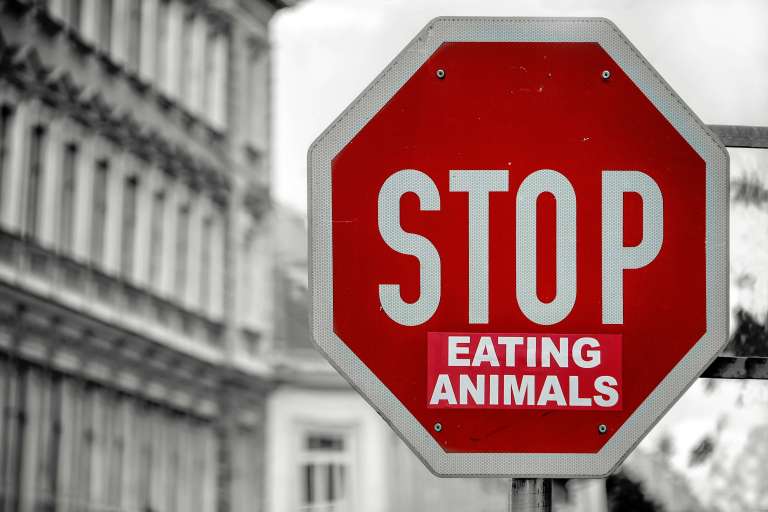
Walk into any farmers’ market or go to any “climate protest” and you’ll hear the same advice: eat local.
It’s sold as one of the simplest ways to reduce your carbon footprint. Buy beef from the farm down the road instead of the one shipped across the world and you’ve supposedly made an environmentally responsible choice.
You haven’t.
The phrase eat local has become one of the most successful pieces of green marketing ever created. Not because it’s entirely wrong, but because it distracts people with one of the smallest parts of the problem while protecting one of the largest.
Note: I use the same terminology as the studies I cite for consistency. That doesn’t mean I endorse it. Terms like beef and chicken are industry labels. They refer to the flesh of cows and hens who were killed, not something separate from the animals themselves.
The 6% illusion
Here’s the number almost nobody mentions.
Transport accounts for just 6% of global food emissions.
The other 94% comes from land use, farming, animal feed, methane, fertilizers and production itself. The truck is rarely the problem. The product is.
But not all products.
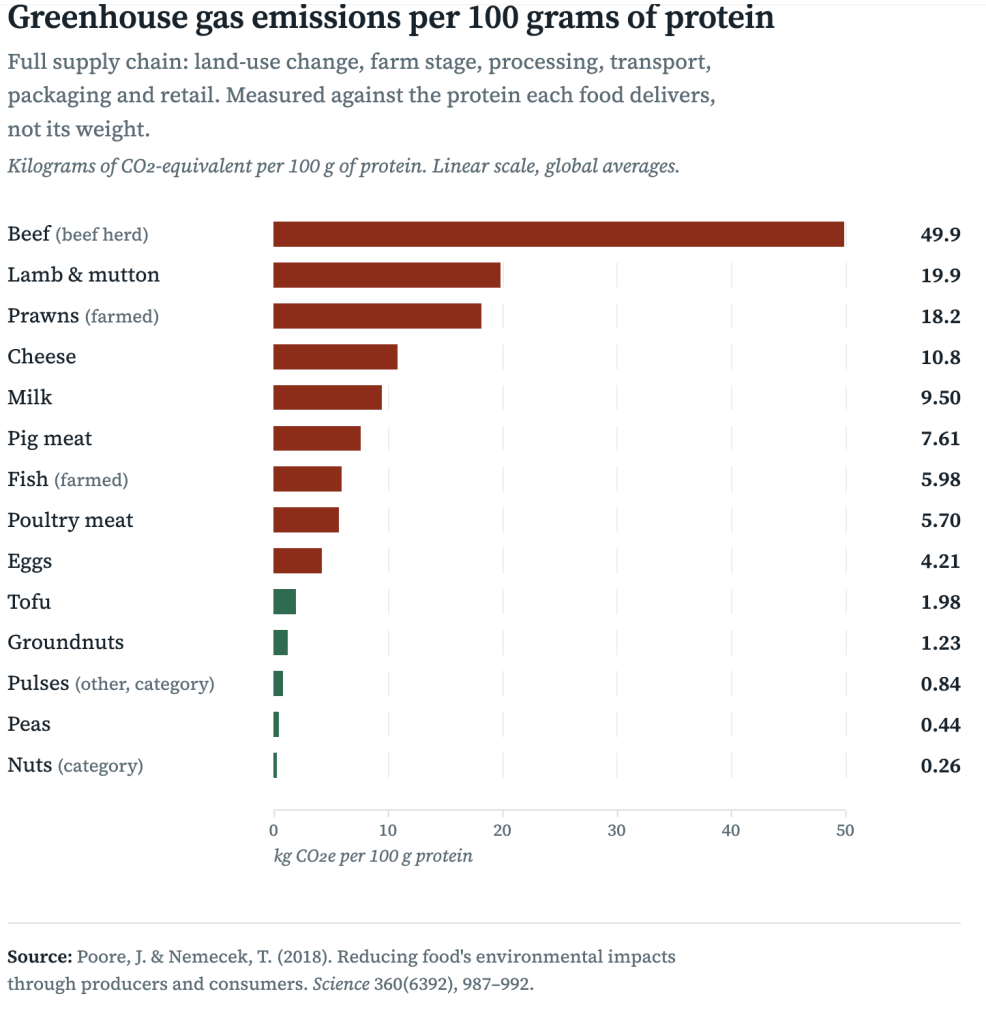
A kilogram of locally raised beef produces around 99 kg of greenhouse gases. Imported beans, lentils and peas produce between 1 and 2 kg.
That’s up to a 100-fold difference, even after crossing an ocean.
The climate doesn’t care whether the cow lived five kilometers away. It cares that it was a cow.
Transport accounts for just 6% of global food emissions, and roughly 1.5 to 2% of global emissions. In comparison, food waste alone is responsible for around 6% of all global greenhouse gas emissions.
Methane changes everything
Animal agriculture isn’t only a carbon problem.
Cattle release methane, a greenhouse gas that’s about 80 times more powerful than CO2 over a 20-year period. It remains in the atmosphere for a much shorter time than carbon dioxide, but its short-term warming effect is devastating, making livestock one of the fastest sectors where emissions should be reduced.
When people argue about food miles while ignoring methane, they’re arguing over the receipt instead of the bill.
The resources we’re running out of
Climate is only one consequence.
Livestock occupies 77% of the world’s farmland and gives back 18% of its calories and 37% of its protein. Most of that land isn’t feeding people. It’s feeding animals that were raised for the wrong reasons.
The cost is easier to see in reverse. If the world shifted to plant-based diets, agricultural land use would fall by about 75%, from roughly 4 billion hectares to 1 billion. Three quarters of all the farmland on Earth could go back to forest, wetland and grassland.
In simpler words, producing a gram of protein from beef or lamb takes up to 100 times the land that peas or tofu do. It also consumes staggering amounts of freshwater.
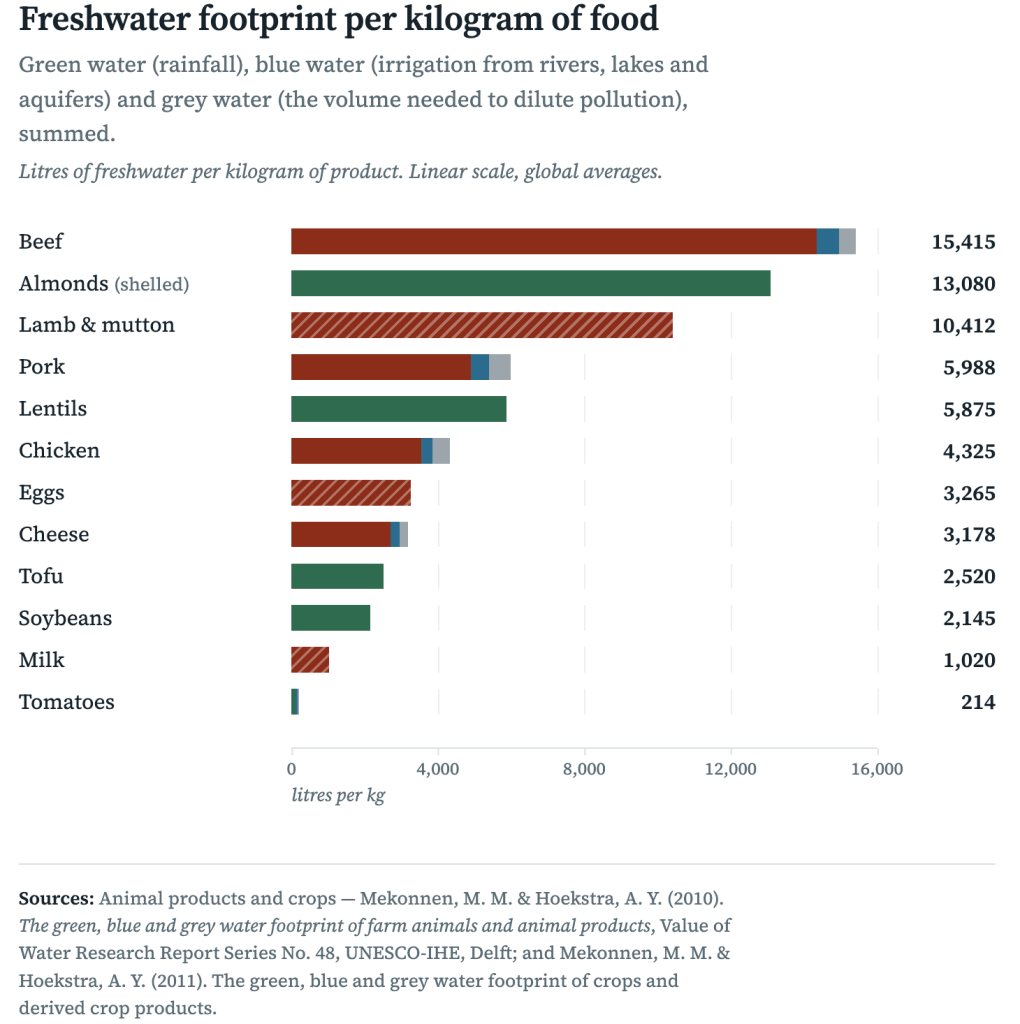
Producing one kilogram of beef requires around 15000 liters of water, while lentils require around 5900.
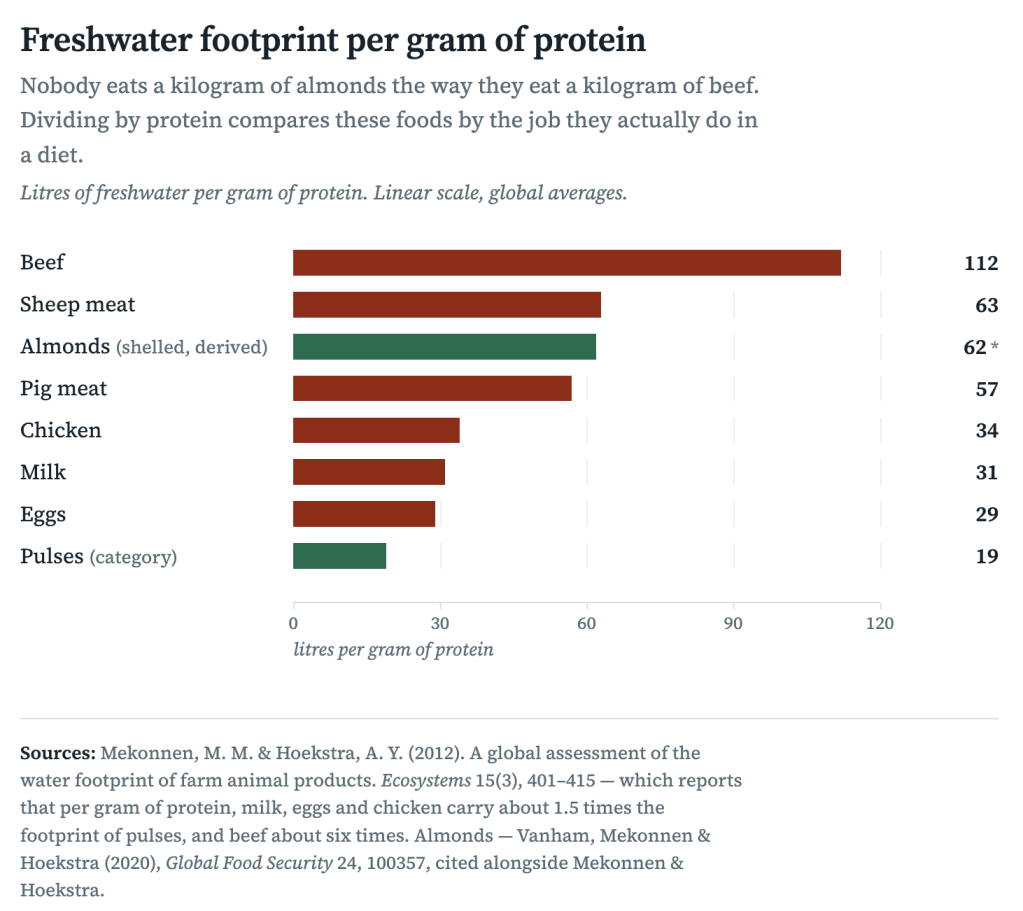
As such, per gram of protein, beef’s footprint is about six times that of pulses (legumes etc). At a time when droughts are intensifying and freshwater is becoming one of humanity’s most valuable resources, wasting it on livestock is becoming increasingly irrational and borderline suicidal.
Water should sustain people and ecosystems, not industrial animal farming.
It destroys our carbon sinks
The greatest (growing) hypocrisy is this: lots of people obsess over reducing transport emissions while defending the industry that destroys the very systems that absorb them.
I’m not saying we don’t need better transportation systems, but healthy oceans absorb about a quarter of humanity’s CO2 emissions every year already. Forests and other land ecosystems absorb close to a third. Together, they are Earth’s two largest natural carbon sinks. Maybe our focus must go to the right causes first, and it all starts with the same industry.
Then comes an even greater loss.
Mangroves, seagrass meadows and salt marshes, known as blue carbon ecosystems, store up to five times more carbon per square meter than tropical forests. Yet they’re disappearing through coastal development, agricultural pollution and increasingly severe droughts that dry out wetlands and accelerate their collapse.
Animal agriculture doesn’t only emit greenhouse gases. It replaces forests with pasture, pollutes rivers with billions of tonnes of manure, fuels green algae blooms that suffocate coastal waters and degrades wetlands that have protected our climate for thousands of years.
We’re not just adding carbon to the atmosphere, we’re destroying the planet’s ability to remove it.
The avocado argument
This is where the conversation becomes laughable.
Critics love pointing at avocados and almonds as if they’ve uncovered some fatal flaw in veganism.
It’s absurd for two reasons.
First, you don’t need to eat any of them to be vegan. Avocados and almonds are optional foods, not pillars of a plant-based diet. Lentils, beans, peas, potatoes, oats and countless other staples make the argument collapse before it even begins.
Second, even the numbers destroy the criticism.
A kilogram of beef requires around 15000 liters of water. Avocados use roughly 2000 liters. But sure, almonds are among the thirstiest plant foods on Earth at about 13000 liters, except nobody eats almonds by the kilogram.
Per gram of protein, beef still costs nearly twice as much water as almonds, and six times as much as pulses.
That said, not every animal product loses on every measure. Chicken uses less water per kilogram than lentils, and pointing that out doesn’t make a chicken farm a solution to anything.
So the comparison isn’t between perfect and imperfect.
It’s between one of the most resource-intensive plant foods and one of the most environmentally destructive foods on Earth.
Pointing at avocados while defending beef isn’t environmentalism. It’s deflection.
Stop confusing proximity with sustainability
None of this means local food has no value.
Supporting nearby farmers can strengthen rural communities, improve food resilience and reduce dependence on fragile global supply chains. Those are legitimate political and economic arguments.
Climate isn’t one of them.
If we’re serious about reducing environmental damage, the priorities are obvious:
Replace animal products with plants.
Restore forests, wetlands and mangroves.
Protect healthy oceans from pollution and overexploitation.
Move freight from roads to rail wherever possible.
Build reliable and affordable public transport.
Design walkable cities with safe cycling infrastructure.
Construct buildings that consume far less energy.
These solutions don’t compete. They reinforce one another.
The real environmental question was never how far did my food travel?
It was always what did it cost the planet to produce it?
P.S.: This essay focuses exclusively on the environmental impact of animal agriculture and carbon offsetting. The ethical question of animal wellbeing deserves its own discussion, and reducing living beings to emissions data alone misses a much deeper issue.
People ask me why I’m vegan more than almost any other question.
They expect a simple answer, one reason. The animals. The climate. Health.
The truth is less convenient.
A documentary started it. I watched Cowspiracy expecting to feel informed for an evening and come out the other side unchanged. That’s not what happened. Something in me actually shifted, and it didn’t shift back. It’s not a perfect film, a few of its numbers got oversimplified to the point of losing context, but the core of what it lays out is factual and well researched, and it did enough to make me curious.
It was the door. I went down the rabbit hole, and every subject I cared enough to study kept leading me to the same place. Climate change, ocean conservation, water scarcity, public health, colonial exploitation, every one of them led there.
The more I learned, the harder it became to justify participating in an industry that sits at the center of so many crises at once.
Sentience isn’t a seasoning
Everything else comes second.
A cow doesn’t want to be slaughtered. A pig fights for its life. Chickens recognize dozens of individuals and form complex social hierarchies. Octopuses solve puzzles. Fish remember routes, cooperate, and avoid painful experiences. The scientific debate is no longer whether many animals are sentient. It’s how rich their inner lives actually are.
An estimated 80 billion land animals are slaughtered every year for food. That number doesn’t include fish, whose deaths are measured in the trillions because they’re counted by weight rather than as individuals.
Modern language hides this. We say beef instead of cow, pork instead of pig, seafood instead of animals. We call slaughterhouses processing plants and carcasses products. The vocabulary exists to make violence feel industrial instead of personal.
If another being can suffer, the burden of proof should never sit on compassion. It should sit on exploitation.
The net effect
The ocean made me rethink everything.
I dive, and most of the people I dived with aren’t vegan. Ask them and they’ll tell you they love the ocean, and I don’t doubt they mean it. But loving an ecosystem while still funding the industries gutting it is a contradiction worth sitting with, not a small one, and it’s one very few divers ever examine.
We often imagine plastic bottles floating on the surface as the defining image of marine pollution. They matter, but they’re not the whole story. A large share of the plastic mass in the Great Pacific Garbage Patch, by most estimates close to half, is abandoned or discarded fishing gear. Nets keep killing animals for years after being lost, a phenomenon known as ghost fishing.
Then there’s bottom trawling.
Imagine dragging a weighted net across an ancient forest, flattening everything in its path, then throwing most of the wildlife back dead because it has no commercial value. That’s essentially what industrial trawling does to the seabed. Coral gardens, sponges, and countless species disappear beneath steel chains because efficiency demands it.
Every year, an estimated hundreds of thousands of dolphins, turtles, sharks, and seabirds die as bycatch. They were never the target. They’re collateral damage.
The ocean isn’t being emptied because billions of ordinary people fish with small boats. It’s being emptied because industrial fleets have turned living ecosystems into extraction zones.
Catch of the day
Fishing is also a story about power.
Countries with enormous industrial fleets don’t limit themselves to their own waters. They travel thousands of kilometers into the waters of poorer nations through unequal agreements, weak enforcement or outright illegal fishing.
In Senegal, fish has long been the foundation of both culture and nutrition. Yet many local fishers return with smaller catches than previous generations because industrial vessels remove fish on an entirely different scale. The result isn’t simply environmental decline. It’s food insecurity, unemployment, and ultimately migration.
When communities that have fished sustainably for centuries start struggling to feed themselves while foreign ships export their catch across continents, it’s hard to call that free trade. It looks much closer to colonial extraction wearing a modern suit.
The ocean belongs to no empire.
Empire and industry run on the same logic. Whoever holds power decides which lives count as resources and which don’t. That logic doesn’t start with the ocean. It starts with the animal on the plate, the first life reduced to a commodity, the template every later extraction gets copied from. Stop treating animals as property and the whole chain of domination loses the argument it was built on.
But soy
People still blame vegans for soy.
It’s one of the most successful and ridiculous myths ever created.
Every estimate lands well north of three quarters of the world’s soy grown to feed livestock, not people eating tofu or soy milk.
Chickens, pigs, and cattle consume astonishing quantities of crops before becoming meat. We don’t destroy forests because humans suddenly developed a love for edamame. We destroy them because billions of farmed animals need feeding.
The Amazon illustrates this perfectly.
Cattle ranching remains the largest driver of deforestation there. Forests are cleared for pasture, while surrounding land increasingly becomes monoculture growing feed for animals. Fire is often the cheapest way to erase thousands of years of biodiversity in a matter of hours.
The images are almost unbearable. Trees burning. Birds unable to escape. Mammals trapped by flames moving faster than they can run. Entire ecosystems reduced to ash so empty grass can replace living forest.
We call it development.
I call it extinction.
Green algae
People often argue over percentages. Was livestock responsible for 14 percent of emissions or 18 percent?
Here’s what the argument over the exact number misses. Whichever figure turns out to be more accurate, both put livestock among the two largest contributors to global emissions, alongside fossil fuels. Fighting over four percentage points doesn’t change which industries need to shrink.
Food systems account for roughly a third of global greenhouse gas emissions, and livestock is one of the largest pieces of that share through methane, deforestation, feed production and land use. Methane matters especially because it traps heat far more effectively than carbon dioxide in the short term.
The damage doesn’t stop at the atmosphere. It ends up in the water too.
Industrial farms produce mountains of manure. When nitrogen and phosphorus run into rivers, lakes, and coastal waters, algae multiply out of control. As they decompose, oxygen disappears and aquatic life suffocates.
Few places show this as clearly as Brittany, in France. Every summer, vast blooms of green algae cover its beaches. As the algae rot, they release hydrogen sulfide, a toxic gas that has been linked to the deaths of wild animals and, in a small number of documented cases, humans. This isn’t a natural disaster. It’s the predictable consequence of decades of intensive livestock farming and fertilizer runoff.
And the warming comes back around to the animals themselves. During recent heatwaves across Europe, thousands of farm animals died trapped inside industrial sheds and trucks before reaching slaughter. They survived neither nature nor the system built to profit from them.
The victims of climate change increasingly include those forced to produce it.
The side effects
I didn’t become vegan for my health.
It became an unexpected consequence.
The strongest scientific evidence is remarkably consistent. Diets centered on legumes, whole grains, fruits, vegetables, nuts, and seeds are associated with lower risks of cardiovascular disease, hypertension, and type 2 diabetes. Consumption of processed meat increases the risk of several cancers.
That doesn’t mean every vegan is healthy. French fries are vegan. Some donuts are vegan. Ethics and nutrition are different conversations.
The point isn’t that plants are magic. It’s that our healthiest dietary patterns consistently lean more on them and less on animals.
The next pandemic has a farm address
Humanity keeps building the perfect laboratory for new diseases.
When thousands of genetically similar animals are confined together, viruses evolve more easily. The closer the contact between stressed animals and humans, the greater the chance for pathogens to jump species.
Many of history’s most significant infectious diseases are zoonotic. They originated through animal to human transmission, even if each followed a different path.
Alongside this sits a quieter crisis. Antibiotics are routinely used in livestock around the world, not only to treat disease but often to prevent it in intensive systems. This accelerates antimicrobial resistance, letting bacteria evolve past medicines that once saved millions of lives.
We talk about the next pandemic as if it will arrive from nowhere. Often, we’re building it ourselves.
Burning calories to make calories
Perhaps the strangest part of all this is how inefficient it is.
We grow enormous quantities of edible crops, feed them to animals, lose most of the calories and protein during that biological conversion, then wonder why feeding humanity keeps getting harder.
Animal protein is one of the least efficient ways to produce food from land, water and crops. Producing protein directly from plants generally takes dramatically fewer resources while leaving more room for forests, wildlife and carbon storage.
Hunger has never been purely an agricultural problem. It’s always been a political one.
Life, itemized
The deeper I looked, the more one pattern kept repeating.
A forest became timber.
An ocean became a resource.
A river became a waste channel.
A cow became a machine for milk.
A chicken became a production unit.
A fish became tonnage.
Capitalism has an extraordinary ability to rename living beings until they sound like inventory. Once something becomes a commodity, its suffering disappears behind spreadsheets, shipping containers and quarterly profits. Dead bodies cross continents refrigerated inside trucks and cargo ships while consumers rarely think about the individual lives those numbers once represented.
The system depends on distance.
Distance between the slaughterhouse and the supermarket.
Distance between the fishing fleet and the village it impoverishes.
Distance between the burning forest and the burger.
Distance makes almost anything feel normal.
All roads lead to veganism
People still ask why I’m vegan.
I could say it’s for the animals, and that would be true.
I could say it’s for the climate, and that would also be true.
I could say it’s for cleaner rivers, living oceans, public health, or the communities losing their fisheries to industrial extraction. Every answer would be incomplete on its own.
Because veganism was never one road.
It was the destination where all the roads met.
The more I learned about suffering, the more impossible it became to justify taking part in it when another choice existed.
We spend our lives chasing numbers on a screen. GDP, stock markets, billionaires, inflation, currencies. We act as if money is the bedrock everything else stands on.
It’s not.
Food is.
Without food, there are no people. No workers, no soldiers, no consumers, no billionaires. Hunger has always been humanity’s first enemy, and every civilization was built around solving that one problem.
But there’s a truth hiding underneath it.
You can’t secure food without energy.
For tens of thousands of years, that energy came from human muscle, animals, rivers and wind. Then we found coal, oil and gas, and suddenly one machine could replace hundreds of people. Fossil fuels didn’t invent energy. They concentrated it. They turned power into something that could be owned, extracted and sold.
That’s when the game changed.
Whoever controls energy controls transport. Whoever controls transport controls food. Whoever controls food controls hunger. And whoever controls hunger controls nations. First it’s a national interest. Then a security interest. Then a reason to send an army.
That’s the real ledger. Everything else is cover. Democracy, freedom, human rights, security. Different century, same script, and the resource underneath it rarely changes. Energy-rich regions have a long history of becoming “unstable” right when a great power needs what’s under their ground. That’s not coincidence. That’s the pattern of intent.
The cruelest part is that even those of us who reject that history still run on its infrastructure. I oppose exploitation, yet I fill my tank and charge my phone. I criticize empire, yet I use electricity flowing through grids built on centuries of extraction. I condemn colonialism while still benefiting from resources mined thousands of kilometers away. None of us stand outside the machine, no matter how loudly we object to it.
Since I can’t opt out of the system, the next best thing is shrinking how much of my life it gets to run. That’s the actual reason I became a minimalist, not the aesthetic.
People think minimalism is white walls and linen shirts and empty apartments.
It’s not. It’s about dependence.
Every unnecessary possession draws on that same energy chain. Every gadget needs electricity. Every trend needs a factory, a cargo ship and something pulled out of the ground to make it. The more you need, the more someone else gets to set the terms of your life.
Freedom isn’t earning enough to consume without limit. Freedom is needing so little that scarcity loses its grip on you.
Markets are built to sell people infinite desires, because a person who always wants more is a person who can always be sold something. Minimalism breaks that loop. It won’t dismantle any empire by itself, but it quietly stops feeding it.
Own less. Need less. Depend less.
Because in a world where power runs on energy, the simplest resistance is deciding how much of it you hand over.
The greatest tragedy of global warming is not that the planet is getting hotter.
It’s that humanity is slowly abandoning the outdoors.
We’re sleepwalking into an indoor civilization where the sun becomes something we look at through glass, fresh air is replaced by recycled air, and daily life happens inside sealed boxes connected by roads built for machines instead of people.
We call this adaptation.
I call it surrender.
For most of human history, we survived heat and cold without turning the atmosphere into an appliance. Homes had thick walls and were oriented for natural cooling and heating. Streets were narrow and shaded. Courtyards created airflow. Trees cooled entire neighborhoods.
In the Sonoran desert, on the Arabian peninsula, across the Arctic circle, people lived for thousands of years in the harshest climates on earth, not by avoiding them but by designing for them. Architecture responded to climate because it had to.
Then something changed. Construction stopped answering to climate and started answering to speed and margin. Cheap materials, fast timelines, glass towers that look identical from Dubai to Shanghai to New York City.
This happens under different economic systems in different ways, but under capitalism specifically, the incentive is sharpest and the scale is biggest. We paved cities with concrete, cut down trees, covered skylines with heat trapping glass, and filled streets with cars that turn neighborhoods into furnaces.
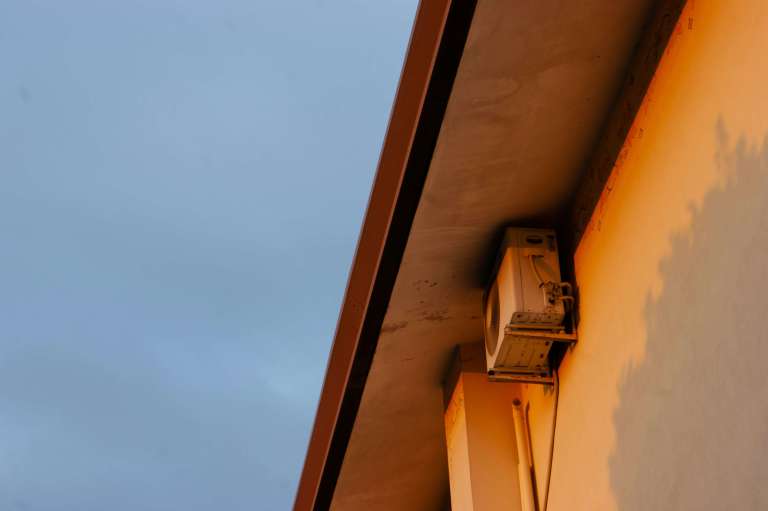
Instead of questioning the design, we invented a product to survive it. Every summer gets hotter. Every building gets another compressor. Every apartment becomes another sealed container.
The machine that promises relief quietly becomes part of the world that made relief necessary.
That machine is air conditioning, and naming it here isn’t a knock against it. In 1936, before home AC existed anywhere in the US, a heat wave killed close to five thousand people across the country, most of them in homes with no insulation, no shade, no relief.
That death toll wasn’t inevitable and it wasn’t just bad luck. It happened in the middle of the Dust Bowl, and the Dust Bowl was manufactured. Farmers had stripped the deep rooted native prairie grass, the kind that held moisture and cooled the ground through the plants themselves, and replaced it with shallow rooted wheat grown for profit.
When the drought came, there was nothing left to hold the land together and nothing left to cool it. Indigenous communities had farmed those same plains for centuries without triggering that collapse. The 1936 death toll wasn’t proof that hot places are hostile to humans. It was proof of what happens when land and housing get built for yield instead of for the climate they sit in.
AC didn’t create that problem. It arrived as a patch for a problem that profit driven land use and profit driven construction had manufactured, and it’s remained a patch ever since, papering over bad design instead of fixing it.
That’s the honest version of the argument. Not that AC invented the crisis, but that we reached for the machine instead of reaching for the wall thickness, the window placement, the shade, the airflow that would have made the machine unnecessary in the first place.
Spend time in many hot, humid cities today and you notice something unsettling. The day disappears. Life retreats to dawn and returns after sunset.
Office workers leave an air conditioned apartment, enter an elevator, board an air conditioned train, spend nine hours in an air conditioned office or mall, and return home after dark. Entire days pass without sunlight touching their skin.
Not because they hate nature. Because the city has made nature hostile.
Outside is heat that exhausts you within minutes. Humidity that clings to your lungs. Mosquitoes thriving in a warming climate, carrying diseases that turn an open window into a calculation of risk. Pollution hanging over traffic. The safest option becomes staying inside.
Home stops being shelter. It becomes life support.
The cost is much larger than vitamin D deficiency, though that’s where it starts. Less sun on skin means less vitamin D produced, and vitamin D deficiency is tied to low energy, low mood, and a weaker immune system, which is why people who spend their days sealed away from sunlight tend to get sick more often, not less.
Our bodies evolved with morning light, changing temperatures, wind on our skin, fresh moving air. Circadian rhythms sync to dawn, not to LED panels, and when that sync breaks down, sleep breaks down with it, and disrupted sleep drags hormonal cycles, mood, and energy down with it.
Recycled indoor air adds another layer on top. Research on indoor air quality has linked poor ventilation and recirculated air to worse asthma symptoms and higher rates of respiratory illness, especially in buildings that trade fresh air exchange for sealed, climate controlled comfort.
Even our eyeballs are stretching out of shape. Children who spend most of their days indoors under artificial light are developing myopia at rates that have doubled in some countries in a generation, while the ones who spend two hours a day outdoors are far less likely to need glasses at all.
There’s a crueler twist hiding underneath all of it. Studies comparing people who live in constantly air conditioned spaces to people who live with natural ventilation find that the AC group’s bodies lose the ability to handle heat at all, weaker sweat response, less tolerance, more discomfort at the same temperature a naturally ventilated body handles with ease.
The machine doesn’t just fail to fix our relationship with heat, it erodes our own built in defenses against it, so we need the machine more, not less, the longer we rely on it.
And a life spent moving between sealed rooms is a life spent sitting down. Outdoor space invites movement in a way four walls never will, and the sedentary indoor hours we’ve traded for it are independently linked to weight gain and rising obesity, on top of anything diet explains.
Sleep, mood, hormonal cycles, the air in our lungs, the shape of our eyeballs, our own tolerance for the climate we live in, our own bodies at rest, all bent out of shape by a relationship with the natural world that modern urban life steadily erases.
We’ve normalized breathing recycled air more often than fresh air. That should horrify us.
The cruelest part is the loop that follows. The hotter cities become, the more air conditioners we install. The more compressors run, the more waste heat gets dumped straight back into the streets.
Research on Phoenix Arizona has found that AC waste heat alone pushes nighttime outdoor temperatures up by more than one degree Celsius, right when the heat should be breaking. Elsewhere, modeling done on a city like Paris found that if every building ran AC to hold a comfortable indoor temperature, the waste heat could raise the temperature by up to three and a half degrees Celsius.
The same mechanism behind the Dust Bowl I mentioned earlier is still running quietly in American suburbs today. Grass and trees cool the air through evapotranspiration, water moving up through roots and out through leaves. Strip that away for pavement and clean-cut lawns and you lose all the moisture. The ground stops cooling itself the way it used to, so the heat just builds and kills the remaining grass.
Singapore has more air conditioners per capita than anywhere else in Southeast Asia, and it has also spent years planting rooftop gardens, vertical greenery, and tree canopy to bring outdoor temperatures down.
The greenery helps, but the heat from all those compressors doesn’t disappear just because there are more trees to stand under. As long as the AC stays, the waste heat stays with it. Greening a city while leaving mechanical cooling untouched isn’t the answer, it’s proof that the answer has to include using less of the machine, not just planting around it.
This is capitalism distilled into a single object.
Create the crisis. Sell the adaptation. Repeat.
The future should not be millions of homes humming behind permanently closed windows.
It should be cities dense with trees instead of parking lots. Buildings designed for cross ventilation, thermal mass, and passive solar heating and cooling instead of sealed glass that needs a machine to survive its own design. Public spaces that invite people outdoors instead of shopping malls that replace them. Fewer cars. Less concrete. More shade. More wind. More life.
We don’t need to get better at hiding from the climate. We need to build a world where hiding is no longer necessary, and stop mistaking climate control for control over the climate.
Global warming is not only melting glaciers. It’s melting the very idea of outside. If we accept air conditioned isolation as the endpoint of civilization, we’ve accepted far more than a hotter planet.
We’ve accepted the disappearance of human life beneath the open sky.
The tourist didn’t design the system that made travel a substitute for a life worth living.
A new form of environmental propaganda has quietly become mainstream.
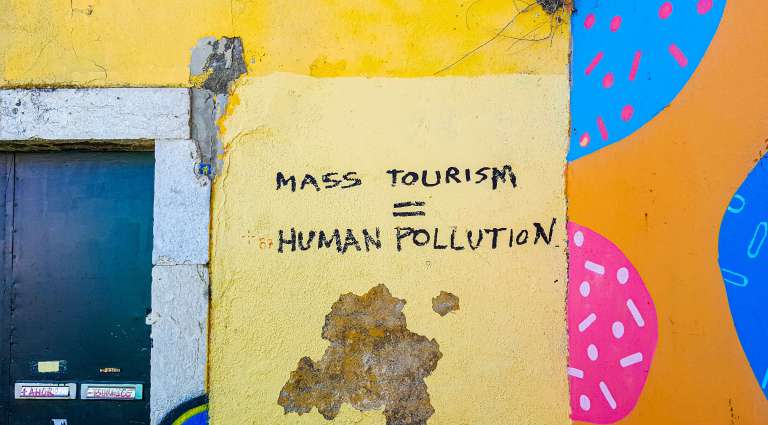
Every week, another headline appears telling ordinary people they are responsible for climate change, then hands down the same list of penances. Drive less. Fly less. Stop buying this. Stop enjoying that. Recently, Le Monde highlighted that tourism accounts for around 9% of global CO2 emissions.
The number itself bothers me. It’s huge, and mass tourism is something I have no patience for.
The framing bothered me even more.
Once again, the spotlight was placed on ordinary people instead of the system that shapes almost every decision they make.
It’s becoming increasingly common to hear the same message.
You’re responsible.
You’re the polluter.
You’re destroying the planet.
Study. Work. Pay your bills. Repeat. But if you finally manage to save enough money for a vacation, you’re suddenly made to feel guilty for that too.
That is not environmentalism.
That is misdirection.
Anyone who reads my essays knows I take my environmental footprint seriously. The choices behind that, the minimalism, going vegan, the way I get around, weren’t picked up to look good or fit in. They came out of years of reflection.
I’ve been a minimalist for nearly a decade because endless consumption makes neither people nor the planet happier.
I’m vegan because I care about animals. I also recognize the immense environmental cost of industrial animal agriculture, from habitat destruction to food waste and greenhouse gas emissions.
I buy second hand exclusively and repair things before replacing them. I don’t buy new clothes. I’d rather walk or take public transportation than drive, and I’d rather borrow or share something than own it outright, because half the stuff we buy individually just sits there waiting to be used once a year. I’ve taken a nine hour bus instead of a forty five minute flight to the same destination, more than once, because the extra hours felt like a small price for the difference in footprint. I believe we should leave this world better than we found it.
None of that makes me exceptional. It just means I got lucky, or stubborn, enough to question habits most people never get the chance to question, because those habits get taught before we’re old enough to notice them.
Unlike wild animals, humans cannot realistically leave no trace at all. We build, consume, and transform our surroundings. But we can choose to leave as little trace as possible.
That responsibility matters.
What I reject is the idea that environmental collapse is primarily the consequence of millions of individuals making bad personal choices, as if those choices appeared out of nowhere.
They didn’t.
We’re born into a world that treats consumption as the default. Questioning it comes later, if at all, because most people spend their lives just trying to survive rent, survive the cost of food and shelter. Then, once that survival eases up even a little, we try to make up for lost time. We overconsume to compensate for what we never had, the same way anyone leaving poverty tends to, emulating the people who always had the means. “Treat yourself. You earned it. You worked hard for it.”
Individualism finishes the job from there. Look after your own happiness first, leave everyone else’s problems to someone else. That isn’t a flaw people are born with. It’s a job someone trained us for.
So yes, individuals are responsible for what they do. But the system is responsible for how most individuals were shaped to behave in the first place, and pretending otherwise lets the actual architects of the mess off the hook.
The system was built so individuals would fit inside it, and it worked well enough that the individual is now a piece of the machine that keeps breaking us. That’s what makes escape so hard. It isn’t one bad law or one greedy company standing in the way. It’s advertising, employers, housing, food systems, culture, and habit all pulling the same direction at once, thousands of small parts that don’t need to coordinate because they all reward the same behavior. No amount of individual willpower gets the masses out of a system built from that many interlocking pieces. You can opt out personally. The system barely notices.
Now, does tourism have environmental impacts?
Absolutely.
Mass tourism damages ecosystems. It strains local infrastructure. It raises housing prices. It pollutes coastlines. It turns historic neighborhoods into amusement parks. Entire cities are transformed into products designed for visitors instead of homes for residents.
These are real problems.
But they’re not caused by tourists wanting to see the world. They’re caused by an industry that’s turned that desire into something to sell as much of as possible, to as many people as possible, regardless of what the planet or the destination can absorb.
That distinction matters.
And here’s the part that should actually worry us. Right now, only a small share of the world’s population can afford to travel the way tourism gets discussed in Le Monde or anywhere else. If everyone on earth consumed the way the average French person does, we’d need close to three planets to sustain it. Live like the average American and the number climbs higher still.
The uncomfortable truth is that the planet is only holding together because most of humanity is still too poor to consume like the wealthy world does. As more of that population gets richer, and some of it will, that 9% doesn’t stay at 9%. It grows, the same way every other consumption metric grows when purchasing power spreads. We’re not looking at a stable number. We’re looking at a preview.
I also have for a long time questioned whether much of what we call tourism today is even about travel anymore. My work attests to that.
For many people, traveling is just another form of consumption.
They fly somewhere, stay in the same spots, eat at the same chain restaurants, shop in the same luxury stores, and return home with thousands of photos that exist mainly to prove they were there.
The destination changes.
The lifestyle doesn’t.
Social media has accelerated this transformation. Many destinations are no longer visited because they offer something meaningful. They’re visited because their images perform well online.
Travel becomes content.
Experiences become status symbols.
Places become backdrops.
This isn’t the industry malfunctioning. It’s the industry working exactly as designed. Travel companies exist to grow. Growth means selling more trips to more people more often, and the easiest way to do that is to sell travel as a reward, a treat, a thing you’ve earned and deserve, the same script used to sell everything else. Advertise the escape, not the destination. Call it self care. Call it living your best life. The vacation guilt the headlines produce and the vacation obsession the industry produces come from the same machine. One hand points the finger, the other hand keeps the conveyor belt running.
I think it reflects something much deeper than the shallowness of the masses.
Many people feel disconnected from their work, their communities, and even themselves. Life often revolves around earning enough money to repeat the same routine next week. Under these conditions, vacations become less about discovery and more about escape.
People aren’t always searching for another country.
They’re searching for relief.
Give people meaningful work. Give them stronger communities. Give them time with family. Give them parks, culture, nature, and purpose close to home.
Many would feel far less pressure to chase an escape valve on the other side of the planet every summer.
There will always be genuine explorers.
Some people are naturally driven to understand different cultures, ecosystems, languages, and ways of living. They travel to learn, to question their assumptions, and to return home with ideas worth sharing.
I’d guess that’s a minority. Watch how travel actually gets consumed, the itineraries, the photo spots, the same five restaurants recommended to everyone, and it’s hard to conclude that curiosity is the main thing driving most of it.
Historically, travel served the purpose of learning through exploration rather than consumption. People left home to study, exchange knowledge, observe other societies, and bring back innovations that improved their own communities.
Travel wasn’t simply about extracting something from a place.
It was about growing through them.
Today, too much tourism encourages the opposite. It treats landscapes the way it treats products, something to use up and move on from. It’s also flattening a diverse world into sameness.
That isn’t a failure of human nature.
It’s a predictable outcome of an economic system that turns everything into something to be bought and sold.
So yes, I oppose mass tourism. I absolutely do.
I oppose cruise ships that poison the oceans they sail through before dumping their waste in port cities and leaving.
I oppose short weekend flights taken simply because they’re cheap.
I oppose cities being redesigned for visitors while residents are priced out.
I oppose zoos and circuses that trade animal suffering for entertainment.
I oppose beachfront developments that sell the view and never mention what it cost to build.
I even oppose ecotourism, most of the time it’s just greenwashed tourism for the rich, another way to price out ordinary people while the outcome stays the same.
None of that makes the tourist the offender. An industry built to sell escape, and paid handsomely for doing it, is the one that turned a personal desire into an ecological liability.
The system is the culprit.
The environmental crisis will not be solved by making people feel guilty for taking a vacation. Most don’t even care.
It starts with education, teaching people to question the conditioning instead of just living inside it.
From there, it will be solved by degrowth. Not for the nation building its first hospitals or its first clean water system, that’s need. Degrowth is for the societies that already have what they need and keep manufacturing new needs anyway, the Emirates building another amusement park in the desert, Nevada building another casino with a golf course attached. One is need. The other is appetite dressed up as progress.
We already own enough clothes to dress the world for generations. The pile sitting in circulation right now would outlast most of us several times over, yet the fashion industry keeps manufacturing seasonal trends to convince us otherwise. That’s the target. That’s where degrowth should appear.
Less consumerism. Less unnecessary work. Eating plant based, living with less, minimalism as a norm rather than a lifestyle choice for the few. More shared economy and less of the individualism that trains us to treat our own comfort as the only thing worth protecting.
Degrowth looks like communities that function without a car and a credit card for every errand, hobbies that give something back instead of costing something, planting trees and cleaning rivers instead of shopping malls and card tables in casinos.
It looks like people who no longer need two weeks a year on the other side of the planet to remember they’re alive, because the other fifty weeks stopped feeling like a sentence.
Until we are willing to confront that reality, the headlines will keep telling you to fly less while the industry keeps telling you to fly more, and both of them profit from you never noticing it’s the same voice. Guilt won’t shrink a system built to keep expanding. Only pulling its foundations out will.
That’s the trip actually worth taking. And unlike the one on the brochure, nobody’s selling it to you.
On the ego that turned exploration into consumption.
People often ask why I spend weeks in one place when I could be crossing several countries off my list instead. I suppose I’ve never understood how moving more is supposed to mean seeing more.
I don’t travel to collect countries.
I travel to disappear into one.
Backpackers don’t stay anywhere anymore.
They arrive. They sleep. They photograph. They publish. They leave.
Then they repeat the process somewhere else until the trip ends and they return home exhausted, convinced they’ve seen the world because they were physically present in it.
They haven’t.
They’ve consumed it.
That’s what backpacking has become.
Not exploration.
Consumption.
Call me a gatekeeper if you want, but I don’t think making travel accessible to everyone was a good thing.
Some things deserve to remain difficult.
Difficulty isn’t just an obstacle.
It’s a filter.
Backpacking once demanded uncertainty. You hitchhiked because there wasn’t another option. You camped because you couldn’t afford hotels. You got lost because Google Maps didn’t exist. You depended on strangers because there was nobody else.
You didn’t stay three weeks because slow travel was fashionable.
You stayed because leaving wasn’t simple.
That difficulty selected people.
Not better people.
People with different motivations.
People who wanted to understand rather than display.
Then technology removed almost every barrier.
Flights became cheap.
Hostels multiplied.
Google Maps eliminated uncertainty.
Translation apps eliminated effort.
Social media eliminated the need to tell stories because photographs could pretend to tell them for you.
The filter disappeared.
The culture changed.
Today, travel isn’t sold as curiosity.
It’s sold as identity.
The tourism industry doesn’t ask what a country might teach you.
It asks who you’ll become once other people know you’ve been there.
Travel has become one of the cheapest ways to manufacture an identity.
You don’t need to become interesting.
You just need to stand somewhere interesting.
That’s why so many people return with bigger egos instead of broader minds.
Ask them what they learned.
Most will tell you what they saw.
Ask them about the people.
They’ll tell you about the monuments.
Ask them about the language.
They’ll proudly repeat the three words they learned after spending 90 days crossing six countries.
They’re collecting locations, not understanding and certainly not growth.
Tourism has become another branch of consumerism.
Countries are products.
Experiences are products.
Cultures are products.
Even people become products.
Everything exists to be consumed, photographed and replaced by the next destination.
The strangest part is how proud we are of this.
“I’ve been to 25 countries.“
Why is that impressive?
Wouldn’t it be more impressive to deeply understand one?
To speak its language.
To know its neighborhoods instead of its viewpoints.
To have friends instead of recommendations.
To return home with your certainties broken instead of your passport filled.
Movement has become confused with growth.
They’re not the same thing.
Most people don’t travel to become different.
They travel to confirm the person they already believe themselves to be.
Travel becomes evidence.
Proof that they’re adventurous.
Proof of their supposed open-mindedness, despite the racist behavior they display toward locals.
Proof that they’re successful.
It’s ego disguised as curiosity.
The environmental hypocrisy follows naturally.
People cry in front of ancient forests before buying products linked to deforestation.
They snorkel around coral reefs while financing industries that destroy them.
They admire wild animals, then return home and continue consuming the system driving those animals toward extinction.
Nature isn’t changing them.
It’s entertaining them.
People tell me tourism creates conservation.
I think that’s backwards.
Conservation is usually the bill we pay after treating the natural world like a warehouse.
The less we consume, the less there is to rescue.
The same thing happens with culture.
We’re constantly told cultural exchange is inherently beautiful.
Sometimes it is.
Sometimes it spreads destructive habits faster than wisdom.
The world is becoming culturally flatter.
Walk through enough cities and they begin to blur together.
The same cafés.
The same apartment blocks.
The same shopping streets.
The same influencers taking the same photographs.
We’ve mistaken imitation for development.
We’ve decided that progress means looking like whoever industrialized first.
Traditional architecture disappears because concrete and glass looks richer.
Buildings that evolved over centuries to suit local climates are demolished so cities can resemble places they were never meant to resemble.
I don’t call that progress.
I call it forgetting.
A yurt isn’t inferior because it doesn’t resemble a skyscraper.
An earth house isn’t backward because it isn’t made of concrete.
Architecture should answer the climate before it answers fashion.
A society should adapt to its environment before adapting to global trends.
That’s my definition of progress.
Better adaptation.
Not better imitation.
The same principle applies everywhere.
The easier photography became, the less people learned photography.
The easier publishing became, the less people learned to write.
The easier backpacking became, the more it became tourism.
Convenience doesn’t simply allow more people to participate.
It changes why they participate.
And once the reason changes, the activity changes with it.
That’s what happened to travel.
The greatest journeys aren’t measured by distance.
They’re measured by transformation.
You should come home questioning yourself more than the people you visited.
If all you brought back were photographs, opinions and a stronger sense of your own importance, then you didn’t really travel.
You consumed another place.
The tragedy isn’t that the world became accessible.
The tragedy is that accessibility turned one of humanity’s greatest opportunities for humility into another marketplace for ego.
France has barely extinguished one of its largest wildfires in decades. An area roughly the size of Hong Kong has burned, and we’re only halfway through the summer. But another heatwave is already here.
People ask how this keeps happening.
I think we’re asking the wrong question.
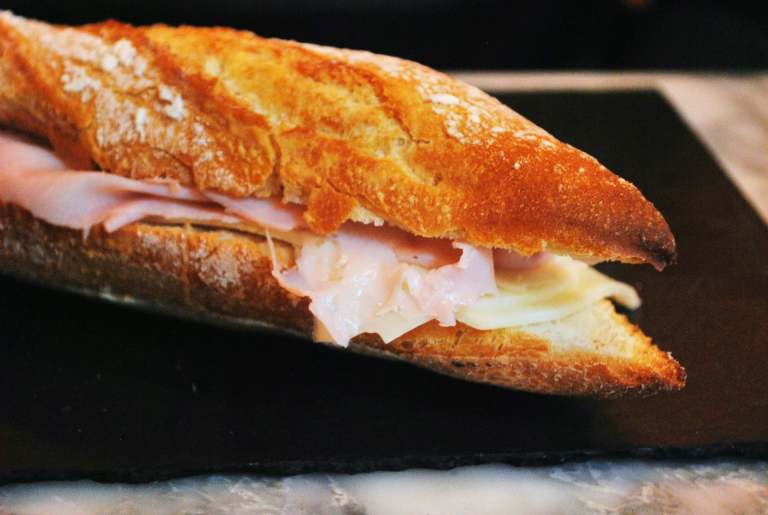
Every wildfire begins with a sandwich.
Not because a ham sandwich can physically ignite a forest, but because it represents the countless ordinary decisions that build the world in which forests burn.
The sandwich.
The cigarette.
The dairy ice cream we hand to our children without a second thought.
The Shein order arriving tomorrow.
The new backpack and notebooks bought every September even though last year’s are still perfectly usable.
Each decision appears harmless. Each is too small to matter. That is exactly how systems survive. It’s recreated every morning when we choose convenience over necessity, novelty over sufficiency, habit over reflection.
Every purchase is a vote. Not because one purchase changes the world overnight, but because billions of purchases, repeated every day, determine which industries grow, which disappear, and what kind of civilization we continue to finance.
One Amazon order won’t send a billionaire and his friends into space. One dairy ice cream won’t destroy a forest. One unnecessary notebook won’t fill a landfill.
But none of those things happens only once. They happen millions of times, every single day. Eventually those “insignificant” decisions become greenhouse gases, deforestation, polluted rivers, shrinking biodiversity, exhausted soils, expanding infrastructure and ecosystems pushed beyond their limits.
Then comes the heat. Then the drought. Then the spark.
And suddenly everyone becomes an environmentalist.
Hundreds of volunteers leave their homes to protect forests from the flames. They carry water, clear vegetation, do everything they can to stop the fire from reaching nearby villages. Most people see humanity at its finest.
I see humanity desperately trying to repair yesterday while continuing to finance it this morning.
The same people who volunteer their time and energy to protect the forest are then handed tables full of ham and butter sandwiches, soft drinks, sometimes cigarettes.
Volunteering is great. These people are giving their time to protect their homes, their communities, the forest around them. That matters. What bothers me is how easily we separate the emergency from everything that preceded it. We celebrate the person who runs toward the flames while treating the quieter forms of prevention as optional, eccentric, even ridiculous.
Those choices rarely earn applause because they happen long before the crisis, when there is no fire to fight and nobody watching. Yet they may matter far more than the dramatic moments that make the evening news.
We have confused loving the way nature makes us feel with caring about nature itself.
We hike through forests while eating products that contribute to the destruction of ecosystems. We photograph mountains while wrapped in disposable consumption. We defend a burning forest while continuing to finance the industries that place increasing pressure on forests around the world. We rush to fight the fire while throwing fuel onto it for the rest of the year. Economic fuel. Cultural fuel. Political fuel.
None of this means every choice weighs the same. A handful of industries and a handful of governments make decisions that outweigh what any individual could do in a lifetime, and no amount of reused notebooks cancels out a pipeline. But that asymmetry is not an excuse. It’s the reason our purchases are also our politics. Every dollar we hand to an industry is a small vote for its continued expansion, and the industries we’re describing don’t grow without millions of us feeding them first.
People often ask who is responsible for ecological collapse. The government? Corporations? Consumers? The uncomfortable answer is that there isn’t a single culprit. There is a chain, a chain in which every link seems too small to matter until the whole thing snaps.
That’s the butterfly effect.
A civilization is not destroyed by one catastrophic decision. It’ss destroyed by millions of ordinary ones.
Schools are closing or changing schedules. Trains are slowing down. Workers are being told to adapt. Older people are urged to stay indoors. Animals are dying in barns. Rivers are warming. Nuclear power stations are struggling to cool their reactors and being closed down. Farmers are watching the sky, hoping for rain that never comes. Cities are discovering, once again, that concrete, asphalt and glass are not neutral materials. They trap heat.
Every heatwave ends the same way.
“We need to adapt.”
Of course we do. Nobody serious argues otherwise. When temperatures reach 40°C, we need shade, cool public spaces, drinking fountains, schools that do not become ovens, hospitals that can keep functioning and cooling in strategic public buildings, especially for older people, children, sick people, outdoor workers and anyone trapped in poorly designed housing.
But adaptation cannot become the polite word for surrender.
The real question is not how we survive longer heatwaves.
The real question is why we continue to organize society in ways that make them worse.
Unfortunately, that’s the conversation many people would rather avoid.
The climate crisis is not a natural disaster in the way an earthquake is. Scientists warned us for decades. Communities raised the alarm. The solutions have been available for years. Yet, governments protected fossil fuel interests. Oil and gas companies expanded production. Executives collected billions. Politicians delayed, negotiated, softened regulations, greenwashed and lied.
This was not inevitable.
It was a political and economic choice.
Now, the same system that chose fire is trying to sell us fans, bottled water, air conditioners, climate insurance, private pools, green capitalism and survival kits.
The house is burning, and someone has opened a shop in the living room.
Heat Is Only the Symptom
The mistake is thinking this is only about high temperatures.
A heatwave is a stress test for almost everything that keeps society running.
It pushes the human body beyond its limits. It kills directly, especially when nights remain hot and people cannot recover. It damages sleep, concentration, heart health and kidney function. It turns classrooms into places where children struggle to learn and workplaces into places where people struggle to work.
It pushes infrastructure to its limits. Railway tracks expand. Roads soften. Electricity grids strain under rising demand. Hospitals become overloaded.
The irony is that ACs draw more power precisely when energy systems are already under pressure. Nuclear plants need cool water, yet rivers become warmer and shallower. The same heat that increases electricity demand can make electricity harder to produce.
It pushes agriculture as well. Cows produce less milk. Chickens die in industrial sheds. Crops dry out and/or suffer damage that only becomes visible weeks or months later. Soil loses moisture. Water restrictions arrive. Harvests shrink. Food prices rise.
Then everyone acts surprised that groceries become more expensive.
The damage does not end when the thermometer falls.
That’s why surviving the next heatwave is not enough.
The Food System Nobody Wants to Discuss
Climate conversations usually focus on transport.
And transport matters. Flying less matters. Driving less whenever possible matters. The World Cup spread across North America is a perfect example of climate absurdity, an event marketed as global unity while sending teams, fans, journalists and sponsors across an entire continent for entertainment.
But another major part of the crisis rarely receives the same attention because it sits on our plates.
Animal agriculture is one of the least efficient uses of land, water, energy and living ecosystems on Earth.
Livestock occupies roughly three quarters to more than four fifths of global agricultural land, depending on how it is measured, once grazing land and crops grown for animal feed are included. Yet, animal products provide only a minority of the world’s calories and protein. One widely cited Science study found that meat, dairy, eggs and aquaculture use about 83% of farmland while supplying just 18% of calories and 37% of protein.
Read that again.
Most of the farmland.
A fraction of the food.
That is not efficiency.
It is ideology disguised as agriculture.
The system produces far more than meat, milk and eggs. It produces methane, deforestation, polluted rivers, antibiotic resistance, dead zones in coastal waters and immense pressure on land and water.
It also produces immense suffering.
During heatwaves, pigs, chickens and cows cannot simply adapt because consumers expect cheap animal products. Ventilation systems fail. Cooling systems are inadequate or absent. Transport trucks become ovens. Poultry dies by the hundreds of thousands. Dairy cows suffer severe heat stress and milk production falls.
Then the industry presents itself as another victim of climate change while helping drive the crisis in the first place.
This is not about blaming someone trying to feed their family on a tight budget.
The ocean may be the most neglected part of the climate conversation.
We rightly describe forests as the lungs of the planet. They deserve that attention. But the ocean is far more essential to life on Earth. It has absorbed more than 90% of the excess heat trapped by greenhouse gases. It takes in a large share of the carbon dioxide we emit. It produces roughly half of the oxygen we breathe, largely through microscopic phytoplankton.
The ocean is not scenery.
It’s not a backdrop for holidays.
It is one of the reasons this planet is still habitable.
There is something profoundly irrational about destroying marine ecosystems while wondering why the planet keeps overheating.
Industrial fishing is not simply the act of catching fish. It tears apart ecosystems. It removes key species from food webs, kills countless non-target animals and drags heavy nets across the seabed, destroying habitats that took decades, centuries or even millennia to develop.
Yet this rarely appears in mainstream climate debates.
We are told to fly less, and rightly so.
We are told to drive less, and rightly so.
We are only beginning to hear serious discussion about livestock.
But fishing is still treated as though fish simply appear on supermarket shelves and the ocean can absorb endless extraction without consequence.
It cannot.
If the ocean regulates climate, absorbs carbon dioxide, produces oxygen and stores enormous amounts of heat, protecting marine ecosystems is climate policy.
Eating less fish, or choosing not to eat it at all, is not only an ethical position. It is a climate position.
For those who continue to eat seafood, there is at least an important distinction to make between small-scale fisheries and industrial fleets that empty entire ecosystems.
The ocean is one of Earth’s greatest cooling systems. Protect it at all costs.
Why Air Conditioning Can’t Be the Plan
Air conditioning has an important role.
During extreme heat, it saves lives. Hospitals, schools, care homes, public libraries, emergency shelters and social housing all need effective cooling strategies. No one should die inside an apartment built for a climate that no longer exists.
But air conditioning can’t become our primary response.
Every unit cools an indoor space by releasing heat outdoors. Across an entire city, that extra heat makes streets even hotter, particularly after sunset. Air conditioners also increase electricity demand during the hottest periods of the year. Where electricity still depends on fossil fuels, emissions rise. Even cleaner grids face greater strain as peak demand grows.
Singapore illustrates both the benefits and the limits of this approach.
The city has become highly dependent on cooling. Buildings require constant air conditioning. Those systems release heat into the streets. Outdoor spaces become less comfortable, encouraging people to remain indoors, which increases demand for cooling still further.
The cycle reinforces itself.
That’s not resilience, it’s technological dependence.
We don’t need cities filled with cooled rooms.
We need cities that stay cool in the first place.
We Forgot How to Build for Nature
The most effective cooling technology has existed for millions of years.
Trees.
Not decorative saplings planted in tiny squares of concrete, but mature urban forests and healthy green canopies.
Anyone who has walked barefoot from hot pavement onto shaded grass already understands this without reading a scientific paper.
So why, every time France approaches 40°C, do we talk about buying more air conditioners before planting more trees?
Why do we pave over soil, remove mature trees, expand shopping centres, build vast parking lots and approve developments that trap heat, only to claim that more machines are the answer?
They store water, protect biodiversity, stabilise soils, reduce erosion, create humidity and lower temperatures. They make landscapes more resilient long before a heatwave arrives.
Yet even forests are increasingly treated as another industrial resource.
Living ecosystems become timber reserves. Old-growth forests become biomass. Trees are cut down, burned for energy and labelled renewable, while complex ecosystems that took centuries to develop are reduced to units of production.
The same logic appears again and again.
If something can be extracted, it is.
If something can be sold, it is.
The living world is valued less for keeping us alive than for generating another stream of profit.
Water Is Becoming Political
Water is becoming one of the defining political issues of this century.
Yet we still manage it as though nothing has changed.
During droughts, ordinary people are told to take shorter showers. Farmers are asked to reduce irrigation. Small growers are criticised for watering their crops.
Meanwhile, luxury uses fight for exemptions.
Golf courses have become symbols of this contradiction because they expose the politics behind water allocation. While vegetables struggle and ecosystems dry out, perfectly green fairways are often defended. Leisure for the comfortable can receive more protection than food production or ecosystem survival.
Mega-basins reveal the same mindset.
On paper, the idea sounds simple. Capture water in winter and use it during summer.
Reality is more complicated.
Many of these reservoirs are open to the air, increasing evaporation as temperatures rise. They can concentrate control of water in the hands of a limited number of large farms. They often allow water-intensive agricultural models to continue instead of encouraging the transition toward crops and farming systems adapted to the climate that is already arriving.
The question is not whether storing water can ever make sense.
The question is who controls it, who benefits from it and whether it helps transform agriculture or merely postpones change.
A society preparing for the future would treat every drop of freshwater as precious.
Rainwater would be collected wherever possible.
Wastewater would be safely reused.
Leaking infrastructure would be repaired.
Soils would be restored so they can retain moisture.
Cities would remove unnecessary concrete and allow water to return to the ground.
Farmers would receive support to transition toward more resilient practices.
Luxury water use would never be treated as equivalent to drinking water, food production or healthy ecosystems.
The Logic Behind the Crisis
The deeper problem is that our economic system rarely asks what keeps life alive.
It asks what can be sold.
That’s why so many climate conversations end in absurdity.
We’re told to separate our recycling while billionaires fly private jets.
We’re reminded to save water while enormous data centres consume vast amounts of electricity and freshwater to cool servers powering artificial intelligence, advertising and endless digital consumption.
We debate plastic straws while militaries burn enormous quantities of fuel, flatten cities, destroy farms, poison soil and create another wave of emissions through reconstruction.
The priorities are impossible to ignore once you see them.
The Climate Cost of War
War remains one of the largest blind spots in climate politics.
The climate impact of the war on Gaza has been estimated in the tens of millions of tonnes of carbon dioxide equivalent once direct military activity and reconstruction are included.
The opening weeks of the US-Israel war on Iran were estimated to produce several million tonnes of emissions.
Lebanon has accused Israel of ecocide following the destruction of forests, farmland and ecosystems in the south.
Yet military emissions are still treated as though they exist outside the atmosphere.
As though bombs leave no carbon footprint.
As though fighter jets fly on moral complexity.
As though hospitals, schools, roads, farms and homes rebuild themselves without steel, cement, machinery and energy.
We can’t keep pretending these emissions don’t count simply because they’re politically inconvenient.
The pattern is difficult to ignore.
Capitalism drives extraction.
Extraction fuels empire.
Empire produces war.
War destroys societies.
Destruction demands reconstruction.
Reconstruction creates more emissions.
Then we’re told that buying a bamboo toothbrush is the meaningful response.
It is not.
Personal Responsibility Matters, but It Is Not Equal
None of this means personal choices are meaningless.
They matter because they reduce demand for destructive industries, help shift culture and make political demands more credible.
But responsibility is not shared equally.
A working family struggling to pay rent is not comparable to a billionaire with private aircraft, multiple homes, yachts and investments in fossil fuels.
Someone eating the foods they were encouraged to consume from childhood is not comparable to multinational agribusinesses lobbying to protect industrial livestock.
A commuter driving because public transport is inadequate is not comparable to governments that refuse to invest in reliable trains, cycling infrastructure and walkable cities.
The message can’t be that ordinary people are the problem.
The message is that we live inside a system designed to make destructive choices easy, profitable and normal while making better choices more expensive, less accessible or socially unusual.
Recognising that distinction is not about avoiding responsibility.
It is the first step toward directing responsibility where it belongs.
What We Can Do
None of this means waiting for someone else to act.
Some of the simplest changes are still among the most effective.
Eat less meat, or stop eating it.
Eat less fish, or stop eating it. If you choose to keep eating fish, understand the difference between small-scale fisheries and industrial fleets that empty entire ecosystems.
Buy fewer clothes. Buy second hand. Repair what you own. Stop treating fashion as a weekly identity update.
Do the same with appliances. Borrow, share, repair and buy used whenever possible.
Build a culture where tools, equipment, transport and household goods are shared instead of endlessly duplicated.
Fly less.
Drive less whenever practical.
Support political parties and movements that take climate change, biodiversity, animal welfare, water management, public services and peace seriously. Voting alone will not solve the crisis, but electing governments that deny climate science, protect fossil fuel interests and normalise war will accelerate it.
Above all, reject fake solutions.
A city with air conditioning but no trees is not prepared.
A country with mega-basins but dying soils is not prepared.
A food system built on industrial animal suffering is not prepared.
A sporting culture that flies millions of people across continents for profit is not prepared.
A digital economy that consumes ever more electricity and water in pursuit of endless growth is not prepared.
A world that treats war as ordinary is not prepared.
France is not ready for what’s coming, and that pains me.
Europe and America aren’t ready either.
The Crisis Behind the Crisis
The tragedy is that even by the narrow standards of economic growth, this system is failing.
Heat kills workers.
It reduces productivity.
It damages harvests.
It weakens infrastructure.
It raises healthcare costs.
It disrupts schools.
It destabilises insurance.
It pushes food prices higher.
It forces governments to spend billions (of our money) responding to disasters they chose not to prevent.
Even someone who cares nothing for animals, forests, rivers, oceans or social justice should recognise one simple reality.
This model is becoming too expensive to sustain itself.
The climate crisis is not only an ecological crisis.
It is a crisis of imagination.
We keep trying to preserve the lifestyle that created the emergency, then call that realism.
But there is nothing realistic about filling unliveable cities with more air conditioners while cutting down trees.
There is nothing realistic about building reservoirs while refusing to transform agriculture.
There is nothing realistic about defending industrial livestock, industrial fishing, fossil fuels, permanent war and luxury consumption while asking ordinary people to adapt.
Realism begins by accepting that an economy built on endless extraction can’t produce a liveable planet.
We don’t need a parasasol over the apocalypse.
We need accountability.
We need to recognise that climate is not a separate issue. It runs through everything.
Our cities.
Our countryside.
Our food.
Our transport.
Our water.
Our forests.
Our oceans.
Our economies.
Our wars.
Not because that sounds radical.
Because the moderate path has become the one driving the crisis.
The planet is not burning because we failed to understand what was happening.
It’s burning because those with the power to change course chose not to.
That choice can still be reversed.
But only if we stop confusing adaptation with acceptance and start confronting the system that keeps choosing fire.
And how unlikely engineers are fixing what we broke.
Somewhere between dams, drains and forgotten beaver ponds, we taught water to behave unnaturally.
For centuries, rivers weren’t linear channels cutting through land. They were living systems with multiple rhythms. They had (some still do) a normal bed, a medium bed and a larger floodplain. During certain periods, rivers would overflow into nearby fields and forests, depositing sediments, organic matter and nutrients. They would slow down, spread out, feed themselves and recharge the surrounding soils before returning to their usual course. Water lingered. Land absorbed it like a sponge. Life depended on that slowness.
Modern (human) engineering broke this balance. To protect infrastructure, agriculture and urban areas, rivers were straightened, dredged and confined between embankments. Their wider beds were erased. This caused for river channels to deepen because the straighter a river is, the faster it goes, and the faster it goes, the more it digs under itself, thus lowering its bed. This phenom’ had two immediate consequences. First, rivers stopped feeding themselves. Cut off from floodplains, they no longer collect organic matter, sediments and nutrients that once sustained aquatic ecosystems. Second, and more critically, they stopped feeding the land around them. The earth lost its role as a sponge.
When soils are regularly rehydrated by slow, spreading water, they remain loose, alive and porous. Microorganisms thrive. Roots penetrate deeply. Organic matter accumulates.
When this process is interrupted, soils dry out and compact. They become stiff and tight. Rain no longer infiltrates. It slides across the surface, picking up speed, eroding topsoil and rushing straight into rivers, then quickly into the ocean. Water is no longer stored in landscapes but evacuated as quickly as possible. What we call floods and droughts are often two sides of the same engineered mistake.
This acceleration of water is a massive stress on the planet. Freshwater ecosystems collapse. Groundwater reserves fail to recharge. Agricultural soils lose fertility. Coastal zones receive sudden, polluted surges of freshwater and sediments. The problem is not a lack of rain but a lack of time. Water is not allowed to stay.
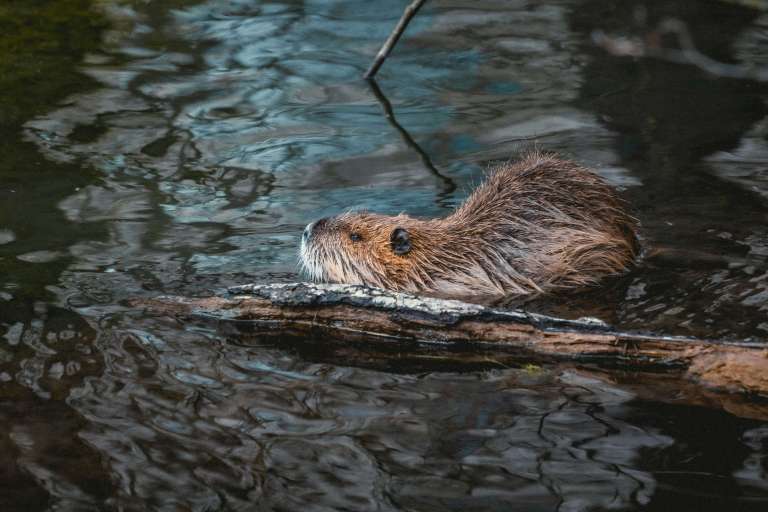
Nature, left to itself, mirrors its creator’s perfection. So naturally, solutions do exist, and one of the most powerful allies in restoring hydrological balance is none other than the beaver.
Often dismissed as a nuisance or a pest, the beaver is in fact a master engineer, working in harmony with natural laws rather than against them. By building “dams”, beavers slow water down. They raise river levels back toward their natural height. They reconnect streams with floodplains. They recreate the layered beds that humans spent centuries destroying, and still are.
Beaver dams create chains of small wetlands and ponds, true oases across landscapes. These wetlands filter water by trapping sediments and pollutants. They store water during wet periods and release it slowly during dry ones, reducing both floods and droughts. They soften the surrounding soils, allowing water to infiltrate deeply and recharge aquifers. Land regains its sponge-like function.
The ecological benefits are extraordinary. Beaver wetlands provide habitat for fish, amphibians, aquatic insects, birds and mammals. Frogs, salamanders, dragonflies, trout, ducks and herons all thrive in these environments. Biodiversity increases not despite the dams but because of them. Even forests benefit, as higher groundwater levels support healthier trees and reduce vulnerability to fires.
Beavers don’t build for profit, efficiency or short-term control. They build for stability. Their work reverses, piece by piece, the damage caused by rigid, fast and extractive water management systems, built by us.
Where humans forced rivers to behave like drains, beavers restore them as living systems.
Reintroducing and protecting beavers is not a romantic gesture or a return to some imagined past. It’s a practical, science-backed response to centuries of bad engineering. Beavers show that the solution to water crises is not always more concrete, deeper channels or faster flows. Sometimes, the solution is to slow down, raise water back into the land and let ecosystems do what they have always done best.
If we’re serious about restoring soils, securing water and easing the planetary stress we created, we should stop fighting nature’s intelligence and start learning from it.
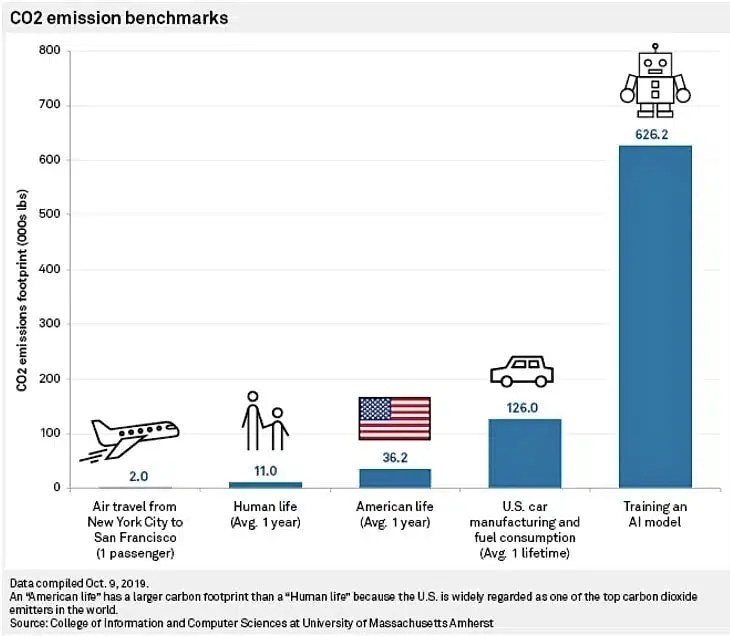
AI tools have made an already bad situation worse.
Every time you touch an AI tool, whether you’re making images or words, you’re feeding a machine that drinks real water and eats real power. Not in theory. Literally. There’s no harmless cloud floating above us. There are data centers on the ground, towers pulling heat out, plants burning fuel, all so content can come out faster while the bill gets paid somewhere else.
Think of it this way. One text request to a large AI model uses roughly the same amount of water as a few mouthfuls from a soda can. That sounds small until you remember these systems handle billions of requests a day! At that scale, we’re not talking about sips. We’re talking about entire truckloads of bottled drinks being poured straight down the drain, every single day, just to keep servers cool.
Generating a single AI image uses several times more energy than a text request. One article with five or six AI images might be using the equivalent electricity of leaving a laptop running for hours. Multiply that by thousands of articles, social posts, newsletters and ads, and suddenly it’s not trivial at all.
Zoom out a little more and the picture gets uglier. AI-related data centers are already using as much electricity as mid-sized cities. Estimates put global AI power demand on track to rival places like San Francisco or Boston within a few years. That’s millions of homes worth of electricity being burned so companies can automate writing, art and video at scale. AI doesn’t just steal jobs, it steals our resources.
Now stack dozens of these facilities across drought-prone states and you start to see why people are angry.
And they are angry.
Lately, I’ve seen organizers in Arizona, Pennsylvania and Georgia mobilize against new data center construction. Nobody wants these things in their communities. They strain power grids, drain water supplies and mostly benefit companies that don’t live there (don’t they always?). Luckily, these fights seem to be working. Projects are being delayed, while others are being stopped altogether. We can and will win against these tech oligarchs, but first, we need to be smart about our usage.
This is why it’s so frustrating to see articles about resistance, climate justice or helping nature paired with AI-written images. You can’t talk about fighting extraction while actively participating in it. You can’t warn about corporate overreach while relying on the most opaque, resource-hungry tech industry on the planet.
And it’s not just images. AI-written articles, AI-edited videos, AI voiceovers, all of it runs on the same infrastructure. Longer outputs mean more compute. Videos are especially brutal, far more than text or AI generated images. That one slick AI video you just posted (or liked) could represent the electricity use of a household for days. Yes, dayzz!
The worst part is how little transparency there is. AI companies won’t clearly say how much water or energy a specific model or request uses. Communities are asked to trust them, just like users are. Meanwhile the meters keep spinning.
Just to be clear, I’m not saying we need to go off-grid or stop using technology entirely, but we should start making conscious choices. Take your own photos. Use art made by real people. Scan a drawing, even a bad one. Use stock photos from photographers who actually went outside and did the work. Write things yourself or don’t write at all!
If you’re serious about resistance, about protecting nature, about fighting back against corporate power, your tools matter. Using AI by default, especially for images and media, actively undermines your message. People feel that contradiction, even if they don’t always have the numbers to explain it.