Walk into any farmers’ market or go to any “climate protest” and you’ll hear the same advice: eat local.
It’s sold as one of the simplest ways to reduce your carbon footprint. Buy beef from the farm down the road instead of the one shipped across the world and you’ve supposedly made an environmentally responsible choice.
You haven’t.
The phrase eat local has become one of the most successful pieces of green marketing ever created. Not because it’s entirely wrong, but because it distracts people with one of the smallest parts of the problem while protecting one of the largest.
Note: I use the same terminology as the studies I cite for consistency. That doesn’t mean I endorse it. Terms like beef and chicken are industry labels. They refer to the flesh of cows and hens who were killed, not something separate from the animals themselves.
The 6% illusion
Here’s the number almost nobody mentions.
Transport accounts for just 6% of global food emissions.
The other 94% comes from land use, farming, animal feed, methane, fertilizers and production itself. The truck is rarely the problem. The product is.
But not all products.
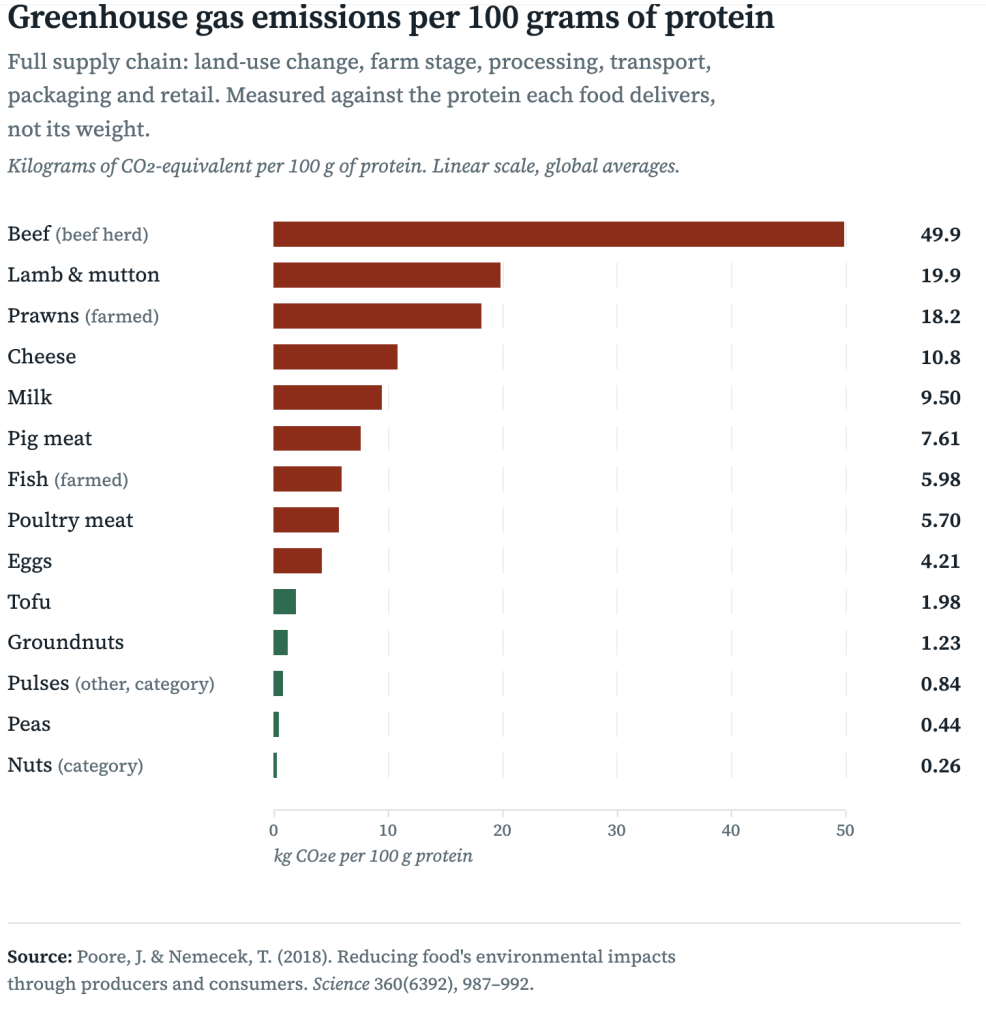
A kilogram of locally raised beef produces around 99 kg of greenhouse gases. Imported beans, lentils and peas produce between 1 and 2 kg.
That’s up to a 100-fold difference, even after crossing an ocean.
The climate doesn’t care whether the cow lived five kilometers away. It cares that it was a cow.
Transport accounts for just 6% of global food emissions, and roughly 1.5 to 2% of global emissions. In comparison, food waste alone is responsible for around 6% of all global greenhouse gas emissions.
Methane changes everything
Animal agriculture isn’t only a carbon problem.
Cattle release methane, a greenhouse gas that’s about 80 times more powerful than CO2 over a 20-year period. It remains in the atmosphere for a much shorter time than carbon dioxide, but its short-term warming effect is devastating, making livestock one of the fastest sectors where emissions should be reduced.
When people argue about food miles while ignoring methane, they’re arguing over the receipt instead of the bill.
The resources we’re running out of
Climate is only one consequence.
Livestock occupies 77% of the world’s farmland and gives back 18% of its calories and 37% of its protein. Most of that land isn’t feeding people. It’s feeding animals that were raised for the wrong reasons.
The cost is easier to see in reverse. If the world shifted to plant-based diets, agricultural land use would fall by about 75%, from roughly 4 billion hectares to 1 billion. Three quarters of all the farmland on Earth could go back to forest, wetland and grassland.
In simpler words, producing a gram of protein from beef or lamb takes up to 100 times the land that peas or tofu do. It also consumes staggering amounts of freshwater.
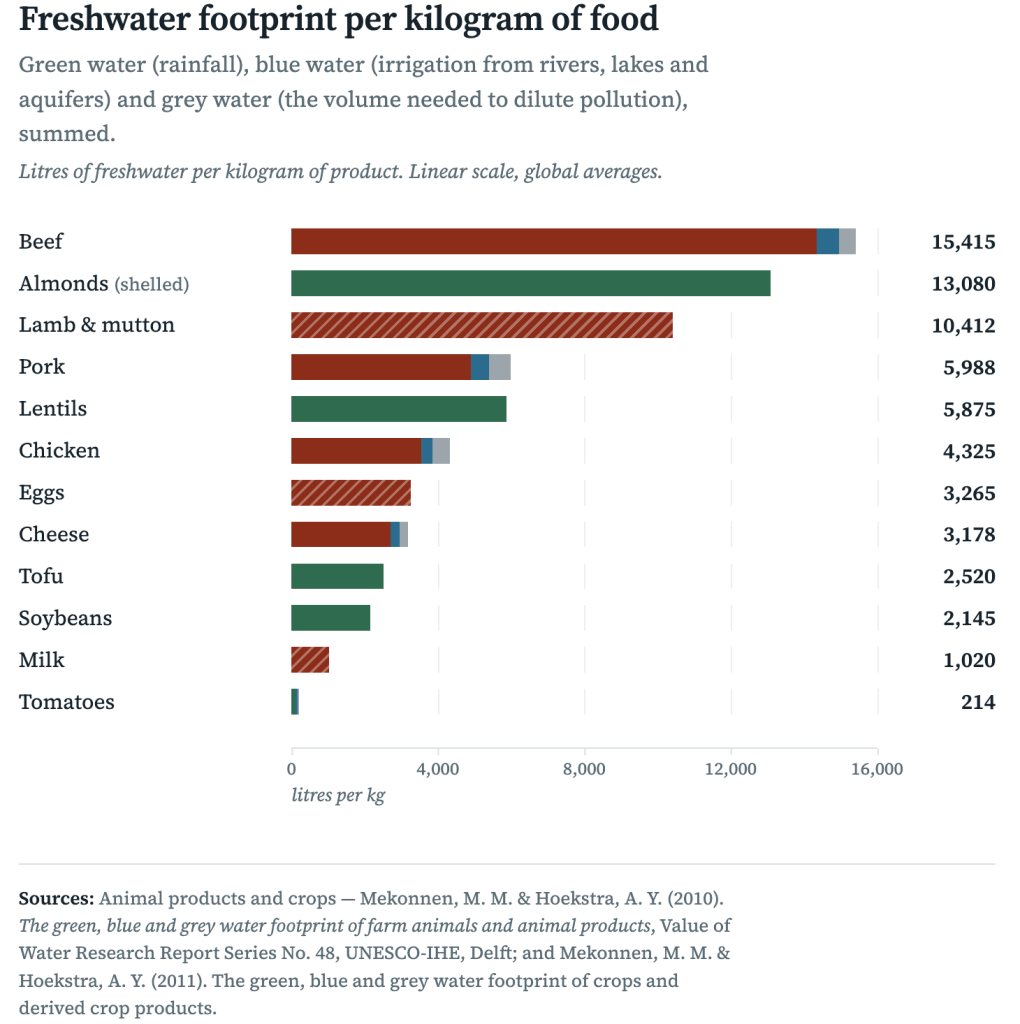
Producing one kilogram of beef requires around 15000 liters of water, while lentils require around 5900.
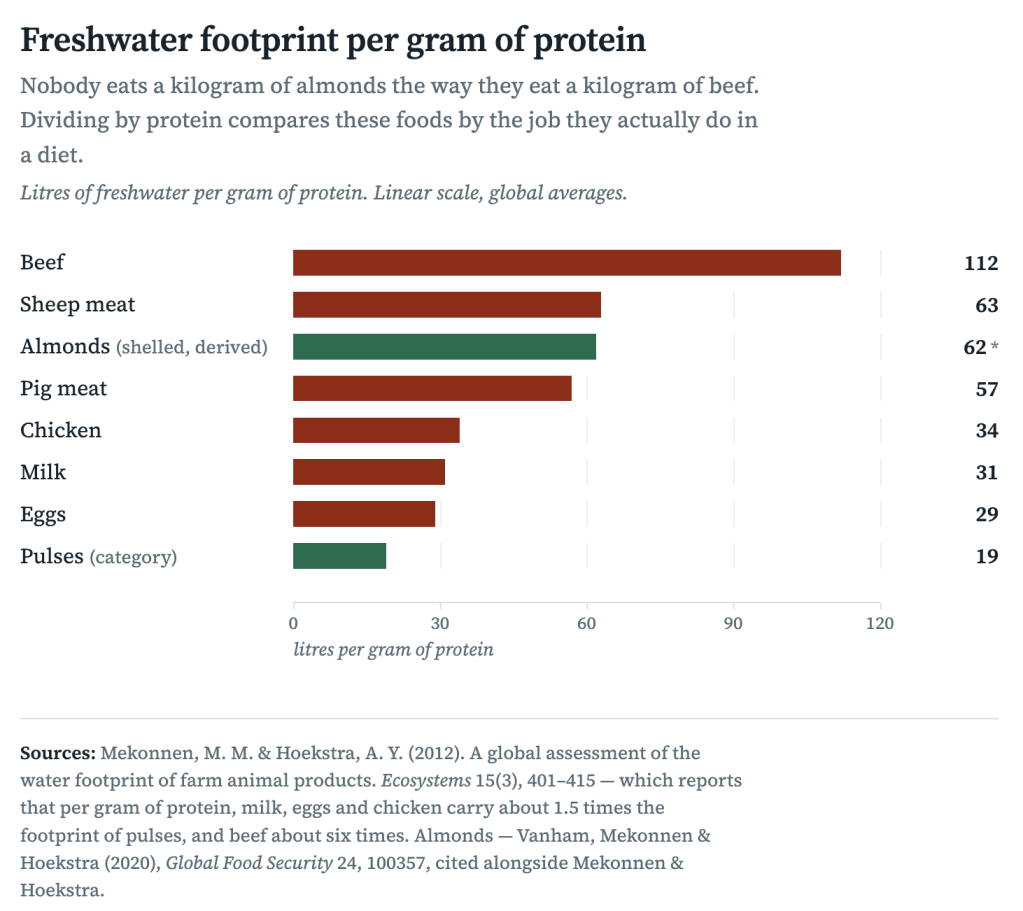
As such, per gram of protein, beef’s footprint is about six times that of pulses (legumes etc). At a time when droughts are intensifying and freshwater is becoming one of humanity’s most valuable resources, wasting it on livestock is becoming increasingly irrational and borderline suicidal.
Water should sustain people and ecosystems, not industrial animal farming.
It destroys our carbon sinks
The greatest (growing) hypocrisy is this: lots of people obsess over reducing transport emissions while defending the industry that destroys the very systems that absorb them.
I’m not saying we don’t need better transportation systems, but healthy oceans absorb about a quarter of humanity’s CO2 emissions every year already. Forests and other land ecosystems absorb close to a third. Together, they are Earth’s two largest natural carbon sinks. Maybe our focus must go to the right causes first, and it all starts with the same industry.
Then comes an even greater loss.
Mangroves, seagrass meadows and salt marshes, known as blue carbon ecosystems, store up to five times more carbon per square meter than tropical forests. Yet they’re disappearing through coastal development, agricultural pollution and increasingly severe droughts that dry out wetlands and accelerate their collapse.
Animal agriculture doesn’t only emit greenhouse gases. It replaces forests with pasture, pollutes rivers with billions of tonnes of manure, fuels green algae blooms that suffocate coastal waters and degrades wetlands that have protected our climate for thousands of years.
We’re not just adding carbon to the atmosphere, we’re destroying the planet’s ability to remove it.
The avocado argument
This is where the conversation becomes laughable.
Critics love pointing at avocados and almonds as if they’ve uncovered some fatal flaw in veganism.
It’s absurd for two reasons.
First, you don’t need to eat any of them to be vegan. Avocados and almonds are optional foods, not pillars of a plant-based diet. Lentils, beans, peas, potatoes, oats and countless other staples make the argument collapse before it even begins.
Second, even the numbers destroy the criticism.
A kilogram of beef requires around 15000 liters of water. Avocados use roughly 2000 liters. But sure, almonds are among the thirstiest plant foods on Earth at about 13000 liters, except nobody eats almonds by the kilogram.
Per gram of protein, beef still costs nearly twice as much water as almonds, and six times as much as pulses.
That said, not every animal product loses on every measure. Chicken uses less water per kilogram than lentils, and pointing that out doesn’t make a chicken farm a solution to anything.
So the comparison isn’t between perfect and imperfect.
It’s between one of the most resource-intensive plant foods and one of the most environmentally destructive foods on Earth.
Pointing at avocados while defending beef isn’t environmentalism. It’s deflection.
Stop confusing proximity with sustainability
None of this means local food has no value.
Supporting nearby farmers can strengthen rural communities, improve food resilience and reduce dependence on fragile global supply chains. Those are legitimate political and economic arguments.
Climate isn’t one of them.
If we’re serious about reducing environmental damage, the priorities are obvious:
Replace animal products with plants.
Restore forests, wetlands and mangroves.
Protect healthy oceans from pollution and overexploitation.
Move freight from roads to rail wherever possible.
Build reliable and affordable public transport.
Design walkable cities with safe cycling infrastructure.
Construct buildings that consume far less energy.
These solutions don’t compete. They reinforce one another.
The real environmental question was never how far did my food travel?
It was always what did it cost the planet to produce it?
P.S.: This essay focuses exclusively on the environmental impact of animal agriculture and carbon offsetting. The ethical question of animal wellbeing deserves its own discussion, and reducing living beings to emissions data alone misses a much deeper issue.
Schools are closing or changing schedules. Trains are slowing down. Workers are being told to adapt. Older people are urged to stay indoors. Animals are dying in barns. Rivers are warming. Nuclear power stations are struggling to cool their reactors and being closed down. Farmers are watching the sky, hoping for rain that never comes. Cities are discovering, once again, that concrete, asphalt and glass are not neutral materials. They trap heat.
Every heatwave ends the same way.
“We need to adapt.”
Of course we do. Nobody serious argues otherwise. When temperatures reach 40°C, we need shade, cool public spaces, drinking fountains, schools that do not become ovens, hospitals that can keep functioning and cooling in strategic public buildings, especially for older people, children, sick people, outdoor workers and anyone trapped in poorly designed housing.
But adaptation cannot become the polite word for surrender.
The real question is not how we survive longer heatwaves.
The real question is why we continue to organize society in ways that make them worse.
Unfortunately, that’s the conversation many people would rather avoid.
The climate crisis is not a natural disaster in the way an earthquake is. Scientists warned us for decades. Communities raised the alarm. The solutions have been available for years. Yet, governments protected fossil fuel interests. Oil and gas companies expanded production. Executives collected billions. Politicians delayed, negotiated, softened regulations, greenwashed and lied.
This was not inevitable.
It was a political and economic choice.
Now, the same system that chose fire is trying to sell us fans, bottled water, air conditioners, climate insurance, private pools, green capitalism and survival kits.
The house is burning, and someone has opened a shop in the living room.
Heat Is Only the Symptom
The mistake is thinking this is only about high temperatures.
A heatwave is a stress test for almost everything that keeps society running.
It pushes the human body beyond its limits. It kills directly, especially when nights remain hot and people cannot recover. It damages sleep, concentration, heart health and kidney function. It turns classrooms into places where children struggle to learn and workplaces into places where people struggle to work.
It pushes infrastructure to its limits. Railway tracks expand. Roads soften. Electricity grids strain under rising demand. Hospitals become overloaded.
The irony is that ACs draw more power precisely when energy systems are already under pressure. Nuclear plants need cool water, yet rivers become warmer and shallower. The same heat that increases electricity demand can make electricity harder to produce.
It pushes agriculture as well. Cows produce less milk. Chickens die in industrial sheds. Crops dry out and/or suffer damage that only becomes visible weeks or months later. Soil loses moisture. Water restrictions arrive. Harvests shrink. Food prices rise.
Then everyone acts surprised that groceries become more expensive.
The damage does not end when the thermometer falls.
That’s why surviving the next heatwave is not enough.
The Food System Nobody Wants to Discuss
Climate conversations usually focus on transport.
And transport matters. Flying less matters. Driving less whenever possible matters. The World Cup spread across North America is a perfect example of climate absurdity, an event marketed as global unity while sending teams, fans, journalists and sponsors across an entire continent for entertainment.
But another major part of the crisis rarely receives the same attention because it sits on our plates.
Animal agriculture is one of the least efficient uses of land, water, energy and living ecosystems on Earth.
Livestock occupies roughly three quarters to more than four fifths of global agricultural land, depending on how it is measured, once grazing land and crops grown for animal feed are included. Yet, animal products provide only a minority of the world’s calories and protein. One widely cited Science study found that meat, dairy, eggs and aquaculture use about 83% of farmland while supplying just 18% of calories and 37% of protein.
Read that again.
Most of the farmland.
A fraction of the food.
That is not efficiency.
It is ideology disguised as agriculture.
The system produces far more than meat, milk and eggs. It produces methane, deforestation, polluted rivers, antibiotic resistance, dead zones in coastal waters and immense pressure on land and water.
It also produces immense suffering.
During heatwaves, pigs, chickens and cows cannot simply adapt because consumers expect cheap animal products. Ventilation systems fail. Cooling systems are inadequate or absent. Transport trucks become ovens. Poultry dies by the hundreds of thousands. Dairy cows suffer severe heat stress and milk production falls.
Then the industry presents itself as another victim of climate change while helping drive the crisis in the first place.
This is not about blaming someone trying to feed their family on a tight budget.
The ocean may be the most neglected part of the climate conversation.
We rightly describe forests as the lungs of the planet. They deserve that attention. But the ocean is far more essential to life on Earth. It has absorbed more than 90% of the excess heat trapped by greenhouse gases. It takes in a large share of the carbon dioxide we emit. It produces roughly half of the oxygen we breathe, largely through microscopic phytoplankton.
The ocean is not scenery.
It’s not a backdrop for holidays.
It is one of the reasons this planet is still habitable.
There is something profoundly irrational about destroying marine ecosystems while wondering why the planet keeps overheating.
Industrial fishing is not simply the act of catching fish. It tears apart ecosystems. It removes key species from food webs, kills countless non-target animals and drags heavy nets across the seabed, destroying habitats that took decades, centuries or even millennia to develop.
Yet this rarely appears in mainstream climate debates.
We are told to fly less, and rightly so.
We are told to drive less, and rightly so.
We are only beginning to hear serious discussion about livestock.
But fishing is still treated as though fish simply appear on supermarket shelves and the ocean can absorb endless extraction without consequence.
It cannot.
If the ocean regulates climate, absorbs carbon dioxide, produces oxygen and stores enormous amounts of heat, protecting marine ecosystems is climate policy.
Eating less fish, or choosing not to eat it at all, is not only an ethical position. It is a climate position.
For those who continue to eat seafood, there is at least an important distinction to make between small-scale fisheries and industrial fleets that empty entire ecosystems.
The ocean is one of Earth’s greatest cooling systems. Protect it at all costs.
Why Air Conditioning Can’t Be the Plan
Air conditioning has an important role.
During extreme heat, it saves lives. Hospitals, schools, care homes, public libraries, emergency shelters and social housing all need effective cooling strategies. No one should die inside an apartment built for a climate that no longer exists.
But air conditioning can’t become our primary response.
Every unit cools an indoor space by releasing heat outdoors. Across an entire city, that extra heat makes streets even hotter, particularly after sunset. Air conditioners also increase electricity demand during the hottest periods of the year. Where electricity still depends on fossil fuels, emissions rise. Even cleaner grids face greater strain as peak demand grows.
Singapore illustrates both the benefits and the limits of this approach.
The city has become highly dependent on cooling. Buildings require constant air conditioning. Those systems release heat into the streets. Outdoor spaces become less comfortable, encouraging people to remain indoors, which increases demand for cooling still further.
The cycle reinforces itself.
That’s not resilience, it’s technological dependence.
We don’t need cities filled with cooled rooms.
We need cities that stay cool in the first place.
We Forgot How to Build for Nature
The most effective cooling technology has existed for millions of years.
Trees.
Not decorative saplings planted in tiny squares of concrete, but mature urban forests and healthy green canopies.
Anyone who has walked barefoot from hot pavement onto shaded grass already understands this without reading a scientific paper.
So why, every time France approaches 40°C, do we talk about buying more air conditioners before planting more trees?
Why do we pave over soil, remove mature trees, expand shopping centres, build vast parking lots and approve developments that trap heat, only to claim that more machines are the answer?
They store water, protect biodiversity, stabilise soils, reduce erosion, create humidity and lower temperatures. They make landscapes more resilient long before a heatwave arrives.
Yet even forests are increasingly treated as another industrial resource.
Living ecosystems become timber reserves. Old-growth forests become biomass. Trees are cut down, burned for energy and labelled renewable, while complex ecosystems that took centuries to develop are reduced to units of production.
The same logic appears again and again.
If something can be extracted, it is.
If something can be sold, it is.
The living world is valued less for keeping us alive than for generating another stream of profit.
Water Is Becoming Political
Water is becoming one of the defining political issues of this century.
Yet we still manage it as though nothing has changed.
During droughts, ordinary people are told to take shorter showers. Farmers are asked to reduce irrigation. Small growers are criticised for watering their crops.
Meanwhile, luxury uses fight for exemptions.
Golf courses have become symbols of this contradiction because they expose the politics behind water allocation. While vegetables struggle and ecosystems dry out, perfectly green fairways are often defended. Leisure for the comfortable can receive more protection than food production or ecosystem survival.
Mega-basins reveal the same mindset.
On paper, the idea sounds simple. Capture water in winter and use it during summer.
Reality is more complicated.
Many of these reservoirs are open to the air, increasing evaporation as temperatures rise. They can concentrate control of water in the hands of a limited number of large farms. They often allow water-intensive agricultural models to continue instead of encouraging the transition toward crops and farming systems adapted to the climate that is already arriving.
The question is not whether storing water can ever make sense.
The question is who controls it, who benefits from it and whether it helps transform agriculture or merely postpones change.
A society preparing for the future would treat every drop of freshwater as precious.
Rainwater would be collected wherever possible.
Wastewater would be safely reused.
Leaking infrastructure would be repaired.
Soils would be restored so they can retain moisture.
Cities would remove unnecessary concrete and allow water to return to the ground.
Farmers would receive support to transition toward more resilient practices.
Luxury water use would never be treated as equivalent to drinking water, food production or healthy ecosystems.
The Logic Behind the Crisis
The deeper problem is that our economic system rarely asks what keeps life alive.
It asks what can be sold.
That’s why so many climate conversations end in absurdity.
We’re told to separate our recycling while billionaires fly private jets.
We’re reminded to save water while enormous data centres consume vast amounts of electricity and freshwater to cool servers powering artificial intelligence, advertising and endless digital consumption.
We debate plastic straws while militaries burn enormous quantities of fuel, flatten cities, destroy farms, poison soil and create another wave of emissions through reconstruction.
The priorities are impossible to ignore once you see them.
The Climate Cost of War
War remains one of the largest blind spots in climate politics.
The climate impact of the war on Gaza has been estimated in the tens of millions of tonnes of carbon dioxide equivalent once direct military activity and reconstruction are included.
The opening weeks of the US-Israel war on Iran were estimated to produce several million tonnes of emissions.
Lebanon has accused Israel of ecocide following the destruction of forests, farmland and ecosystems in the south.
Yet military emissions are still treated as though they exist outside the atmosphere.
As though bombs leave no carbon footprint.
As though fighter jets fly on moral complexity.
As though hospitals, schools, roads, farms and homes rebuild themselves without steel, cement, machinery and energy.
We can’t keep pretending these emissions don’t count simply because they’re politically inconvenient.
The pattern is difficult to ignore.
Capitalism drives extraction.
Extraction fuels empire.
Empire produces war.
War destroys societies.
Destruction demands reconstruction.
Reconstruction creates more emissions.
Then we’re told that buying a bamboo toothbrush is the meaningful response.
It is not.
Personal Responsibility Matters, but It Is Not Equal
None of this means personal choices are meaningless.
They matter because they reduce demand for destructive industries, help shift culture and make political demands more credible.
But responsibility is not shared equally.
A working family struggling to pay rent is not comparable to a billionaire with private aircraft, multiple homes, yachts and investments in fossil fuels.
Someone eating the foods they were encouraged to consume from childhood is not comparable to multinational agribusinesses lobbying to protect industrial livestock.
A commuter driving because public transport is inadequate is not comparable to governments that refuse to invest in reliable trains, cycling infrastructure and walkable cities.
The message can’t be that ordinary people are the problem.
The message is that we live inside a system designed to make destructive choices easy, profitable and normal while making better choices more expensive, less accessible or socially unusual.
Recognising that distinction is not about avoiding responsibility.
It is the first step toward directing responsibility where it belongs.
What We Can Do
None of this means waiting for someone else to act.
Some of the simplest changes are still among the most effective.
Eat less meat, or stop eating it.
Eat less fish, or stop eating it. If you choose to keep eating fish, understand the difference between small-scale fisheries and industrial fleets that empty entire ecosystems.
Buy fewer clothes. Buy second hand. Repair what you own. Stop treating fashion as a weekly identity update.
Do the same with appliances. Borrow, share, repair and buy used whenever possible.
Build a culture where tools, equipment, transport and household goods are shared instead of endlessly duplicated.
Fly less.
Drive less whenever practical.
Support political parties and movements that take climate change, biodiversity, animal welfare, water management, public services and peace seriously. Voting alone will not solve the crisis, but electing governments that deny climate science, protect fossil fuel interests and normalise war will accelerate it.
Above all, reject fake solutions.
A city with air conditioning but no trees is not prepared.
A country with mega-basins but dying soils is not prepared.
A food system built on industrial animal suffering is not prepared.
A sporting culture that flies millions of people across continents for profit is not prepared.
A digital economy that consumes ever more electricity and water in pursuit of endless growth is not prepared.
A world that treats war as ordinary is not prepared.
France is not ready for what’s coming, and that pains me.
Europe and America aren’t ready either.
The Crisis Behind the Crisis
The tragedy is that even by the narrow standards of economic growth, this system is failing.
Heat kills workers.
It reduces productivity.
It damages harvests.
It weakens infrastructure.
It raises healthcare costs.
It disrupts schools.
It destabilises insurance.
It pushes food prices higher.
It forces governments to spend billions (of our money) responding to disasters they chose not to prevent.
Even someone who cares nothing for animals, forests, rivers, oceans or social justice should recognise one simple reality.
This model is becoming too expensive to sustain itself.
The climate crisis is not only an ecological crisis.
It is a crisis of imagination.
We keep trying to preserve the lifestyle that created the emergency, then call that realism.
But there is nothing realistic about filling unliveable cities with more air conditioners while cutting down trees.
There is nothing realistic about building reservoirs while refusing to transform agriculture.
There is nothing realistic about defending industrial livestock, industrial fishing, fossil fuels, permanent war and luxury consumption while asking ordinary people to adapt.
Realism begins by accepting that an economy built on endless extraction can’t produce a liveable planet.
We don’t need a parasasol over the apocalypse.
We need accountability.
We need to recognise that climate is not a separate issue. It runs through everything.
Our cities.
Our countryside.
Our food.
Our transport.
Our water.
Our forests.
Our oceans.
Our economies.
Our wars.
Not because that sounds radical.
Because the moderate path has become the one driving the crisis.
The planet is not burning because we failed to understand what was happening.
It’s burning because those with the power to change course chose not to.
That choice can still be reversed.
But only if we stop confusing adaptation with acceptance and start confronting the system that keeps choosing fire.
AI tools have made an already bad situation worse.
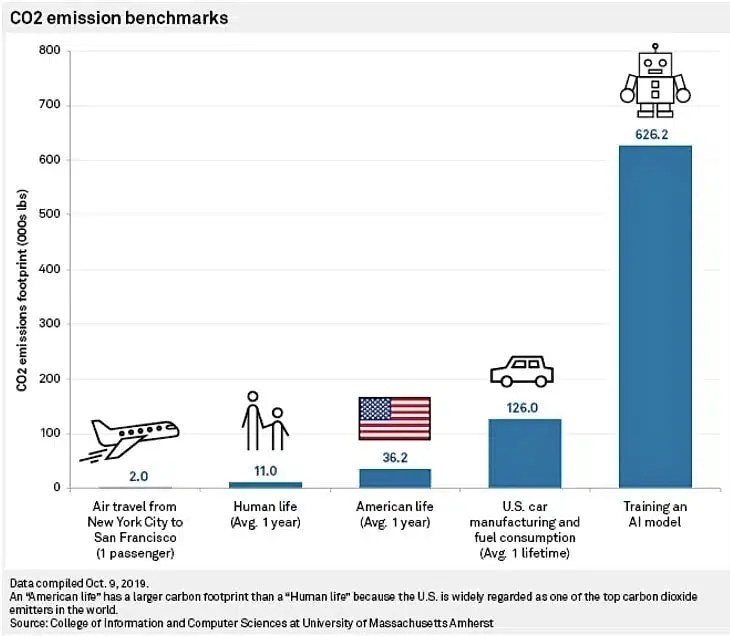
Every time you touch an AI tool, whether you’re making images or words, you’re feeding a machine that drinks real water and eats real power. Not in theory. Literally. There’s no harmless cloud floating above us. There are data centers on the ground, towers pulling heat out, plants burning fuel, all so content can come out faster while the bill gets paid somewhere else.
Think of it this way. One text request to a large AI model uses roughly the same amount of water as a few mouthfuls from a soda can. That sounds small until you remember these systems handle billions of requests a day! At that scale, we’re not talking about sips. We’re talking about entire truckloads of bottled drinks being poured straight down the drain, every single day, just to keep servers cool.
Generating a single AI image uses several times more energy than a text request. One article with five or six AI images might be using the equivalent electricity of leaving a laptop running for hours. Multiply that by thousands of articles, social posts, newsletters and ads, and suddenly it’s not trivial at all.
Zoom out a little more and the picture gets uglier. AI-related data centers are already using as much electricity as mid-sized cities. Estimates put global AI power demand on track to rival places like San Francisco or Boston within a few years. That’s millions of homes worth of electricity being burned so companies can automate writing, art and video at scale. AI doesn’t just steal jobs, it steals our resources.
Now stack dozens of these facilities across drought-prone states and you start to see why people are angry.
And they are angry.
Lately, I’ve seen organizers in Arizona, Pennsylvania and Georgia mobilize against new data center construction. Nobody wants these things in their communities. They strain power grids, drain water supplies and mostly benefit companies that don’t live there (don’t they always?). Luckily, these fights seem to be working. Projects are being delayed, while others are being stopped altogether. We can and will win against these tech oligarchs, but first, we need to be smart about our usage.
This is why it’s so frustrating to see articles about resistance, climate justice or helping nature paired with AI-written images. You can’t talk about fighting extraction while actively participating in it. You can’t warn about corporate overreach while relying on the most opaque, resource-hungry tech industry on the planet.
And it’s not just images. AI-written articles, AI-edited videos, AI voiceovers, all of it runs on the same infrastructure. Longer outputs mean more compute. Videos are especially brutal, far more than text or AI generated images. That one slick AI video you just posted (or liked) could represent the electricity use of a household for days. Yes, dayzz!
The worst part is how little transparency there is. AI companies won’t clearly say how much water or energy a specific model or request uses. Communities are asked to trust them, just like users are. Meanwhile the meters keep spinning.
Just to be clear, I’m not saying we need to go off-grid or stop using technology entirely, but we should start making conscious choices. Take your own photos. Use art made by real people. Scan a drawing, even a bad one. Use stock photos from photographers who actually went outside and did the work. Write things yourself or don’t write at all!
If you’re serious about resistance, about protecting nature, about fighting back against corporate power, your tools matter. Using AI by default, especially for images and media, actively undermines your message. People feel that contradiction, even if they don’t always have the numbers to explain it.
Climate change has become one of the most polarizing topics of our time.
Depending on who you ask, it’s either the greatest challenge humanity has ever faced or a problem that’s been exaggerated beyond recognition. Politicians argue about it. Television debates it. Social media turns it into another battleground.
But what if we stepped away from all of that for a moment?
What if, instead of asking what politicians, journalists or commentators think, we simply looked around us?
Sometimes, reality speaks for itself.
Over the past few years, I’ve watched rivers shrink, forests burn and heatwaves become increasingly common in places where they once felt exceptional. Friends living in different parts of the world tell similar stories. Farmers talk about unpredictable seasons. Water restrictions have become more frequent. Wildfires have intensified across multiple continents.
You don’t have to agree with every headline to notice that something is changing.
You don’t have to trust every report to observe what’s happening around you.
Talk to older relatives.
Talk to people who work the land.
Talk to fishermen, hikers or anyone who spends significant time outdoors.
Ask them whether the seasons still feel the same as they did twenty or thirty years ago.
Whether you trust politicians, journalists or climate scientists isn’t actually the point I’m making.
Reality exists independently of who reports it.
Climate change doesn’t care whether we’re conservative or progressive, religious or secular, rich or poor.
The atmosphere doesn’t vote.
Nature doesn’t negotiate.
The real question isn’t whether the climate is changing.
It’s how we choose to respond.
For me, the answer has less to do with waiting for revolutionary technologies than with rethinking the way we live.
We consume far more than we need.
We replace products that still work.
We normalize waste.
We chase convenience even when it comes at a tremendous environmental cost.
Modern consumerism has taught us that happiness comes from buying more.
The planet is telling us otherwise.
That doesn’t mean giving up comfort or returning to life centuries ago.
It means consuming more intentionally.
Buying fewer but better things.
Repairing instead of replacing.
Walking when we can.
Using public transportation more often.
Supporting companies that take sustainability seriously.
Reducing food waste.
Sharing resources instead of duplicating them.
Holding companies like banks accountable.
Many of these habits don’t just reduce our environmental impact.
They also save money, reduce stress and improve our quality of life.
That’s one of the reasons I was drawn to minimalism in the first place.
The same choices that help us live with less clutter often happen to be the same choices that place less strain on the planet.
Perhaps that isn’t a coincidence.
Maybe we’ve spent so long looking for complicated solutions that we’ve overlooked the simple ones.
Throughout history, humanity has repeatedly adapted to new challenges.