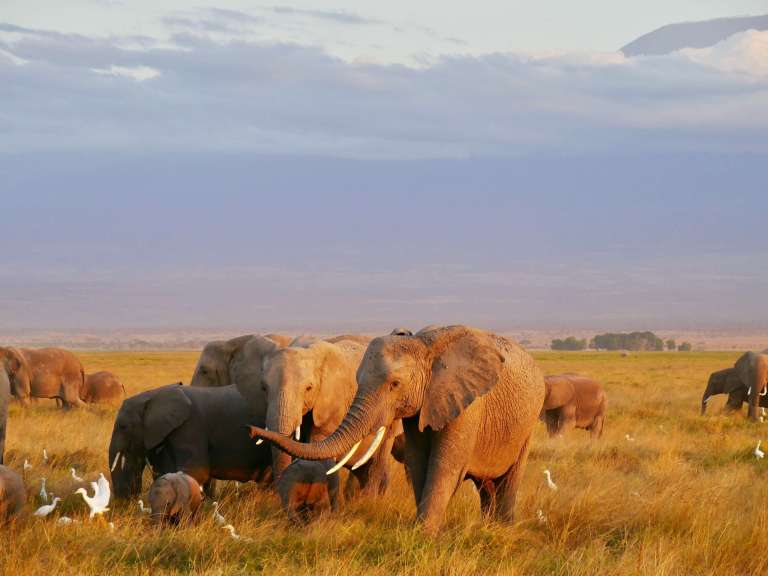
In 2017, sixteen women walked into the Zimbabwean bush to stop poachers.
Some had survived domestic violence.
Some had survived sexual assault.
Some were raising children alone, with almost nothing.
Nobody had ever trusted them with anything worth protecting.
Now they were protecting elephants.
They became Akashinga. In Shona, the brave ones.
National Geographic followed them as they trained, patrolled and confronted the people killing wildlife for profit.
Akashinga was founded by Damien Mander, a former Australian special forces soldier. He recruited women from poor rural communities and gave them training, a salary and a role in protecting the land they grew up on.
That last part matters.
Conservation loves a story in which wildlife only became valuable once outsiders arrived to protect it.
Zimbabwe never needed that lesson.
Shona communities lived by totems, ancestral beliefs and customary rules that governed which animals could be hunted and which resources could be taken. Nature wasn’t a wilderness behind a fence. It was law, family and memory.
What changed wasn’t how much people valued wildlife.
It was who got to decide what happened to it.
Akashinga puts local women on the front line. For decades, conservation treated the communities living beside parks as the problem to keep out.
Now those communities are the ones keeping watch.
The program also breaks the idea that conservation is something wealthy Westerners do on vacation.
And there’s one more detail that’s easy to skim past.
The rangers eat a plant-based diet.
They patrol the bush and face down poachers on it.
Mander himself is vegan.
So much for plant-based food being a soft, urban luxury for people with yoga mats and oat milk.
That detail brings me to the question I can’t put down.
We fly across continents to see elephants.
We donate to save them.
We mourn when they’re killed.
Then we grill a pig and call it Sunday.
Why?
Not because we’ve weighed what each animal does for the planet.
Even people who share their land with elephants think this way. In northeast India, tea-estate communities support elephant conservation out of cultural reverence and a belief in the animal’s right to exist, not for anything it does for the ecosystem.
And we eat the animals we were raised to eat. When people defend meat, nearly every justification falls into four buckets: natural, normal, necessary and nice.
Tradition and taste, dressed up as reasons.
None of them has anything to say about a pig’s suffering.
We inherit categories. Companion. Food. Sacred. Pest. Every culture draws those lines differently, and every culture believes its own lines are obvious.
Then the food system finishes the job. By the time a pig reaches the supermarket shelf, there’s no pig left. Just a product, packaged so nobody has to wonder where it came from.
Familiarity isn’t an argument.
And the contradiction isn’t only moral.
Livestock and the crops grown to feed them swallow enormous amounts of land. Cattle ranching is the biggest driver of deforestation in the Amazon. Globally, livestock produce a sixth of humanity’s greenhouse gas emissions.
So we pay rangers to defend wildlife while our plates finance the destruction of the places wildlife lives.
Yes, subsidies, trade rules and corporations shape the system far more than any single shopper.
That’s a reason to demand better policy.
It’s not an excuse to eat as if nothing is connected.
I wrote recently that conservation is usually the bill we pay after treating the natural world like a warehouse.
This is the same bill.
We just pay it at dinner.
I can’t think about any of this without thinking about Islam.
It gives me three words for our place in creation.
Khalifah, or stewardship.
Amanah, or trust.
Mizan, or balance.
None of them mean ownership. Power over other creatures isn’t a license. It’s a debt.
The Quran permits eating certain animals. It doesn’t command veganism, and I won’t pretend it does.
But permission isn’t obligation.
Halal tells us what we’re allowed to eat.
Tayyib asks whether it’s good. Pure. Wholesome.
Was the animal raised, killed and brought to our table in a way we could defend?
Most of us stop at the first question.
I can’t stop at the second.
If I’m a steward, that animal’s safety was entrusted to me.
So the real question isn’t whether I’m allowed to eat it.
It’s whether I should cowardly pay someone else to kill an innocent, sentient being I’m meant to protect, when my plate has countless options that don’t require a death.
For me, the answer is obviously no.
That’s where faith stops being a rulebook and becomes a conscience.
The women of Akashinga know what it means to live at the mercy of someone stronger.
Today, they stand between the strong and the defenseless.
They protect elephants from people who look at a living animal and see only what it’s worth to them.
An animal’s right to live shouldn’t depend on its cuteness.
Every year, rats in Paris are estimated to consume around 850 metric tons of waste. That’s roughly 2.3 metric tons a day. Think about that for a second. Without rats eating that waste, we’d have even more garbage to collect from our streets, more work for sanitation workers and more waste ending up in landfills.
We throw food away, rats eat some of it, and then we poison them for being there.
In cities around the world, rats are killed with poison or caught on glue boards, where they struggle for hours before dying of exhaustion, dehydration or injury. If we inflicted the same suffering on a cat or a dog, we’d call it cruelty. When the victim is a rat, we call it “pest control”.
Why should the species determine whether a death is acceptable?
For centuries, rats have been cast as villains in the story of the plague. The connection between rodents, fleas and plague is real, but the history is more complicated than the familiar account suggests. A 2018 study published in PNAS found that human fleas and body lice could explain the spread of several major European plague epidemics better than rat fleas could. The findings challenge the story we’ve told about them for generations.
Rats are also far more complex than their reputation suggests. They groom themselves, play, learn and form social relationships. In a 2011 experiment published in Science, researchers found that rats learned to release trapped companions, sometimes freeing them before accessing chocolate and later sharing it. The researchers interpreted their findings as evidence of prosocial behavior consistent with empathy-like motivation.
We can’t know whether rats experience empathy exactly as we do. But imagine if they had soft faces, expressive eyes and a reputation for loyalty. Would we describe their behavior differently? We celebrate a dog comforting another dog. A rat helping a companion rarely enters our collective imagination.
That said, a rat shouldn’t have to prove its intelligence, demonstrate affection or resemble us to earn the right to live.
The same problem appears whenever wildlife conflicts with human interests. A wild boar destroys a field. A fox takes poultry. A deer eats young shoots. The damage can be real, and farmers have every right to protect their livelihoods. But we rarely ask how much of the conflict stems from the way we’ve transformed the land around us.
We clear forests, fragment habitats, build roads and expand farms. Wildlife loses places to live and sources of food. When animals enter our fields and settlements to survive, we treat their presence as an offense. We claim the land, draw the boundaries and expect other species to adapt. When they do, we punish them for it.
I’m not saying people shouldn’t have to accept every loss or leave their homes and crops unprotected. What I’m saying is that we can secure food and waste, use non-lethal deterrents and find ways to coexist without killing the animals whose presence inconveniences us. Too often, killing is treated as the obvious answer before other approaches have been seriously considered.
A glue board doesn’t become humane because the animal caught on it is a rat. Poison doesn’t become less cruel because its victim is a fox. A deer doesn’t become incapable of suffering because someone has decided there are too many of them (there aren’t). Words like culling, population management and pest control may describe what we’re doing, but they don’t change what happens to the animal.
I don’t believe an animal should have to die because it damages our property, threatens our crops or costs us money. Protecting a livelihood is not the same as defending a life. If an animal poses an immediate threat to our safety, self-defense is another matter. But a damaged field, a raided bin or a fox in a chicken coop isn’t an attack on us.
We shouldn’t confuse the loss of something we own with a threat to our lives, then make another living being pay for the difference.
We’ve built a world in which our needs are treated as facts and other animals’ needs as problems. A rat looks for food, a fox seeks shelter and a boar wanders into a field. We see damage, infestation and a population to control. The animals are trying to survive in a world we’ve reshaped around ourselves.
The question isn’t whether rats are lovable. It’s whether an animal’s right to live should depend on how well it fits into the world we’ve claimed for ourselves.
We keep asking what these animals cost us. Perhaps it’s time to ask what we’re willing to make them pay.
A few years back I interviewed an architect for my podcast. He spent an hour on something that should be obvious and somehow isn’t anymore, a building can heat and cool itself just by facing the right way.
I haven’t stopped thinking about it since.
We build homes that ignore where the sun rises, block the wind, and wrap them in glass that lets the sun in all day with no way to let the heat back out. Then we spend fifty years paying to undo it. Air conditioning in summer and heating in winter have both become so normal we forgot they’re solving a problem the building created for itself.
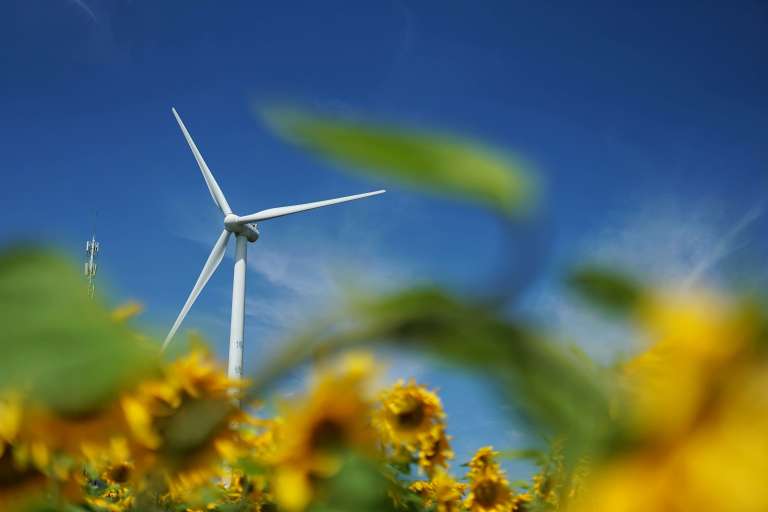
That energy has to come from somewhere, coal, gas, nuclear. Nuclear seemed like the cleanest way to produce electricity until the heatwaves started warming the rivers it depends on. For instance, in 2026 France, plants have had to cut output during heatwaves because the rivers that cool their reactors got too warm to do the job.
Grids buckle under demand spikes exactly when everyone switches their AC on at once. The machine we built to save us from bad design turns out to have its own limits too, and those limits are only going to show up more often as summers get worse.
None of this is abstract for the people paying for it. In Albi, a 36 year old named Pauline Paredes described her own apartment as a kettle after weeks of 40 degree heat, and said flatly she has to be out of it before next summer. She’s one of hundreds of people a French outlet interviewed this year alone about heat pushing them out of their own homes.
A geographer in Lyon estimates around 100 000 people already leave French cities every year for the outskirts and the countryside because of it, and expects that number to double as the heatwaves keep stacking up. Winter runs the same script in reverse. More than five million French households live in fuel poverty, a third of the country couldn’t properly heat their home this past winter, and three out of four households are now rationing their own heating just to keep the bill payable.
None of this is a footnote to a design conversation. It’s what happens when a building depends entirely on a machine, and the machine gets too expensive to run or the grid buckles at the exact moment everyone needs it most.
Passive solar design isn’t futuristic. It’s ancient. For most of human history, people built with the climate instead of against it. Thick walls, shaded courtyards, windows placed on purpose, trees that dropped their leaves right when you needed the sun back. None of that was decoration. It was adaptation and survival.
We gave that up the moment cheap energy got easier than good design.
The shift has a start date. In 1952, the United Nations Secretariat went up in Manhattan as the first tower wrapped entirely in glass and cooled entirely by machine. This building, like the ones that followed, wasn’t designed around the sun. It was designed to look like the future, and cheap postwar energy is the only reason it got away with it. Every glass tower built since has copied that template. Offices cooled that way now run about 60% higher in carbon emissions than ones that use natural or mechanical ventilation properly.
We didn’t inherit bad buildings. We inherited a look, and we’re still paying the electric bill for it.
Every architect knows where the sun rises and sets. And yet, somehow most buildings are still designed like it doesn’t matter.
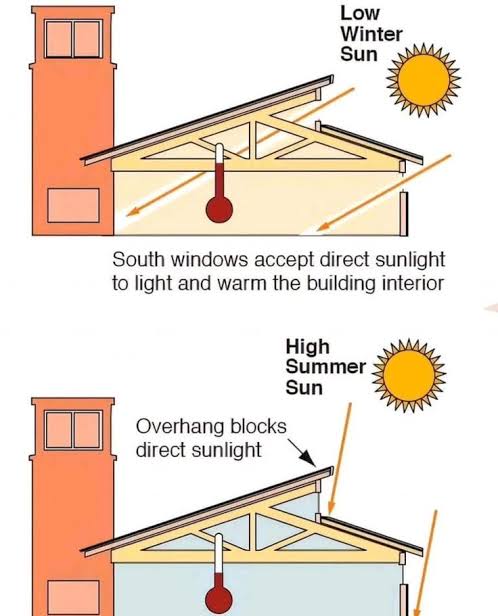
For instance, in the northern hemisphere, your longest wall generally wants to face south. That one decision decides how much free heat you get in winter and how easily you can block it in summer, before a single brick goes down.
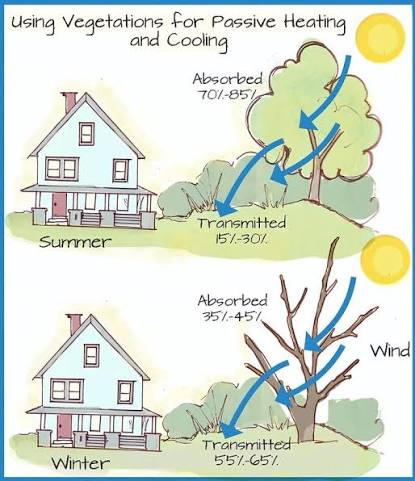
In winter the sun sits low. It travels under the roof overhang and warms the floor and the walls, which quietly hold onto that heat all day.
Six months later, the same window behaves completely differently. The summer sun sits high, the same overhang blocks it, the room stays bright without turning into an oven. Nothing moved. Nothing plugged in. The only technology was geometry.
Get the geometry wrong and it stops being merely inefficient. London’s famous 20 Fenchurch Street tower, nicknamed the Walkie Talkie, curves its south face inward like a satellite dish. In 2013, that curve did exactly what a concave mirror does, it focused the sun into a single point on the street below. The hot spot passed 90 degrees Celsius. It melted panels on a parked car, warped a bike saddle, and set a doormat on fire outside a barbershop. The developers ended up bolting a permanent sunshade onto the building afterward, aluminum fins running from the 3rd floor to the 34th, a fix that cost low single digit millions of pounds because nobody modeled where the sun would actually land before they built it.
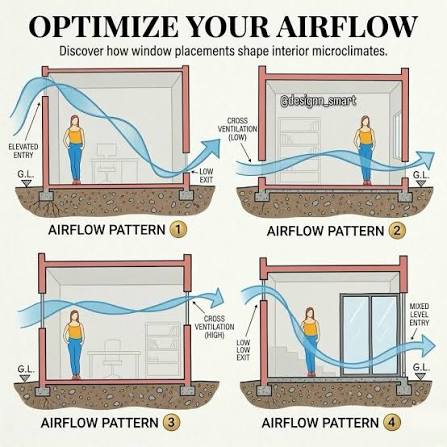
Cooling didn’t start with a compressor. It started with a window across from another window. Cross ventilation works on one idea, put openings on opposite sides of a space so air has somewhere to go. Wind comes in one side, pushes the stale heat out the other, and the building breathes on its own.
Older buildings understood this without needing to be told. Doors lined up with courtyards. Vents sat high to let hot air escape. Floor plans stayed narrow so every room caught moving air. A lot of modern apartments do the opposite, one glass wall and nowhere for heat to go. So we swap airflow for machinery and act surprised when cities burn through electricity every summer.
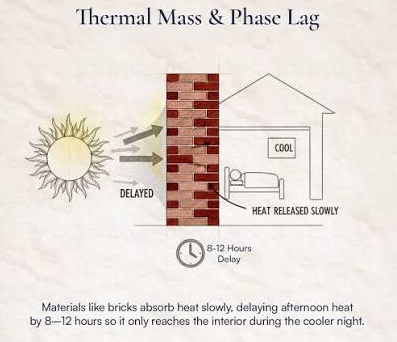
And the comes in “thermal mass”, which sounds technical but isn’t. It’s closer to cooking. A cast iron pan stays hot long after it leaves the stove because it holds heat. Stone, adobe, brick, and concrete do the same job inside a building, soaking up warmth slowly, holding onto it for hours, letting it go once the temperature drops.
That’s why old stone houses stay cool through a scorching afternoon. The walls delay the heat instead of handing it straight to the room, and once the evening air cools, that stored warmth finally lets go. A light building reacts to the weather. A heavy one negotiates with it. The difference is a few degrees you never had to pay for.
Somewhere along the way we split architecture from the landscape around it. That was the mistake. A mature deciduous tree is one of the oldest climate technologies we have. In summer its leaves catch the sun before it reaches your roof. In winter those same leaves drop and let the light back in, right when you need it.
Compare that to a parking lot, which soaks up heat all day and radiates it back into the block long after dark. Trees do the opposite, they cool the air around them while they’re at it. During a heatwave, tree canopy runs 8 to 12 degrees Celsius cooler than bare pavement, and a shaded sidewalk can feel up to 14 degrees cooler than one with nothing overhead. We keep shopping for smarter cooling systems while we cut down the oldest one.
None of this needs a backyard. A fifteen story block can face the right way and breathe on two sides just like a bungalow can, the physics doesn’t care how many units are stacked on it. Sprawl is the real opposite of passive design, not density, since sprawl is the one typology that only works with a car in the driveway and a compressor on the wall.
Food for thought
People ask if insulation is the most important feature of an efficient building. Insulation matters, but it comes after the fundamentals. A well designed passive building stacks orientation, shading, ventilation, thermal mass, and insulation into one system where each part is quietly doing the others’ job too.
Orientation catches the winter light. Overhangs block the summer sun. Trees add seasonal shade. Windows catch the wind. Walls bank the day’s heat. Insulation keeps all of it from leaking back out. None of this is new. It’s just been sitting there unused for about a century.
Climate change keeps exposing how badly we build. Our answer is always the same, a bigger unit, a stronger system, more electricity. We rarely ask if the building was ever designed with any of this in mind to begin with. Passive design offers something else, comfort you get from understanding a place instead of comfort you buy every month. Latitude, wind, trees, sunlight, seasons.
A building shouldn’t have to fight the place it’s standing in every single day, and for most of human history none of them did. Architecture was an extension of the land before it became a product line.
Pauline Paredes shouldn’t have to leave Albi to stop living in a kettle. The five million households rationing their own heat this winter shouldn’t have to choose between warmth and the electric bill. None of that is the weather’s fault alone. It’s the bill for a hundred years of buildings that were never asked to do their share of the work.
The most sustainable energy was never going to be the one we invent next. It was always the one we stopped needing the day we designed the building right the first time. We just built our way out of remembering that, one glass tower at a time.
The tourist didn’t design the system that made travel a substitute for a life worth living.
A new form of environmental propaganda has quietly become mainstream.
Every week, another headline appears telling ordinary people they are responsible for climate change, then hands down the same list of penances. Drive less. Fly less. Stop buying this. Stop enjoying that. Recently, Le Monde highlighted that tourism accounts for around 9% of global CO2 emissions.
The number itself bothers me. It’s huge, and mass tourism is something I have no patience for.
The framing bothered me even more.
Once again, the spotlight was placed on ordinary people instead of the system that shapes almost every decision they make.
It’s becoming increasingly common to hear the same message.
You’re responsible.
You’re the polluter.
You’re destroying the planet.
Study. Work. Pay your bills. Repeat. But if you finally manage to save enough money for a vacation, you’re suddenly made to feel guilty for that too.
That is not environmentalism.
That is misdirection.
Anyone who reads my essays knows I take my environmental footprint seriously. The choices behind that, the minimalism, going vegan, the way I get around, weren’t picked up to look good or fit in. They came out of years of reflection.
I’ve been a minimalist for nearly a decade because endless consumption makes neither people nor the planet happier.
I’m vegan because I care about animals. I also recognize the immense environmental cost of industrial animal agriculture, from habitat destruction to food waste and greenhouse gas emissions.
I buy second hand exclusively and repair things before replacing them. I don’t buy new clothes. I’d rather walk or take public transportation than drive, and I’d rather borrow or share something than own it outright, because half the stuff we buy individually just sits there waiting to be used once a year. I’ve taken a nine hour bus instead of a forty five minute flight to the same destination, more than once, because the extra hours felt like a small price for the difference in footprint. I believe we should leave this world better than we found it.
None of that makes me exceptional. It just means I got lucky, or stubborn, enough to question habits most people never get the chance to question, because those habits get taught before we’re old enough to notice them.
Unlike wild animals, humans cannot realistically leave no trace at all. We build, consume, and transform our surroundings. But we can choose to leave as little trace as possible.
That responsibility matters.
What I reject is the idea that environmental collapse is primarily the consequence of millions of individuals making bad personal choices, as if those choices appeared out of nowhere.
They didn’t.
We’re born into a world that treats consumption as the default. Questioning it comes later, if at all, because most people spend their lives just trying to survive rent, survive the cost of food and shelter. Then, once that survival eases up even a little, we try to make up for lost time. We overconsume to compensate for what we never had, the same way anyone leaving poverty tends to, emulating the people who always had the means. “Treat yourself. You earned it. You worked hard for it.”
Individualism finishes the job from there. Look after your own happiness first, leave everyone else’s problems to someone else. That isn’t a flaw people are born with. It’s a job someone trained us for.
So yes, individuals are responsible for what they do. But the system is responsible for how most individuals were shaped to behave in the first place, and pretending otherwise lets the actual architects of the mess off the hook.
The system was built so individuals would fit inside it, and it worked well enough that the individual is now a piece of the machine that keeps breaking us. That’s what makes escape so hard. It isn’t one bad law or one greedy company standing in the way. It’s advertising, employers, housing, food systems, culture, and habit all pulling the same direction at once, thousands of small parts that don’t need to coordinate because they all reward the same behavior. No amount of individual willpower gets the masses out of a system built from that many interlocking pieces. You can opt out personally. The system barely notices.
Now, does tourism have environmental impacts?
Absolutely.
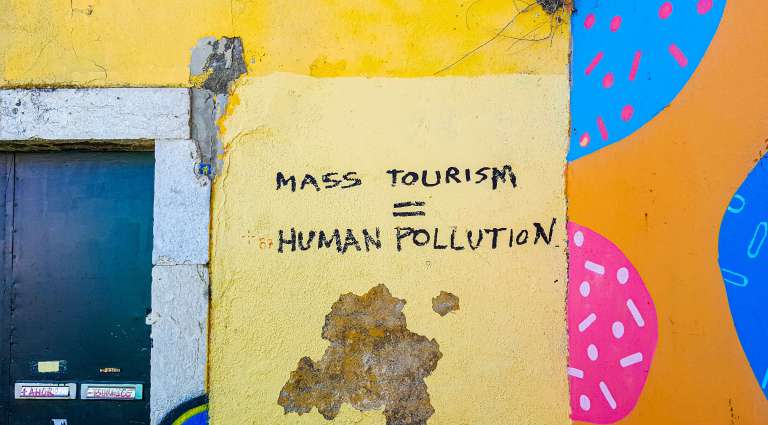
Mass tourism damages ecosystems. It strains local infrastructure. It raises housing prices. It pollutes coastlines. It turns historic neighborhoods into amusement parks. Entire cities are transformed into products designed for visitors instead of homes for residents.
These are real problems.
But they’re not caused by tourists wanting to see the world. They’re caused by an industry that’s turned that desire into something to sell as much of as possible, to as many people as possible, regardless of what the planet or the destination can absorb.
That distinction matters.
And here’s the part that should actually worry us. Right now, only a small share of the world’s population can afford to travel the way tourism gets discussed in Le Monde or anywhere else. If everyone on earth consumed the way the average French person does, we’d need close to three planets to sustain it. Live like the average American and the number climbs higher still.
The uncomfortable truth is that the planet is only holding together because most of humanity is still too poor to consume like the wealthy world does. As more of that population gets richer, and some of it will, that 9% doesn’t stay at 9%. It grows, the same way every other consumption metric grows when purchasing power spreads. We’re not looking at a stable number. We’re looking at a preview.
I also have for a long time questioned whether much of what we call tourism today is even about travel anymore. My work attests to that.
For many people, traveling is just another form of consumption.
They fly somewhere, stay in the same spots, eat at the same chain restaurants, shop in the same luxury stores, and return home with thousands of photos that exist mainly to prove they were there.
The destination changes.
The lifestyle doesn’t.
Social media has accelerated this transformation. Many destinations are no longer visited because they offer something meaningful. They’re visited because their images perform well online.
Travel becomes content.
Experiences become status symbols.
Places become backdrops.
This isn’t the industry malfunctioning. It’s the industry working exactly as designed. Travel companies exist to grow. Growth means selling more trips to more people more often, and the easiest way to do that is to sell travel as a reward, a treat, a thing you’ve earned and deserve, the same script used to sell everything else. Advertise the escape, not the destination. Call it self care. Call it living your best life. The vacation guilt the headlines produce and the vacation obsession the industry produces come from the same machine. One hand points the finger, the other hand keeps the conveyor belt running.
I think it reflects something much deeper than the shallowness of the masses.
Many people feel disconnected from their work, their communities, and even themselves. Life often revolves around earning enough money to repeat the same routine next week. Under these conditions, vacations become less about discovery and more about escape.
People aren’t always searching for another country.
They’re searching for relief.
Give people meaningful work. Give them stronger communities. Give them time with family. Give them parks, culture, nature, and purpose close to home.
Many would feel far less pressure to chase an escape valve on the other side of the planet every summer.
There will always be genuine explorers.
Some people are naturally driven to understand different cultures, ecosystems, languages, and ways of living. They travel to learn, to question their assumptions, and to return home with ideas worth sharing.
I’d guess that’s a minority. Watch how travel actually gets consumed, the itineraries, the photo spots, the same five restaurants recommended to everyone, and it’s hard to conclude that curiosity is the main thing driving most of it.
Historically, travel served the purpose of learning through exploration rather than consumption. People left home to study, exchange knowledge, observe other societies, and bring back innovations that improved their own communities.
Travel wasn’t simply about extracting something from a place.
It was about growing through them.
Today, too much tourism encourages the opposite. It treats landscapes the way it treats products, something to use up and move on from. It’s also flattening a diverse world into sameness.
That isn’t a failure of human nature.
It’s a predictable outcome of an economic system that turns everything into something to be bought and sold.
So yes, I oppose mass tourism. I absolutely do.
I oppose cruise ships that poison the oceans they sail through before dumping their waste in port cities and leaving.
I oppose short weekend flights taken simply because they’re cheap.
I oppose cities being redesigned for visitors while residents are priced out.
I oppose zoos and circuses that trade animal suffering for entertainment.
I oppose beachfront developments that sell the view and never mention what it cost to build.
I even oppose ecotourism, most of the time it’s just greenwashed tourism for the rich, another way to price out ordinary people while the outcome stays the same.
None of that makes the tourist the offender. An industry built to sell escape, and paid handsomely for doing it, is the one that turned a personal desire into an ecological liability.
The system is the culprit.
The environmental crisis will not be solved by making people feel guilty for taking a vacation. Most don’t even care.
It starts with education, teaching people to question the conditioning instead of just living inside it.
From there, it will be solved by degrowth. Not for the nation building its first hospitals or its first clean water system, that’s need. Degrowth is for the societies that already have what they need and keep manufacturing new needs anyway, the Emirates building another amusement park in the desert, Nevada building another casino with a golf course attached. One is need. The other is appetite dressed up as progress.
We already own enough clothes to dress the world for generations. The pile sitting in circulation right now would outlast most of us several times over, yet the fashion industry keeps manufacturing seasonal trends to convince us otherwise. That’s the target. That’s where degrowth should appear.
Less consumerism. Less unnecessary work. Eating plant based, living with less, minimalism as a norm rather than a lifestyle choice for the few. More shared economy and less of the individualism that trains us to treat our own comfort as the only thing worth protecting.
Degrowth looks like communities that function without a car and a credit card for every errand, hobbies that give something back instead of costing something, planting trees and cleaning rivers instead of shopping malls and card tables in casinos.
It looks like people who no longer need two weeks a year on the other side of the planet to remember they’re alive, because the other fifty weeks stopped feeling like a sentence.
Until we are willing to confront that reality, the headlines will keep telling you to fly less while the industry keeps telling you to fly more, and both of them profit from you never noticing it’s the same voice. Guilt won’t shrink a system built to keep expanding. Only pulling its foundations out will.
That’s the trip actually worth taking. And unlike the one on the brochure, nobody’s selling it to you.
On the plants, poisons and people who turn the jungle into a pharmacy, a grocery store and a home
I didn’t realize how little I knew about the forest until our guide started pointing things out.
Our trek through Taman Negara, near Kuala Tahan, covered around 8 kilometers. We started at 10 in the morning and got back around 5pm, with a break at Teras Waterfall before the boat ride back to town.
The trail demanded attention from beginning to end. Mud, wet rocks, exposed roots and shallow streams meant every step had to be placed carefully, and in several spots ropes were fixed to the hillside to help hikers climb or descend slippery slopes. Waterproof hiking shoes with good grip aren’t optional here. They’re the difference between enjoying the trek and spending the day sliding through the mud, if not something worse.
But the distance and the terrain weren’t what made the hike memorable. It was realizing that most ordinary-looking plants are much more than they let on. By the end of the day, I wasn’t seeing trees and bushes anymore. I was seeing functions.
Our guide walked us through plant after plant, and one stuck with me more than the rest. It was used to treat snake bites. When cut open, it’s applied directly to the wound. According to the guide, the inside of the plant would turn yellow as it absorbed the venom, and fresh pieces were applied until the inside stayed white, which is believed to mean no venom is left. Whether or not modern medicine backs that up, it’s a testament to thousands of years of people experimenting with what grows around them.
Other plants did other jobs. One relieved asthma. Another became shampoo, soap and mosquito repellent all at once. I didn’t catch its name, but all it took was rubbing a few leaves together with water before a rich, citrus-scented foam appeared in the guide’s hands. It smelled better than most commercial soaps I’ve used.
The forest also supplies drinking water. Those thick vines made famous by Tarzan actually hold water inside them, and so does bamboo. In a place where rivers aren’t always close, knowing which plants can quench your thirst can matter more than you’d think.
One of my favorite discoveries was the stingless bees. They build their nests inside hollow tree trunks, with only a narrow wax entrance reaching outside. The honey stays protected deep in the wood, out of reach of most predators. Seeing a colony hidden inside a living tree was something I’d never come across before.
There were still plenty of reminders that we were sharing the forest with wild animals. At several points, the guide stopped because he could smell them before seeing them. The scent, he said, likely came from monkeys or maybe elephants that had recently passed through. We also found deep claw marks running up the side of a tree, almost certainly left by a sun bear climbing toward a hollow trunk where bees had built their nest. As if that wasn’t enough, he showed us a recent photo of a local man who had survived a panther attack, a humbling reminder that this rainforest still belongs to its wildlife as much as its visitors.
After hours of humidity and sweat, reaching Teras Waterfall felt like a reward. The cold water washed away the heat before we made our way back to the river and boarded the boat home.
The boat dropped us off for the last stop of the day, and we walked up a slippery, muddy slope to reach the Batek camp. Right at the entrance sat a pile of freshly cut bamboo, maybe for a new hut. The camp itself had several huts, built entirely from bamboo with roofs made from local palm leaves, arranged around a central fire pit. One small hut off to the side served as the “shop” where they sell crafts to visitors. Off by one of the huts, a group of unmarried men sat together, just talking among themselves, in no hurry to be anywhere.
The Batek are one of the Indigenous peoples of Peninsular Malaysia and have lived in these forests for thousands of years. Physically, they reminded me of Papuan people, though generally taller. Their entire population today is only around 2000 people.
The camp felt almost entirely integrated into the forest. The only domestic animals I noticed were three chickens running around near the huts, apparently kept for special occasions rather than everyday meals, a small sign of how much even their world has started trading with ours.
One man showed us how they start a fire using nothing but what the forest provides. He worked in near silence, and it was over in maybe 20 seconds. The second he finished, he just sat back, calm, like he’d done it ten thousand times before, which he probably had.
Then came the blowpipes, and this is where hunting in the forest really came alive for me. The Batek still use these to hunt monkeys, squirrels and birds high in the canopy, and I was surprised by how sophisticated the weapon actually is. It’s made from bamboo, while the darts are carved from what they call water palm trees. Behind each dart sits a small piece of plant fiber that seals the tube, so the hunter’s breath pushes the dart forward with real force. At the mouthpiece is a black bulb that creates an airtight seal and makes the shot more efficient. The man demonstrating it was quiet, maybe shy, maybe just naturally calm. At one point he said something to me directly, but I didn’t catch it. Even Bahasa isn’t really their first language, let alone English.
I got to try it myself. Standing about 15 meters from the target, I took a deep breath and blew as hard as I could. The dart landed dead center, which I wasn’t expecting at all.
The darts get even more interesting once you learn how they’re prepared. Their tips are coated with poison collected from a tree. The bark is cut until a white sap starts to bleed out, then the dart is coated with the latex and left to dry. Rather than killing instantly, the poison weakens the animal over the next 15 minutes or so, and hunters simply follow their prey until it collapses.
Back at the village, the hunter presents the animal to the village leader, who carves another ring into the weapon. Over time, the blowpipe stops being just a tool and becomes a record of experience.
They told us how they live too. Unmarried men traditionally live together until they marry, often young. They don’t follow an organized religion but believe the forest is inhabited by spirits.
When someone dies, the body is placed high in a tree and the family leaves the camp to settle elsewhere.
The Batek have traditionally been nomadic, moving every few months, sometimes because food gets scarce, sometimes because predators like leopards make an area unsafe, sometimes because the death of a family member means it’s time to leave. Their movements follow the rhythms of the forest rather than property lines or borders.
Today they also host small groups of visitors and sell handmade crafts, among them miniature blowpipes and hunting sets, to supplement their income. It struck me that they’ve probably never had to think about whether those objects might get stopped by airport customs. In their world, they’re everyday tools. In ours, they’re something else entirely.
I was the last one to leave the camp, and for a moment I just stood there taking it in. These people would spend that night around the same fire pit, and the next night, and the one after that.
The view from the camp looked out over the river and the rainforest, and it hit me that this might be the oldest rainforest in the world, older than the Amazon, and these people have been living in it, exactly like this, the whole time.
Looking back, what stayed with me wasn’t any single plant or demonstration. It was realizing that the rainforest isn’t simply a collection of species. It’s a pharmacy, a grocery store, a hardware store, a source of clean water, a place of worship and a home, all at once. Without someone to interpret it, I would’ve spent seven hours walking through an endless sea of green. With a guide, I found out that almost every tree, vine and leaf had a story to tell.
This trip was a gift for my wife’s birthday. In the end, it turned into a gift for both of us, one more memory we’ll carry for a long time.
On the American War, working with nature and the remarkable ingenuity of the Vietnamese resistance
Of the three things I wanted to see around Saigon (Ho Chi Minh City), Cu Chi was the one I almost didn’t care about.
It was last on my list. It ended up being first in my mind.
I thought I knew the American War in Vietnam fairly well.
Turns out, I barely knew anything.
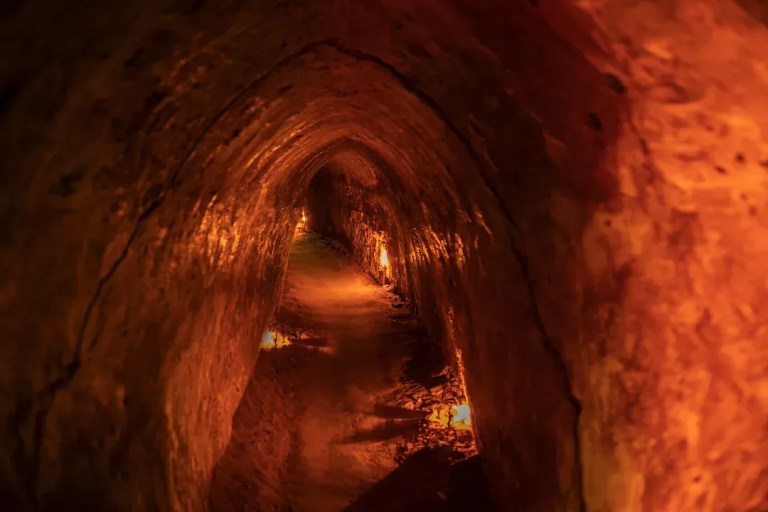
Cu Chi is a district outside Saigon where Vietnamese forces and civilians built a vast underground network during the American War. At its height, the tunnel system stretched for hundreds of kilometers beneath the jungle, allowing soldiers and civilians to live, move, fight and hide underground while American forces tried to destroy them from above.
Before I go any further, a special shoutout to our guide, Dragonking. Without his explanations, I would’ve walked away thinking I’d visited a fascinating historical site. Instead, I left with an entirely different way of looking at war, nature and human ingenuity.
The first thing he explained completely changed the way I looked at the tunnels.
Most people imagine that someone simply decided to dig more than 250 kilometers of tunnels beneath the jungle.
That’s not how it happened.
When American bombs carved enormous craters into the earth, the Vietnamese didn’t waste time filling them back in.
They used them.
A bomb crater became a bunker, built in a single night, without electricity, without machinery, without floodlights. The crater became the room. Trees, bamboo and clay hid it from above. Once the bunker was finished, they dug a tunnel to the next crater, then the next, then the next. Little by little, hundreds of isolated shelters became one of the most extraordinary underground networks ever built.
I kept waiting for Dragonking to move on to the next fact, the next date, the next number. He didn’t. He kept circling back to that same crater, that same night, as if the story wasn’t really about tunnels at all.
It wasn’t.
Along this trip, I realized I wasn’t learning about tunnels. I was learning about a completely different relationship with the world.
The deeper he went into the explanations, the more I noticed the same pattern repeating itself, over and over, in everything he described. Nothing existed on its own. Everything worked together.
The clay hid the entrances. The bamboo became pipes, supports and traps. The trees concealed the bunkers. Termite mounds inspired ventilation shafts that disappeared into the landscape. Some exits near the Saigon River even benefited from the natural movement of the tides to help circulate fresh air.
Smoke from cooking, something that could reveal an entire position, wasn’t simply vented into the air. It traveled through long underground channels before escaping so gradually that it blended into the morning mist rising through the forest.
None of it was borrowed and none of it was forced. Every part of the jungle already had a use, and they just had to notice it. Standing there, I couldn’t think of it as people surviving despite their surroundings. They were becoming part of them.
The tunnels themselves followed exactly the same philosophy. They weren’t designed to be comfortable. They were designed to favor the people who knew them.
Three underground levels housed kitchens, meeting rooms, hospitals, workshops, sleeping quarters and armories. Above them lay a maze of narrow passages, hidden doors and deadly traps. Punji stake pits, swinging spike traps and concealed trapdoors meant that even if an American soldier managed to enter, he had no idea where he was, where he was going or what waited around the next corner.
The jungle wasn’t protecting the tunnels. The tunnels were an extension of the jungle.
Then came the underground workshops, and this part genuinely left me speechless. When American bombs, artillery shells or rockets failed to explode, the Vietnamese collected them. They emptied the explosives to manufacture land mines. They cut up the steel to make traps. The enemy’s weapons became the tools of their own resistance.
Again, the same idea. Nothing was wasted. Everything was transformed.
By then, I stopped seeing individual examples. I started seeing a philosophy.
One side arrived with industrial warfare. Bombers. Napalm. Heavy machinery. The belief that overwhelming force could solve everything.
The other answered with clay, with bamboo, with rivers, with trees, with insects, with patience, with an intimate knowledge of the land they called home.
That’s probably why Cu Chi affected me so much. It wasn’t simply a story about winning a war. It was a story about understanding your environment so deeply that it becomes part of you.
Modern warfare usually leaves behind dead forests, poisoned rivers and landscapes stripped of life. Cu Chi tells another story. It reminds us that our greatest strength has never been our ability to dominate nature. It’s been our ability to work with it.
The Vietnamese didn’t separate themselves from the forest. They became an extension of it.
None of that erases what freedom cost here. No one should ever romanticize war, and nothing about those tunnels was easy or bloodless. But standing in them, one thing became impossible to ignore. The Vietnamese didn’t defeat a superpower by having more. They won by understanding something their enemy never truly could.
France has barely extinguished one of its largest wildfires in decades. An area roughly the size of Hong Kong has burned, and we’re only halfway through the summer. But another heatwave is already here.
People ask how this keeps happening.
I think we’re asking the wrong question.
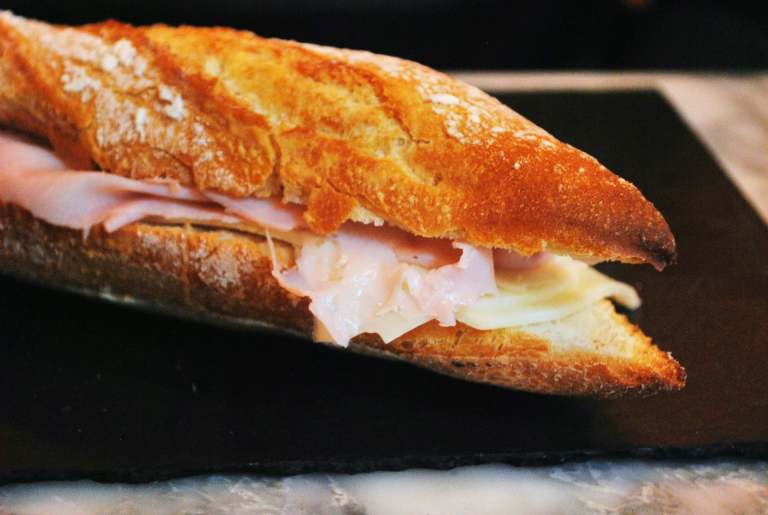
Every wildfire begins with a sandwich.
Not because a ham sandwich can physically ignite a forest, but because it represents the countless ordinary decisions that build the world in which forests burn.
The sandwich.
The cigarette.
The dairy ice cream we hand to our children without a second thought.
The Shein order arriving tomorrow.
The new backpack and notebooks bought every September even though last year’s are still perfectly usable.
Each decision appears harmless. Each is too small to matter. That is exactly how systems survive. It’s recreated every morning when we choose convenience over necessity, novelty over sufficiency, habit over reflection.
Every purchase is a vote. Not because one purchase changes the world overnight, but because billions of purchases, repeated every day, determine which industries grow, which disappear, and what kind of civilization we continue to finance.
One Amazon order won’t send a billionaire and his friends into space. One dairy ice cream won’t destroy a forest. One unnecessary notebook won’t fill a landfill.
But none of those things happens only once. They happen millions of times, every single day. Eventually those “insignificant” decisions become greenhouse gases, deforestation, polluted rivers, shrinking biodiversity, exhausted soils, expanding infrastructure and ecosystems pushed beyond their limits.
Then comes the heat. Then the drought. Then the spark.
And suddenly everyone becomes an environmentalist.
Hundreds of volunteers leave their homes to protect forests from the flames. They carry water, clear vegetation, do everything they can to stop the fire from reaching nearby villages. Most people see humanity at its finest.
I see humanity desperately trying to repair yesterday while continuing to finance it this morning.
The same people who volunteer their time and energy to protect the forest are then handed tables full of ham and butter sandwiches, soft drinks, sometimes cigarettes.
Volunteering is great. These people are giving their time to protect their homes, their communities, the forest around them. That matters. What bothers me is how easily we separate the emergency from everything that preceded it. We celebrate the person who runs toward the flames while treating the quieter forms of prevention as optional, eccentric, even ridiculous.
Those choices rarely earn applause because they happen long before the crisis, when there is no fire to fight and nobody watching. Yet they may matter far more than the dramatic moments that make the evening news.
We have confused loving the way nature makes us feel with caring about nature itself.
We hike through forests while eating products that contribute to the destruction of ecosystems. We photograph mountains while wrapped in disposable consumption. We defend a burning forest while continuing to finance the industries that place increasing pressure on forests around the world. We rush to fight the fire while throwing fuel onto it for the rest of the year. Economic fuel. Cultural fuel. Political fuel.
None of this means every choice weighs the same. A handful of industries and a handful of governments make decisions that outweigh what any individual could do in a lifetime, and no amount of reused notebooks cancels out a pipeline. But that asymmetry is not an excuse. It’s the reason our purchases are also our politics. Every dollar we hand to an industry is a small vote for its continued expansion, and the industries we’re describing don’t grow without millions of us feeding them first.
People often ask who is responsible for ecological collapse. The government? Corporations? Consumers? The uncomfortable answer is that there isn’t a single culprit. There is a chain, a chain in which every link seems too small to matter until the whole thing snaps.
That’s the butterfly effect.
A civilization is not destroyed by one catastrophic decision. It’ss destroyed by millions of ordinary ones.
Schools are closing or changing schedules. Trains are slowing down. Workers are being told to adapt. Older people are urged to stay indoors. Animals are dying in barns. Rivers are warming. Nuclear power stations are struggling to cool their reactors and being closed down. Farmers are watching the sky, hoping for rain that never comes. Cities are discovering, once again, that concrete, asphalt and glass are not neutral materials. They trap heat.
Every heatwave ends the same way.
“We need to adapt.”
Of course we do. Nobody serious argues otherwise. When temperatures reach 40°C, we need shade, cool public spaces, drinking fountains, schools that do not become ovens, hospitals that can keep functioning and cooling in strategic public buildings, especially for older people, children, sick people, outdoor workers and anyone trapped in poorly designed housing.
But adaptation cannot become the polite word for surrender.
The real question is not how we survive longer heatwaves.
The real question is why we continue to organize society in ways that make them worse.
Unfortunately, that’s the conversation many people would rather avoid.
The climate crisis is not a natural disaster in the way an earthquake is. Scientists warned us for decades. Communities raised the alarm. The solutions have been available for years. Yet, governments protected fossil fuel interests. Oil and gas companies expanded production. Executives collected billions. Politicians delayed, negotiated, softened regulations, greenwashed and lied.
This was not inevitable.
It was a political and economic choice.
Now, the same system that chose fire is trying to sell us fans, bottled water, air conditioners, climate insurance, private pools, green capitalism and survival kits.
The house is burning, and someone has opened a shop in the living room.
Heat Is Only the Symptom
The mistake is thinking this is only about high temperatures.
A heatwave is a stress test for almost everything that keeps society running.
It pushes the human body beyond its limits. It kills directly, especially when nights remain hot and people cannot recover. It damages sleep, concentration, heart health and kidney function. It turns classrooms into places where children struggle to learn and workplaces into places where people struggle to work.
It pushes infrastructure to its limits. Railway tracks expand. Roads soften. Electricity grids strain under rising demand. Hospitals become overloaded.
The irony is that ACs draw more power precisely when energy systems are already under pressure. Nuclear plants need cool water, yet rivers become warmer and shallower. The same heat that increases electricity demand can make electricity harder to produce.
It pushes agriculture as well. Cows produce less milk. Chickens die in industrial sheds. Crops dry out and/or suffer damage that only becomes visible weeks or months later. Soil loses moisture. Water restrictions arrive. Harvests shrink. Food prices rise.
Then everyone acts surprised that groceries become more expensive.
The damage does not end when the thermometer falls.
That’s why surviving the next heatwave is not enough.
The Food System Nobody Wants to Discuss
Climate conversations usually focus on transport.
And transport matters. Flying less matters. Driving less whenever possible matters. The World Cup spread across North America is a perfect example of climate absurdity, an event marketed as global unity while sending teams, fans, journalists and sponsors across an entire continent for entertainment.
But another major part of the crisis rarely receives the same attention because it sits on our plates.
Animal agriculture is one of the least efficient uses of land, water, energy and living ecosystems on Earth.
Livestock occupies roughly three quarters to more than four fifths of global agricultural land, depending on how it is measured, once grazing land and crops grown for animal feed are included. Yet, animal products provide only a minority of the world’s calories and protein. One widely cited Science study found that meat, dairy, eggs and aquaculture use about 83% of farmland while supplying just 18% of calories and 37% of protein.
Read that again.
Most of the farmland.
A fraction of the food.
That is not efficiency.
It is ideology disguised as agriculture.
The system produces far more than meat, milk and eggs. It produces methane, deforestation, polluted rivers, antibiotic resistance, dead zones in coastal waters and immense pressure on land and water.
It also produces immense suffering.
During heatwaves, pigs, chickens and cows cannot simply adapt because consumers expect cheap animal products. Ventilation systems fail. Cooling systems are inadequate or absent. Transport trucks become ovens. Poultry dies by the hundreds of thousands. Dairy cows suffer severe heat stress and milk production falls.
Then the industry presents itself as another victim of climate change while helping drive the crisis in the first place.
This is not about blaming someone trying to feed their family on a tight budget.
The ocean may be the most neglected part of the climate conversation.
We rightly describe forests as the lungs of the planet. They deserve that attention. But the ocean is far more essential to life on Earth. It has absorbed more than 90% of the excess heat trapped by greenhouse gases. It takes in a large share of the carbon dioxide we emit. It produces roughly half of the oxygen we breathe, largely through microscopic phytoplankton.
The ocean is not scenery.
It’s not a backdrop for holidays.
It is one of the reasons this planet is still habitable.
There is something profoundly irrational about destroying marine ecosystems while wondering why the planet keeps overheating.
Industrial fishing is not simply the act of catching fish. It tears apart ecosystems. It removes key species from food webs, kills countless non-target animals and drags heavy nets across the seabed, destroying habitats that took decades, centuries or even millennia to develop.
Yet this rarely appears in mainstream climate debates.
We are told to fly less, and rightly so.
We are told to drive less, and rightly so.
We are only beginning to hear serious discussion about livestock.
But fishing is still treated as though fish simply appear on supermarket shelves and the ocean can absorb endless extraction without consequence.
It cannot.
If the ocean regulates climate, absorbs carbon dioxide, produces oxygen and stores enormous amounts of heat, protecting marine ecosystems is climate policy.
Eating less fish, or choosing not to eat it at all, is not only an ethical position. It is a climate position.
For those who continue to eat seafood, there is at least an important distinction to make between small-scale fisheries and industrial fleets that empty entire ecosystems.
The ocean is one of Earth’s greatest cooling systems. Protect it at all costs.
Why Air Conditioning Can’t Be the Plan
Air conditioning has an important role.
During extreme heat, it saves lives. Hospitals, schools, care homes, public libraries, emergency shelters and social housing all need effective cooling strategies. No one should die inside an apartment built for a climate that no longer exists.
But air conditioning can’t become our primary response.
Every unit cools an indoor space by releasing heat outdoors. Across an entire city, that extra heat makes streets even hotter, particularly after sunset. Air conditioners also increase electricity demand during the hottest periods of the year. Where electricity still depends on fossil fuels, emissions rise. Even cleaner grids face greater strain as peak demand grows.
Singapore illustrates both the benefits and the limits of this approach.
The city has become highly dependent on cooling. Buildings require constant air conditioning. Those systems release heat into the streets. Outdoor spaces become less comfortable, encouraging people to remain indoors, which increases demand for cooling still further.
The cycle reinforces itself.
That’s not resilience, it’s technological dependence.
We don’t need cities filled with cooled rooms.
We need cities that stay cool in the first place.
We Forgot How to Build for Nature
The most effective cooling technology has existed for millions of years.
Trees.
Not decorative saplings planted in tiny squares of concrete, but mature urban forests and healthy green canopies.
Anyone who has walked barefoot from hot pavement onto shaded grass already understands this without reading a scientific paper.
So why, every time France approaches 40°C, do we talk about buying more air conditioners before planting more trees?
Why do we pave over soil, remove mature trees, expand shopping centres, build vast parking lots and approve developments that trap heat, only to claim that more machines are the answer?
They store water, protect biodiversity, stabilise soils, reduce erosion, create humidity and lower temperatures. They make landscapes more resilient long before a heatwave arrives.
Yet even forests are increasingly treated as another industrial resource.
Living ecosystems become timber reserves. Old-growth forests become biomass. Trees are cut down, burned for energy and labelled renewable, while complex ecosystems that took centuries to develop are reduced to units of production.
The same logic appears again and again.
If something can be extracted, it is.
If something can be sold, it is.
The living world is valued less for keeping us alive than for generating another stream of profit.
Water Is Becoming Political
Water is becoming one of the defining political issues of this century.
Yet we still manage it as though nothing has changed.
During droughts, ordinary people are told to take shorter showers. Farmers are asked to reduce irrigation. Small growers are criticised for watering their crops.
Meanwhile, luxury uses fight for exemptions.
Golf courses have become symbols of this contradiction because they expose the politics behind water allocation. While vegetables struggle and ecosystems dry out, perfectly green fairways are often defended. Leisure for the comfortable can receive more protection than food production or ecosystem survival.
Mega-basins reveal the same mindset.
On paper, the idea sounds simple. Capture water in winter and use it during summer.
Reality is more complicated.
Many of these reservoirs are open to the air, increasing evaporation as temperatures rise. They can concentrate control of water in the hands of a limited number of large farms. They often allow water-intensive agricultural models to continue instead of encouraging the transition toward crops and farming systems adapted to the climate that is already arriving.
The question is not whether storing water can ever make sense.
The question is who controls it, who benefits from it and whether it helps transform agriculture or merely postpones change.
A society preparing for the future would treat every drop of freshwater as precious.
Rainwater would be collected wherever possible.
Wastewater would be safely reused.
Leaking infrastructure would be repaired.
Soils would be restored so they can retain moisture.
Cities would remove unnecessary concrete and allow water to return to the ground.
Farmers would receive support to transition toward more resilient practices.
Luxury water use would never be treated as equivalent to drinking water, food production or healthy ecosystems.
The Logic Behind the Crisis
The deeper problem is that our economic system rarely asks what keeps life alive.
It asks what can be sold.
That’s why so many climate conversations end in absurdity.
We’re told to separate our recycling while billionaires fly private jets.
We’re reminded to save water while enormous data centres consume vast amounts of electricity and freshwater to cool servers powering artificial intelligence, advertising and endless digital consumption.
We debate plastic straws while militaries burn enormous quantities of fuel, flatten cities, destroy farms, poison soil and create another wave of emissions through reconstruction.
The priorities are impossible to ignore once you see them.
The Climate Cost of War
War remains one of the largest blind spots in climate politics.
The climate impact of the war on Gaza has been estimated in the tens of millions of tonnes of carbon dioxide equivalent once direct military activity and reconstruction are included.
The opening weeks of the US-Israel war on Iran were estimated to produce several million tonnes of emissions.
Lebanon has accused Israel of ecocide following the destruction of forests, farmland and ecosystems in the south.
Yet military emissions are still treated as though they exist outside the atmosphere.
As though bombs leave no carbon footprint.
As though fighter jets fly on moral complexity.
As though hospitals, schools, roads, farms and homes rebuild themselves without steel, cement, machinery and energy.
We can’t keep pretending these emissions don’t count simply because they’re politically inconvenient.
The pattern is difficult to ignore.
Capitalism drives extraction.
Extraction fuels empire.
Empire produces war.
War destroys societies.
Destruction demands reconstruction.
Reconstruction creates more emissions.
Then we’re told that buying a bamboo toothbrush is the meaningful response.
It is not.
Personal Responsibility Matters, but It Is Not Equal
None of this means personal choices are meaningless.
They matter because they reduce demand for destructive industries, help shift culture and make political demands more credible.
But responsibility is not shared equally.
A working family struggling to pay rent is not comparable to a billionaire with private aircraft, multiple homes, yachts and investments in fossil fuels.
Someone eating the foods they were encouraged to consume from childhood is not comparable to multinational agribusinesses lobbying to protect industrial livestock.
A commuter driving because public transport is inadequate is not comparable to governments that refuse to invest in reliable trains, cycling infrastructure and walkable cities.
The message can’t be that ordinary people are the problem.
The message is that we live inside a system designed to make destructive choices easy, profitable and normal while making better choices more expensive, less accessible or socially unusual.
Recognising that distinction is not about avoiding responsibility.
It is the first step toward directing responsibility where it belongs.
What We Can Do
None of this means waiting for someone else to act.
Some of the simplest changes are still among the most effective.
Eat less meat, or stop eating it.
Eat less fish, or stop eating it. If you choose to keep eating fish, understand the difference between small-scale fisheries and industrial fleets that empty entire ecosystems.
Buy fewer clothes. Buy second hand. Repair what you own. Stop treating fashion as a weekly identity update.
Do the same with appliances. Borrow, share, repair and buy used whenever possible.
Build a culture where tools, equipment, transport and household goods are shared instead of endlessly duplicated.
Fly less.
Drive less whenever practical.
Support political parties and movements that take climate change, biodiversity, animal welfare, water management, public services and peace seriously. Voting alone will not solve the crisis, but electing governments that deny climate science, protect fossil fuel interests and normalise war will accelerate it.
Above all, reject fake solutions.
A city with air conditioning but no trees is not prepared.
A country with mega-basins but dying soils is not prepared.
A food system built on industrial animal suffering is not prepared.
A sporting culture that flies millions of people across continents for profit is not prepared.
A digital economy that consumes ever more electricity and water in pursuit of endless growth is not prepared.
A world that treats war as ordinary is not prepared.
France is not ready for what’s coming, and that pains me.
Europe and America aren’t ready either.
The Crisis Behind the Crisis
The tragedy is that even by the narrow standards of economic growth, this system is failing.
Heat kills workers.
It reduces productivity.
It damages harvests.
It weakens infrastructure.
It raises healthcare costs.
It disrupts schools.
It destabilises insurance.
It pushes food prices higher.
It forces governments to spend billions (of our money) responding to disasters they chose not to prevent.
Even someone who cares nothing for animals, forests, rivers, oceans or social justice should recognise one simple reality.
This model is becoming too expensive to sustain itself.
The climate crisis is not only an ecological crisis.
It is a crisis of imagination.
We keep trying to preserve the lifestyle that created the emergency, then call that realism.
But there is nothing realistic about filling unliveable cities with more air conditioners while cutting down trees.
There is nothing realistic about building reservoirs while refusing to transform agriculture.
There is nothing realistic about defending industrial livestock, industrial fishing, fossil fuels, permanent war and luxury consumption while asking ordinary people to adapt.
Realism begins by accepting that an economy built on endless extraction can’t produce a liveable planet.
We don’t need a parasasol over the apocalypse.
We need accountability.
We need to recognise that climate is not a separate issue. It runs through everything.
Our cities.
Our countryside.
Our food.
Our transport.
Our water.
Our forests.
Our oceans.
Our economies.
Our wars.
Not because that sounds radical.
Because the moderate path has become the one driving the crisis.
The planet is not burning because we failed to understand what was happening.
It’s burning because those with the power to change course chose not to.
That choice can still be reversed.
But only if we stop confusing adaptation with acceptance and start confronting the system that keeps choosing fire.
I’ve always felt there was something strange about the way we talk about sleep.
We speak about it as if it should be clean, obedient and uninterrupted.
You go to bed.
You disappear for 8 hours.
You wake up.
You function.
Then you do it all over again the next night.
And when the body does anything else, we treat it like a problem.
Wake up at 2 AM?
Problem.
Lie there thinking?
Problem.
Feel awake for a while, then tired again?
Problem.
Everything becomes a disorder the moment it fails to fit the schedule.
But I’m no longer convinced the schedule is neutral.
I’m not even convinced it’s natural.
Because I’ve lived another kind of sleep.
Not every night. Not perfectly. Not as some routine I’m trying to sell.
But enough to know there is something real there.
I sleep for 4 or 5 hours.
Then I wake up.
Not violently. Not in panic. Not because an alarm ripped me out of my body.
I just wake up.
The world is silent.
Everyone else is asleep.
The air feels different.
My mind feels different.
I pray, then sit in that strange state between sleep and waking, between night and morning, between the body resting and the soul speaking.
And then something opens.
Ideas arrive.
Problems untangle.
Sentences appear.
Things I couldn’t solve during the day suddenly become obvious.
No noise. No demand. No performance. No one needing anything from me.
Just me, the night and whatever rises when the mind is finally left alone.
That’s when I write some of my best work.
The over-controlled mind of the day goes quiet. The part of me that’s always responding, planning, defending, explaining and calculating finally steps aside.
And something deeper speaks.
Then, after a while, my body gets tired again.
So I go back to sleep.
Another few hours.
And somehow, the whole thing feels natural.
Maybe ancient.
Not broken.
Not disordered.
Not like insomnia.
Just ancient.
As if my body remembers something the modern world has tried to erase.
Maybe sleep was never meant to be one single block for everyone.
Maybe the middle of the night wasn’t always an issue to be addressed.
Maybe waking after a few hours wasn’t always something to fear.
Maybe there was a time when the night had two doors: one for rest, one for reflection, then rest again.
Historians have written about segmented sleep, especially in preindustrial Europe. People spoke of a first sleep and a second sleep. Between the two, they might pray, think, talk, make love, tend to small things or simply exist in the dark without immediately diagnosing themselves.
That detail matters.
Because today, when someone wakes in the middle of the night, they don’t usually ask, “What is this moment giving me?”
They ask, “What’s wrong with me?”
That tells us something.
Not only about sleep.
About the society around sleep.
Because modern life doesn’t tolerate rhythms it can’t use.
It sees darkness and calls it wasted time, hence the horrendous daylight saving invention.
It sees silence and tries to fill it.
It sees the body refusing to behave like a machine and immediately asks which product, pill, app, supplement or routine can force it back into obedience.
This is where sleep becomes political.
Sleep itself is natural.
The modern sleep schedule isn’t.
It belongs to work.
To school.
To office hours.
To alarms.
To productivity culture.
To the economic need to make bodies predictable.
Capitalism colonized our sleep.
It took something ancient, intimate and mysterious, then forced it into a format that serves production.
One block.
One alarm.
One workday.
Repeat.
And because we live in a performance-driven society, even rest has to justify itself.
We don’t sleep because the body is sacred.
We sleep so we can function and be productive.
We don’t rest because life is more than work.
We rest so we can return to work less damaged.
Even sleep has been made useful.
Recovery.
Optimization.
Output.
Efficiency.
A better brain.
A better body.
That’s the real sickness.
Not simply lack of sleep.
Not simply insomnia.
A society that can only respect sleep when sleep serves production is very sick.
Nature doesn’t work like that.
Summer is not winter.
December is not June.
The year breathes.
Days stretch and shrink.
Nights lengthen and shorten.
Trees lose their leaves.
Animals slow down.
Light changes.
Energy changes.
Everything adapts except us.
We expect the same output in winter as in summer.
Same wake-up time.
Same productivity.
Same pressure.
Same artificial brightness.
As if the body should be indifferent to the sun.
As if a dark winter morning and a bright summer morning ask the same thing from us.
They don’t.
Winter asks for slowness.
Modern economic life asks for output.
Winter gives us longer nights.
We turn on the lights and carry on.
Then when people collapse, we call it fatigue, burnout, low motivation, seasonal depression or poor sleep hygiene.
Sometimes those words describe something real.
But they can also hide something.
Many people are not failing at rest.
They’re being forced to live against it.
Their rhythm isn’t broken by nature.
It’s broken by a dying society that still demands performance from exhausted bodies.
That’s why I don’t trust most conversations about sleep.
They talk about blue light, magnesium, melatonin, sleep trackers, cold rooms and perfect pillows.
Fine.
Some of that can help.
But they rarely talk about capitalism and all it entails.
Stress.
Work.
Poverty.
Grief.
Debt.
Noise.
Fear.
The nervous system living under constant pressure.
They rarely admit that many people are tired because their lives are built against the body.
Instead, they sell us solutions to problems the system created, the system being capitalism.
You’re stressed, so they sell you sleep content.
You’re overworked, so they sell you recovery hacks.
You’re anxious, so they sell you supplements.
You’re disconnected from nature, so they sell you artificial routines.
You’re exhausted by capitalism, so they sell you wellness.
And the simplest truth is ignored.
Maybe people need less stress.
More time.
More silence.
More prayer.
Work that doesn’t swallow their life.
Enough space to do things that make them happy before their body collapses at night.
Maybe people don’t need to become better machines.
Maybe they need to stop being treated like machines at all.
Science can tell us many useful things about sleep, but it becomes dangerous when it forgets that humans are not only organisms in a lab.
A sleep study can measure the brain.
It can’t fully measure what the night means to a person.
It can’t measure the feeling of waking naturally after 4 or 5 hours, praying in the dark, writing from a place you can’t access during the day, then returning to sleep as if you had visited some hidden room inside yourself.
That room matters.
That middle space matters.
The world has become so loud that we’ve forgotten what the mind does when it’s not being interrupted.
During the day, thought is constantly attacked.
Messages.
Screens.
Tasks.
People.
Plans.
Bills.
Responsibilities.
Even when we’re alone, we’re rarely alone.
But the middle of the night is different.
It gives the mind a privacy the day can’t offer.
Maybe that’s why creativity often lives near sleep, near dreams, near the strange border where the rational mind loosens and something deeper comes forward.
The edge of sleep is not empty.
It’s fertile.
Not always useful in the capitalist sense.
But sometimes revealing.
And that is not the same thing.
That’s why I refuse to see every night waking as a problem.
Sometimes it’s stress, illness or pain.
Sometimes it’s too much worry, too much light or too much life pressing on the chest.
But sometimes, it’s something else.
Sometimes the body wakes because it has entered the second chamber of the night.
The chamber where the ego is quieter.
Where ideas come without being chased.
Then sleep returns.
Not as defeat.
As completion.
First sleep.
A waking.
Second sleep.
A rhythm, a conversation between the body, the soul and the dark.
Maybe that’s what we’ve lost.
The true meaning of sleep.
We reduced it to recovery.
Made it serve productivity.
Turned it into another thing to optimize, track and monetize.
We forgot that sleep is also surrender.
Also mystery.
A borderland.
One of the last places where the body refuses complete control.
That might be why modern life is so obsessed with managing it.
Because sleep reminds us that we’re not machines and never will be.
No matter how many alarms we set.
No matter how many apps we download.
No matter how many experts explain our cycles.
At some point, the body asks to return to the dark.
And maybe, if we stop being afraid of every interruption, we might discover that the night wasn’t only made for unconsciousness.
Maybe part of it was made for meeting ourselves without the noise of the world.
The most human sleep was never a straight line.
It was a tide.
The middle of the night was never the enemy.
The enemy is a society that turned even rest into a performance.
An interconnected system that made me healthier and more aligned.
You can’t expect your body to function properly if everything you expose it to works against it.
What you touch, what you eat, what you breathe in, what you surround yourself with matters.
Most of these changes didn’t come from theory. They came from small moments of doubt. Something feels off, you look into it, you adjust, and then you don’t go back. Over time, those adjustments start forming a pattern.
Plastic was the starting point
Once I started paying attention, plastic was everywhere. Not just single-use items, but containers, cutting boards, utensils, bottles. Even when it’s thick and reusable, it still degrades over time. Microplastics are already present in food and water, so adding more exposure through daily habits made little sense. I removed plastic containers, replaced cutting boards, and shifted entirely to glass, wood, and metal for anything that comes into contact with food. I now store and consume food exclusively using stable, non-degrading materials.
Water isn’t neutral
Tap water is often treated as a given, but once you look into what it contains, it changes how you approach it. I invested in a proper filtration system and regret not having done so earlier. Before that, I went with a basic pitcher, the Brita type, then moved to something more advanced (and more expensive) to remove a wider range of contaminants. That said, I also started being more intentional with how I drink water. In the morning, I’ll often have water with cucumber and lemon, and I’ll leave cucumber slices in the bottle throughout the day. Given how much of the body is made up of water (60%, vs 73% for the brain), it doesn’t make sense to treat it casually.
Cookware and daily exposure
Cooking used to be about convenience. Non-stick pans, plastic utensils, quick cleaning. Once concerns around certain coatings and chemical residues became more visible, that convenience started to feel like a trade-off. I replaced everything with stainless steel cookware and switched plastic utensils for wood or metal. It requires more attention, but it removes a layer of uncertainty.
Eliminating plastic in hygiene products
The same pattern showed up in the bathroom. Most hygiene products come in plastic packaging, and beyond that, their composition raises lots of questions anyway. Shampoo, shower gels, toothpaste, it’s all part of the same system. Moving away from plastic bottles was supposed to be difficult, till it wasn’t. Toothpaste remained the hardest to replace due to cost and availability, though totally doable. Plus, you can make your own, if time allows. As for shampoo, it’s been close to a decade since I’ve reduced it drastically, once a month on average, and even less in the summer when I’m regularly in the ocean or rivers. When I do use one, it’s always a natural, oil-based, plastic-free option. The rest gets washed with regular, natural soap.
Perfumes and what goes through the skin
I used to collect perfumes. At one point I had around thirty bottles. It was part of how I presented myself. Over time, I learned more about what actually goes into most fragrances. They’re not just alcohol and plant extracts. Many contain compounds that interfere with hormonal systems. Applying them directly on the skin, especially around the neck, didn’t make sense anymore. In fact, it became a health hasard. I still use what’s left of my collection, but only and exclusively on my clothes.
Body lotions and absorption
That same logic extended to body lotions. At first, plastic packaging was the issue. Then I realized the formulations themselves raised similar concerns. Long-lasting scents rely on chemical stabilizers that don’t just sit on the surface, they penetrate well into our body and weaken our nervous system. I replaced them with simpler alternatives like coconut oil, jojoba oil, and monoi stored in glass bottles. They do what’s needed without unnecessary complexity.
Sound, stimulation, and the nervous system
There’s also what we expose our brain to. I used to listen to music at maximum volume for hours every day. Looking back, it’s surprising there wasn’t more damage in my inner ear. More recently, I started questioning constant exposure to wireless ear devices as well. It’s not easy to step away from, but I’ve made adjustments. I use wired earphones more often, reduced how much I listen to anything overall, and capped the volume so it never exceeds 85 decibels on my phone. Silence has taken a bigger place too, especially through long walks.
Food as a baseline
Diet was one of the earliest shifts and it stayed consistent. Processed sugars and ultra-processed foods were removed and haven’t come back. The focus is on whole foods, fiber and stable energy rather than spikes. Fermented foods like homemade kefir became part of daily intake to support gut health. Supplements were added with specific purposes. Creatine for performance and recovery, cordyceps and lion’s mane for energy and cognitive support, vitamin D in winter, omega-3 for long-term brain health, turmeric for inflammation. Fruit is eaten whole rather than juiced to avoid unnecessary glucose spikes. Alongside this, I fast intermittently throughout the year, supporting deeper internal regulation. And of course , everything 100% plantbased and palm oil-free.
Sun exposure, corrected over time
Sun exposure is another area where I had to adjust. For a long time I approached it carelessly. I even used coconut oil thinking it would protect my skin, when in reality it was doing the opposite. I rarely burned, but that doesn’t mean there was no damage. Over time, I learned to be more controlled. Less direct exposure on the face, protection when needed, and no more chasing tans.
Living closer to nature
One of the biggest shifts didn’t come from removing something, but from changing the environment itself. Living closer to nature makes everything easier. Movement, silence, exposure to natural elements. Practices like grounding or earthing stop being abstract ideas and become part of daily life. Walking barefoot, touching the ground, spending time in natural surroundings. There’s a noticeable effect on stress levels, posture, and overall balance. Even something as simple as leaning against a tree or staying still outdoors changes how the body settles. Oh yeah, and tree hugging FTW!
Reconnecting with natural signals
Some changes are harder to explain in purely scientific terms, but still feel real in practice. Hair is one of them. There are older ideas about hair acting as a kind of antenna, a connection to the environment. Historically, cutting hair has sometimes been used not only for hygiene but also as a way to strip identity, control individuals, or disconnect them from something deeper, which is why you often see it done immediately in contexts like slavery or imprisonment. Whether or not that idea can be measured, I’ve noticed a difference since growing it out and stopping the use of chemical-heavy products. There’s a stronger sense of awareness and sensitivity, so keep your hair, guy, unless you’re balding, of course !
Positive thinking and internal dialogue
Not everything is physical. The way you think shapes how you experience all of this. I’ve always been confident, but intentional self-talk is something else entirely. It requires awareness, especially when you’ve been exposed to environments where things don’t always go well. I’ve been working on reinforcing more constructive internal patterns. At the same time, I’ve developed more understanding for people who lean toward pessimism. Most of the time it’s not a choice. It’s conditioning. Repeated negative experiences shape expectations, and those expectations shape perception. A lot of people judge that without understanding it, don’t be one of them.
Interconnectedness
At some point, all of this converges. What you eat, what you drink, what you wear, what you apply to your skin, what you listen to, where you spend your time, it all feeds into the same system. None of these changes exist in isolation. Each one reinforces the others. Once you start seeing that, it becomes difficult to go back to unconscious habits. So, approaching one’s environment and lifestyle as one interconnected system is the key to all this.
Across all these changes, the pattern is consistent. Remove what is unnecessary, reduce synthetic exposure, and replace it with simpler alternatives. When something can’t be avoided, create distance between it and the body. Over time, those small decisions compound, and life gets better.