Bordeaux was never the plan
I never planned on living in Bordeaux.
Like, at all.
I never thought it would become anything close to “home” either. Actually, I don’t even really know what home means.
Not in a fake deep way.
Not in the cliché traveler way where people say “home is wherever the heart is” and then post a picture of an airport window or whatever.
I mean it literally.
I’ve moved too much, traveled too much and lived in too many different places to tie that word neatly to one city, one country, one childhood street or one fixed point on a map.
Some people have that.
A place they come from.
A place that explains them.
A place they can point to and say, yeah, that’s home.
I don’t really have that.
So when I say Bordeaux became important to me, I don’t mean it became home in the normal sense.
I just mean it’s one of the rare places where staying made sense.
And for me, that’s already a lot.
What living in Bordeaux is actually like
I’ve lived in and around Bordeaux for years now, after living in places like New York, Barcelona, Lyon, Buenos Aires, Sydney, Addis Ababa, Penang and Hong Kong.
So this isn’t a tourist guide.
It’s not a “48 hours in Bordeaux” thing.
It’s not about where to take cute pictures, where to drink wine or which square looks best on Instagram.
This is a personal look at what living in Bordeaux is actually like. The beauty, the comfort, the cost, the rain, the summer heat, the transport, the vegan options, the access to nature and the strange feeling of a city that somehow made sense to me.
Somehow, over the years, Bordeaux ended up being the place I stayed the longest.
Funny how these things play out.
What’s also interesting is that it wasn’t because I woke up one day and thought, yes, this is the city where I’m going to build my life.
It just kept making sense to stay a little longer.
Then a little longer again.
I’ve been in France on and off for around 20 years now, which is actually mad when I write it down. At one point I studied in Lyon and listen, Lyon is beautiful. I’m not one of those people who pretends a city is ugly just because I didn’t connect with it.
Lyon has history, architecture, culture, food, all that heavy old French city stuff.
But I never felt that comfortable there.
In fact, when I left Lyon, I genuinely thought I was done with France entirely.
Then one day I drove through Bordeaux and that was kind of it.
Immediate click.
No long intellectual analysis.
No checklist.
No “let me compare quality of life, transport, rent and cultural infrastructure.”
Just a feeling.
Like, ok, I get this place.
That’s it.
And I don’t get many places like that.
The feeling of Bordeaux
Bordeaux is beautiful, but not in a loud way.
That’s probably one of the main reasons I like it.
It doesn’t scream at you.
It’s not trying to be Paris. It’s not trying to impress you with giant towers, endless glass buildings or some fake futuristic skyline.
There are no skyscrapers eating the sky.
No weird corporate city-centre energy making you feel like you accidentally walked into someone’s LinkedIn profile.
There’s light.
There’s air.
There are streets that don’t feel like they’re closing in on you.
If you’ve lived in big cities, you know how quickly you can lose the sky. Everything becomes concrete, traffic, glass, noise, pigeons, people walking too fast, cars everywhere, buildings blocking every bit of openness.
Bordeaux doesn’t feel like that.
At least not to me.
It feels softer.
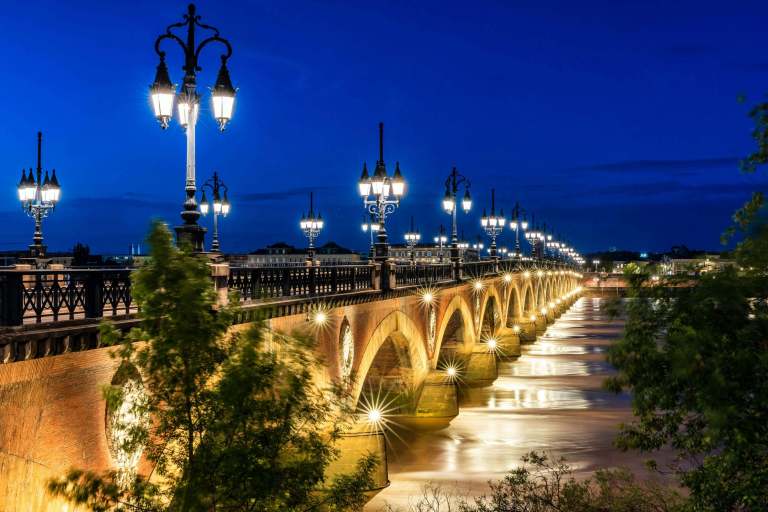
The town hall is genuinely beautiful. The old churches too. The bridges, the stone buildings, the river, the way the city catches light when the weather changes.
Walking around the centre feels visually calm in a way most cities don’t.
Not perfect.
Not magical.
Just soft.
And I like that.
The best things about living in Bordeaux
One of the best things about Bordeaux is that it feels small enough to understand, but not so small that it feels completely closed.
A lot of people in Bordeaux aren’t even really from Bordeaux. They come from nearby towns, the Arcachon Bay, Paris, other parts of France and sometimes somewhere else entirely, like me.
So the city has this mixed energy.
It feels medium-sized, but socially bigger than it looks on paper.
Not too provincial.
Not too massive.
Not too stuck in itself.
That works for me.
Culture is everywhere too, but again, not in a try-hard way.
Montaigne, Montesquieu, Mauriac, universities, opera, theatres. That whole old intellectual background is just there. And yeah, that sounds a bit like something from a tourist office brochure, but you do feel it.
Not every day.
Not every second.
But it sits in the background.
Also, random fact, Bordeaux was the capital of France three times.
Most people don’t know that.
I love facts like that.
Nature, ocean and weekend escapes
Honestly, one of the best things about living in Bordeaux is how easily you can leave it.
Which sounds like an insult, but it really isn’t.
The ocean is just over an hour away.
And not the kind of beach where you’ve got buildings stacked behind the sand, overpriced ice cream stands and people sitting on top of each other.
I’m talking long Atlantic coastlines, dunes, pine forests, surf towns, wind, space.
A completely different rhythm.
You leave the city and suddenly your body remembers that life doesn’t have to feel so tight all the time.
Further south you’ve got the Pyrenees. Sure, they’re about a 3-hour drive away, but still, close enough for a weekend getaway.
Mountains, lakes, hikes, waterfalls, caves, little villages.
A totally different landscape again.
And if you drive inland, say to the Dordogne, you find quiet villages, old mills, open plains and places where everything slows down without asking for permission.
Bordeaux is one of those cities where a short drive can completely change your environment.
That matters to me.
I need nature around me.
Not as an aesthetic.
Not as a weekend hobby.
I genuinely think I get tense without it.
Transport, walking and cycling
Travel is surprisingly easy for a city this size.
You’ve got flights to a lot of major European cities. Paris, London, Lisbon, Madrid, Barcelona, Rome, Istanbul and more.
North Africa is close too, especially Morocco.
Then the TGV gets you to Paris in about two hours, which still feels a bit unreal when you think about it.
From there, everything connects.
You’ve also got trains to Toulouse, Nantes, La Rochelle and other places, plus coaches if you want to travel more slowly into Spain or Portugal.
The city gives you options.
I like places that give you options.
Inside Bordeaux itself, public transport is decent.
Not perfect.
Rush hour can be annoying. The tramway gets packed. Buses can be a bit much sometimes.
But overall, it works.
And the city is walkable, which changes everything.
A city you can walk through is not the same as a city you only pass through.
Cycling is easy too. You can get almost anywhere by bike, which makes owning one feel less like a lifestyle choice and more like common sense.
Just lock it properly.
Actually, lock it very properly.
Bike theft is real.
Weather in Bordeaux
The weather has its own personality.
It rains a lot.
Like, a lot.
People complain about it, but I’ve never really hated Bordeaux rain. Most of the time it doesn’t feel violent or miserable. Not to me anyway.
It feels more like a reset.
Like the city needed to rinse itself off a little.
Summers though?
Yeah.
Summers can be rough.
Sometimes too hot.
I usually leave during peak heat when I can, because Bordeaux in a heatwave is not my favorite version of Bordeaux, that’s for sure.
That’s one thing people should know before moving here.
Bordeaux can look soft and elegant for most of the year, then suddenly become heavy, hot and uncomfortable in summer.
Still beautiful.
But sweaty.
Daily life in Bordeaux
The centre has character.
Small local shops, thrift stores, cafés, concept stores, cobblers, vinyl shops, second-hand electronics, markets.
There’s even a monthly vegan market, which is rare enough to matter in a city this size.
It’s relatively clean and relatively safe too.
People argue about safety a lot, especially online, because apparently everything has to become a dramatic debate now.
But in normal day-to-day life, compared to many urban places, Bordeaux still feels fairly balanced.
There’s greenery as well. Parks, trees, open little pockets of space.
Not enough trees in the very heart of the city in my opinion, and still too many cars, obviously.
But the base is solid.
It’s a city where you can have a normal day without feeling like the city is attacking your nervous system.
That might sound small.
It isn’t.
Cost of living and rent in Bordeaux
Now, let’s not romanticize it too much.
Bordeaux has problems.
Rent is ridiculous for what the city offers in terms of work.
That’s probably one of the biggest contradictions of living here.
The city became desirable, people came, prices went up and now you get this strange gap between the lifestyle Bordeaux sells and the economic reality many people actually live with.
It’s beautiful, yes.
It’s comfortable, yes.
But comfort is never neutral when people are priced out of it.
That’s the thing with cities like Bordeaux. They look soft from the outside, but they still carry all the usual pressures underneath.
Rent.
Work.
Class.
Tourism.
Gentrification.
The slow replacement of ordinary life by polished lifestyle.
It’s not Paris-level brutal, obviously.
But it’s there.
And if you’re thinking of moving to Bordeaux, you should know that the city can be expensive compared to the job opportunities available locally.
Beautiful cities always know how to charge for their beauty.
Vegan life in Bordeaux
Vegan life in Bordeaux is manageable, but limited.
That’s probably the most honest way to put it.
You can find options. You can eat out. You can shop. You can make it work.
But if you’re coming from bigger cities with stronger vegan scenes, Bordeaux will probably feel small.
Not impossible.
Just not abundant.
There’s a monthly vegan market, which I appreciate, and there are some good places around the city, but it’s not the kind of place where vegan food is everywhere without thinking.
You still have to look.
You still have to plan a little.
And sometimes you still end up eating fries and pretending that’s a meal.
It happens.
The downsides of living in Bordeaux
So no, Bordeaux isn’t perfect.
No city is.
Rent is too high.
Transport isn’t cheap.
Bike theft is very real.
Summers can be intense.
Vegan options are still limited compared to bigger cities.
There are still too many cars.
The centre needs more trees.
And there’s this strange seasonal emptiness where a lot of people leave during summer, especially since many residents aren’t originally from there.
The city kind of exhales and partially empties out.
Some people hate that.
I get it.
It can feel peaceful, but also a bit strange, like everyone quietly agreed to disappear at the same time.
Bordeaux can also feel a little too comfortable sometimes.
That might sound like a fake complaint, but I mean it.
Some cities push you. Some cities rough you up. Some cities force you into movement.
Bordeaux doesn’t always do that.
It can soften you.
Which is nice.
Until it isn’t.
So, is Bordeaux a good place to live?
Yes, if you want a beautiful, walkable, culturally rich French city with decent public transport, strong access to the ocean and nature, enough social life to not feel isolated and a softer rhythm than Paris.
No, or not easily, if you need cheap rent, strong local salaries, big-city vegan options, endless nightlife, reliable summer comfort or a city that feels fully alive all year.
For me, Bordeaux isn’t perfect.
But it’s one of the rare places where staying made sense.
And for someone like me, that’s not nothing.
Would I live in Bordeaux again?
Honestly, yes.
In fact, we’re just over an hour away.
I go back almost weekly to volunteer, see friends, run errands or just walk around for a few hours.
And every time, there’s still something.
Not home exactly.
But Bordeaux is one of the few places that ever made me understand why people use that word.
Maybe that’s enough.
If you want to read about another french city I lived in (Lyon), check this article out.
Peace!
Teekay