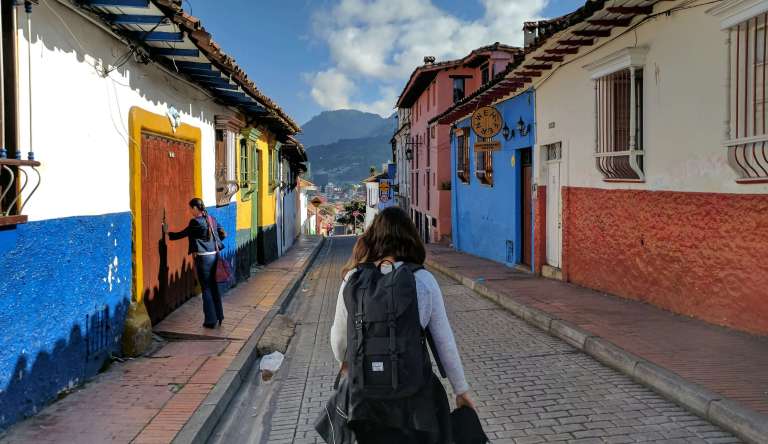
Backpacking

Backpacking lost its soul

On the ego that turned exploration into consumption.

People often ask why I spend weeks in one place when I could be crossing several countries off my list instead. I suppose I’ve never understood how moving more is supposed to mean seeing more.

I don’t travel to collect countries.

I travel to disappear into one.

Backpackers don’t stay anywhere anymore.

They arrive. They sleep. They photograph. They publish. They leave.

Then they repeat the process somewhere else until the trip ends and they return home exhausted, convinced they’ve seen the world because they were physically present in it.

They haven’t.

They’ve consumed it.

That’s what backpacking has become.

Not exploration.

Consumption.

Call me a gatekeeper if you want, but I don’t think making travel accessible to everyone was a good thing.

Some things deserve to remain difficult.

Difficulty isn’t just an obstacle.

It’s a filter.

Backpacking once demanded uncertainty. You hitchhiked because there wasn’t another option. You camped because you couldn’t afford hotels. You got lost because Google Maps didn’t exist. You depended on strangers because there was nobody else.

You didn’t stay three weeks because slow travel was fashionable.

You stayed because leaving wasn’t simple.

That difficulty selected people.

Not better people.

People with different motivations.

People who wanted to understand rather than display.

Then technology removed almost every barrier.

Flights became cheap.

Hostels multiplied.

Google Maps eliminated uncertainty.

Translation apps eliminated effort.

Social media eliminated the need to tell stories because photographs could pretend to tell them for you.

The filter disappeared.

The culture changed.

Today, travel isn’t sold as curiosity.

It’s sold as identity.

The tourism industry doesn’t ask what a country might teach you.

It asks who you’ll become once other people know you’ve been there.

Travel has become one of the cheapest ways to manufacture an identity.

You don’t need to become interesting.

You just need to stand somewhere interesting.

That’s why so many people return with bigger egos instead of broader minds.

Ask them what they learned.

Most will tell you what they saw.

Ask them about the people.

They’ll tell you about the monuments.

Ask them about the language.

They’ll proudly repeat the three words they learned after spending 90 days crossing six countries.

They’re collecting locations, not understanding and certainly not growth.

Tourism has become another branch of consumerism.

Countries are products.

Experiences are products.

Cultures are products.

Even people become products.

Everything exists to be consumed, photographed and replaced by the next destination.

The strangest part is how proud we are of this.

I’ve been to 25 countries.

Why is that impressive?

Wouldn’t it be more impressive to deeply understand one?

To speak its language.

To know its neighborhoods instead of its viewpoints.

To have friends instead of recommendations.

To return home with your certainties broken instead of your passport filled.

Movement has become confused with growth.

They’re not the same thing.

Most people don’t travel to become different.

They travel to confirm the person they already believe themselves to be.

Travel becomes evidence.

Proof that they’re adventurous.

Proof of their supposed open-mindedness, despite the racist behavior they display toward locals.

Proof that they’re successful.

It’s ego disguised as curiosity.

The environmental hypocrisy follows naturally.

People cry in front of ancient forests before buying products linked to deforestation.

They snorkel around coral reefs while financing industries that destroy them.

They admire wild animals, then return home and continue consuming the system driving those animals toward extinction.

Nature isn’t changing them.

It’s entertaining them.

People tell me tourism creates conservation.

I think that’s backwards.

Conservation is usually the bill we pay after treating the natural world like a warehouse.

The less we consume, the less there is to rescue.

The same thing happens with culture.

We’re constantly told cultural exchange is inherently beautiful.

Sometimes it is.

Sometimes it spreads destructive habits faster than wisdom.

The world is becoming culturally flatter.

Walk through enough cities and they begin to blur together.

The same cafés.

The same apartment blocks.

The same shopping streets.

The same influencers taking the same photographs.

We’ve mistaken imitation for development.

We’ve decided that progress means looking like whoever industrialized first.

Traditional architecture disappears because concrete and glass looks richer.

Buildings that evolved over centuries to suit local climates are demolished so cities can resemble places they were never meant to resemble.

I don’t call that progress.

I call it forgetting.

A yurt isn’t inferior because it doesn’t resemble a skyscraper.

An earth house isn’t backward because it isn’t made of concrete.

Architecture should answer the climate before it answers fashion.

A society should adapt to its environment before adapting to global trends.

That’s my definition of progress.

Better adaptation.

Not better imitation.

The same principle applies everywhere.

The easier photography became, the less people learned photography.

The easier publishing became, the less people learned to write.

The easier backpacking became, the more it became tourism.

Convenience doesn’t simply allow more people to participate.

It changes why they participate.

And once the reason changes, the activity changes with it.

That’s what happened to travel.

The greatest journeys aren’t measured by distance.

They’re measured by transformation.

You should come home questioning yourself more than the people you visited.

If all you brought back were photographs, opinions and a stronger sense of your own importance, then you didn’t really travel.

You consumed another place.

The tragedy isn’t that the world became accessible.

The tragedy is that accessibility turned one of humanity’s greatest opportunities for humility into another marketplace for ego.

Backpacking didn’t disappear.

Its soul did.

Thanks for reading.

Teekay

What are the best survival tips every hiker must know ?

Below is a list of survival tips every hiker should know, inspired by (but not only) the movie Backcountry (great flick btw, thanks Bash)

First things first let me tell you this: when you’re out in the wild, worry about survival before you worry about comfort. Always.

Another basic tip and as a rule of thumb, never hike with a backpack that’s more than a third of your body weight.

Anyway, let’s get going:

  • Dos and don’ts in the wild
  1. Never leave your food uncovered in the wilderness
  2. Always have extra energy bars and food in your backpack. Also, eat in rations, you never know what might happen next
  3. When you decide to take a break or to call it a day, NEVER leave food in your tent
  4. Always keep a survival whistle on hand. Survival whistles help scare off wild animals and serve as a signal in emergencies. Mine came in handy when I hiked in Patagonia (Andean forest in Argentina)
  5. Always keep a survival knife on hand
  6. Always keep a candle in your backpack, it’ll help keep you warm in extreme weathers, especially if you ever get lost in the wild (check out this video if you don’t know what I’m hinting at). For this technique to work, you will need something like a poncho or a blanket
  7. Learn more about edible plants and roots just in case you run out of food
  8. Learn basic first aid skills to fix yourself or other hikers in case of an emergency
  9. Always make a mental map of where you are and where you’re headed. A great hiker always knows where the nearest plain is. Plains are safer than the woods. Also, if there’s a rescue heli looking for you, you’d want them to actually see you
  10. Always check the weather before you head out
  11. Make sure your clothing ALWAYS remains dry. I made this mistake twice, once in Sweden and once in France, and both times I thought I was never going to make it. Never again !
  12. When packing your gear, try to pack the heavier gear against your spine with the lightest items on top and equal weight on either side. Remember to pack your rain jacket last so that it is accessible if needed suddenly, and make sure all loose straps are secured and neat so they don’t catch on anything as you walk.
  13. Learn more about the wild animals in your area and how to deal in the event of an unexpected encounter (bears, wolves, boars, snakes, elk, moose, cows, goats)
  • Hiking and survival must-haves
  1. Backpack tips: Choose a backpack with a tubular design. A tubular design is easier to balance, and an unbalanced backpack will tire you out much sooner than you expect. Unbalanced packs also increase the risk of a twisted ankle or a fall. Always strap on because loose straps can be dangerous if they catch on rocks or branches. Make sure the weight doesn’t only sit on your back but rather on the side straps. Distribute as much weight to the straps as possible. With the weight on your straps, your shoulders should feel lighter and unburdened. A sternum strap is also a must when mountain hiking. It keeps the straps from falling off and tiring you out. 
  2. One sharp, full-tang, carbon-steel knife. This is your most important tool in a survival situation. Pick one that fits your hand comfortably, has a single piece of steel from tip to butt, with a blade about 12cm long. Carbon-steel blades are easiest to sharpen and the back of the blade will produce a spark when struck with a hard stone
  3. Consider stainless steel bottle for drinking and heating up water
  4. Make sure your headlamp is easily accessible
  5. A survival whistle is often forgotten but it could come in handy in several situations: to call for help, to scare off snakes and other animals, to signal your presence to other hikers
  6. Touch as little things as you possibly can while hiking. Smell is how animals track their prey
  7. Learn how to start a fire with an ember rock or a flint fire starter in case your matches get wet 
  8. Learn how to navigate a map with a compass
  9. Get a LifeStraw and/or purification drops 
  10. Always have a first aid kit on. Stuff it with bandage wraps, medication for pain, allergies, nausea, vomiting, diarrhoea, dehydration and hypoglycemia
  11. If it’s allowed in your whereabouts, get a smoke or fire signal, very useful in case of an unexpected encounter with a deadly animal
  12. Invest in GREAT hiking shoes. I didn’t say good, I said great. You’re going to spend at least 60% of your time in them so invest well
  13. Rain and wind are your worst enemy. Invest in a windbreaker/raincoat
  14. Invest in good, warm socks and thermal underwear 🧦
  15. A cooking set and/or gas stove is a must in the winter when everything is wet and cold
  16. Keep a phone and potentially a talkie walkie on you. A talkie is much more efficient than a celly, and not everyone can afford a satellite phone. Talkies allow you to connect with other radios in the area
  17. Wear flashy hiking clothes in case a rescue team has to look for you in leafy forests
  18. Learn the basics of hunting. There are always chipmunks and rabbits in the woods that you can hunt if it’s a matter of life or death (I’m vegan but extreme situations require extreme measures)
  19. On the same note, keep fishing gear on you, just in case you have no other options but to fish to feed on
  20. Make sure your clothing always remains dry. The most effective way to waterproof your pack is to line the inside with a dry bag. Buy one that is slightly larger than your backpack so that it completely fills the main compartment and has enough extra space at the top for a tight seal. Once sealed, the dry bag will also serve as a floatation device, so if you do fall into water, your bag won’t drag you under.
  21. Grab a pair of tough gloves to avoid hand wounds and a better grip in extreme situations
  22. An axe could come in handy in many situations. Chopping wood, entertainment, an axe could also save your life in the event of an unexpected encounter with a deadly animal 🪓
  23. Get at least 3m of 550 paracord, super useful in certain situations

There you have it folks. I must’ve missed some other tips but if you follow all of the ones above, you’re very likely to survive any situation in the wild.

I didn’t add all the necessary gear one might need for a hike. That’s a not the primary purpose of this post.

That said, I may post a piece of my favorite hiking gear soon.

Goes without saying but be careful when you’re out there, fam. We humans are much weaker than we think we are, and sh!t happens, all the time.

Also, better safe than sorry.