Rainforest

How to Read a Rainforest

On the plants, poisons and people who turn the jungle into a pharmacy, a grocery store and a home

I didn’t realize how little I knew about the forest until our guide started pointing things out.

Our trek through Taman Negara, near Kuala Tahan, covered around 8 kilometers. We started at 10 in the morning and got back around 5pm, with a break at Teras Waterfall before the boat ride back to town.

The trail demanded attention from beginning to end. Mud, wet rocks, exposed roots and shallow streams meant every step had to be placed carefully, and in several spots ropes were fixed to the hillside to help hikers climb or descend slippery slopes. Waterproof hiking shoes with good grip aren’t optional here. They’re the difference between enjoying the trek and spending the day sliding through the mud, if not something worse.

But the distance and the terrain weren’t what made the hike memorable. It was realizing that most ordinary-looking plants are much more than they let on. By the end of the day, I wasn’t seeing trees and bushes anymore. I was seeing functions.

Our guide walked us through plant after plant, and one stuck with me more than the rest. It was used to treat snake bites. When cut open, it’s applied directly to the wound. According to the guide, the inside of the plant would turn yellow as it absorbed the venom, and fresh pieces were applied until the inside stayed white, which is believed to mean no venom is left. Whether or not modern medicine backs that up, it’s a testament to thousands of years of people experimenting with what grows around them.

Other plants did other jobs. One relieved asthma. Another became shampoo, soap and mosquito repellent all at once. I didn’t catch its name, but all it took was rubbing a few leaves together with water before a rich, citrus-scented foam appeared in the guide’s hands. It smelled better than most commercial soaps I’ve used.

The forest also supplies drinking water. Those thick vines made famous by Tarzan actually hold water inside them, and so does bamboo. In a place where rivers aren’t always close, knowing which plants can quench your thirst can matter more than you’d think.

One of my favorite discoveries was the stingless bees. They build their nests inside hollow tree trunks, with only a narrow wax entrance reaching outside. The honey stays protected deep in the wood, out of reach of most predators. Seeing a colony hidden inside a living tree was something I’d never come across before.

There were still plenty of reminders that we were sharing the forest with wild animals. At several points, the guide stopped because he could smell them before seeing them. The scent, he said, likely came from monkeys or maybe elephants that had recently passed through. We also found deep claw marks running up the side of a tree, almost certainly left by a sun bear climbing toward a hollow trunk where bees had built their nest. As if that wasn’t enough, he showed us a recent photo of a local man who had survived a panther attack, a humbling reminder that this rainforest still belongs to its wildlife as much as its visitors.

After hours of humidity and sweat, reaching Teras Waterfall felt like a reward. The cold water washed away the heat before we made our way back to the river and boarded the boat home.

The boat dropped us off for the last stop of the day, and we walked up a slippery, muddy slope to reach the Batek camp. Right at the entrance sat a pile of freshly cut bamboo, maybe for a new hut. The camp itself had several huts, built entirely from bamboo with roofs made from local palm leaves, arranged around a central fire pit. One small hut off to the side served as the “shop” where they sell crafts to visitors. Off by one of the huts, a group of unmarried men sat together, just talking among themselves, in no hurry to be anywhere.

The Batek are one of the Indigenous peoples of Peninsular Malaysia and have lived in these forests for thousands of years. Physically, they reminded me of Papuan people, though generally taller. Their entire population today is only around 2000 people.

The camp felt almost entirely integrated into the forest. The only domestic animals I noticed were three chickens running around near the huts, apparently kept for special occasions rather than everyday meals, a small sign of how much even their world has started trading with ours.

One man showed us how they start a fire using nothing but what the forest provides. He worked in near silence, and it was over in maybe 20 seconds. The second he finished, he just sat back, calm, like he’d done it ten thousand times before, which he probably had.

Then came the blowpipes, and this is where hunting in the forest really came alive for me. The Batek still use these to hunt monkeys, squirrels and birds high in the canopy, and I was surprised by how sophisticated the weapon actually is. It’s made from bamboo, while the darts are carved from what they call water palm trees. Behind each dart sits a small piece of plant fiber that seals the tube, so the hunter’s breath pushes the dart forward with real force. At the mouthpiece is a black bulb that creates an airtight seal and makes the shot more efficient. The man demonstrating it was quiet, maybe shy, maybe just naturally calm. At one point he said something to me directly, but I didn’t catch it. Even Bahasa isn’t really their first language, let alone English.

I got to try it myself. Standing about 15 meters from the target, I took a deep breath and blew as hard as I could. The dart landed dead center, which I wasn’t expecting at all.

The darts get even more interesting once you learn how they’re prepared. Their tips are coated with poison collected from a tree. The bark is cut until a white sap starts to bleed out, then the dart is coated with the latex and left to dry. Rather than killing instantly, the poison weakens the animal over the next 15 minutes or so, and hunters simply follow their prey until it collapses.

Back at the village, the hunter presents the animal to the village leader, who carves another ring into the weapon. Over time, the blowpipe stops being just a tool and becomes a record of experience.

They told us how they live too. Unmarried men traditionally live together until they marry, often young. They don’t follow an organized religion but believe the forest is inhabited by spirits.

When someone dies, the body is placed high in a tree and the family leaves the camp to settle elsewhere.

The Batek have traditionally been nomadic, moving every few months, sometimes because food gets scarce, sometimes because predators like leopards make an area unsafe, sometimes because the death of a family member means it’s time to leave. Their movements follow the rhythms of the forest rather than property lines or borders.

Today they also host small groups of visitors and sell handmade crafts, among them miniature blowpipes and hunting sets, to supplement their income. It struck me that they’ve probably never had to think about whether those objects might get stopped by airport customs. In their world, they’re everyday tools. In ours, they’re something else entirely.

I was the last one to leave the camp, and for a moment I just stood there taking it in. These people would spend that night around the same fire pit, and the next night, and the one after that.

The view from the camp looked out over the river and the rainforest, and it hit me that this might be the oldest rainforest in the world, older than the Amazon, and these people have been living in it, exactly like this, the whole time.

Looking back, what stayed with me wasn’t any single plant or demonstration. It was realizing that the rainforest isn’t simply a collection of species. It’s a pharmacy, a grocery store, a hardware store, a source of clean water, a place of worship and a home, all at once. Without someone to interpret it, I would’ve spent seven hours walking through an endless sea of green. With a guide, I found out that almost every tree, vine and leaf had a story to tell.

This trip was a gift for my wife’s birthday. In the end, it turned into a gift for both of us, one more memory we’ll carry for a long time.

Thanks for reading.

Teekay
Backpacking

Backpacking lost its soul

On the ego that turned exploration into consumption.

People often ask why I spend weeks in one place when I could be crossing several countries off my list instead. I suppose I’ve never understood how moving more is supposed to mean seeing more.

I don’t travel to collect countries.

I travel to disappear into one.

Backpackers don’t stay anywhere anymore.

They arrive. They sleep. They photograph. They publish. They leave.

Then they repeat the process somewhere else until the trip ends and they return home exhausted, convinced they’ve seen the world because they were physically present in it.

They haven’t.

They’ve consumed it.

That’s what backpacking has become.

Not exploration.

Consumption.

Call me a gatekeeper if you want, but I don’t think making travel accessible to everyone was a good thing.

Some things deserve to remain difficult.

Difficulty isn’t just an obstacle.

It’s a filter.

Backpacking once demanded uncertainty. You hitchhiked because there wasn’t another option. You camped because you couldn’t afford hotels. You got lost because Google Maps didn’t exist. You depended on strangers because there was nobody else.

You didn’t stay three weeks because slow travel was fashionable.

You stayed because leaving wasn’t simple.

That difficulty selected people.

Not better people.

People with different motivations.

People who wanted to understand rather than display.

Then technology removed almost every barrier.

Flights became cheap.

Hostels multiplied.

Google Maps eliminated uncertainty.

Translation apps eliminated effort.

Social media eliminated the need to tell stories because photographs could pretend to tell them for you.

The filter disappeared.

The culture changed.

Today, travel isn’t sold as curiosity.

It’s sold as identity.

The tourism industry doesn’t ask what a country might teach you.

It asks who you’ll become once other people know you’ve been there.

Travel has become one of the cheapest ways to manufacture an identity.

You don’t need to become interesting.

You just need to stand somewhere interesting.

That’s why so many people return with bigger egos instead of broader minds.

Ask them what they learned.

Most will tell you what they saw.

Ask them about the people.

They’ll tell you about the monuments.

Ask them about the language.

They’ll proudly repeat the three words they learned after spending 90 days crossing six countries.

They’re collecting locations, not understanding and certainly not growth.

Tourism has become another branch of consumerism.

Countries are products.

Experiences are products.

Cultures are products.

Even people become products.

Everything exists to be consumed, photographed and replaced by the next destination.

The strangest part is how proud we are of this.

I’ve been to 25 countries.

Why is that impressive?

Wouldn’t it be more impressive to deeply understand one?

To speak its language.

To know its neighborhoods instead of its viewpoints.

To have friends instead of recommendations.

To return home with your certainties broken instead of your passport filled.

Movement has become confused with growth.

They’re not the same thing.

Most people don’t travel to become different.

They travel to confirm the person they already believe themselves to be.

Travel becomes evidence.

Proof that they’re adventurous.

Proof of their supposed open-mindedness, despite the racist behavior they display toward locals.

Proof that they’re successful.

It’s ego disguised as curiosity.

The environmental hypocrisy follows naturally.

People cry in front of ancient forests before buying products linked to deforestation.

They snorkel around coral reefs while financing industries that destroy them.

They admire wild animals, then return home and continue consuming the system driving those animals toward extinction.

Nature isn’t changing them.

It’s entertaining them.

People tell me tourism creates conservation.

I think that’s backwards.

Conservation is usually the bill we pay after treating the natural world like a warehouse.

The less we consume, the less there is to rescue.

The same thing happens with culture.

We’re constantly told cultural exchange is inherently beautiful.

Sometimes it is.

Sometimes it spreads destructive habits faster than wisdom.

The world is becoming culturally flatter.

Walk through enough cities and they begin to blur together.

The same cafés.

The same apartment blocks.

The same shopping streets.

The same influencers taking the same photographs.

We’ve mistaken imitation for development.

We’ve decided that progress means looking like whoever industrialized first.

Traditional architecture disappears because concrete and glass looks richer.

Buildings that evolved over centuries to suit local climates are demolished so cities can resemble places they were never meant to resemble.

I don’t call that progress.

I call it forgetting.

A yurt isn’t inferior because it doesn’t resemble a skyscraper.

An earth house isn’t backward because it isn’t made of concrete.

Architecture should answer the climate before it answers fashion.

A society should adapt to its environment before adapting to global trends.

That’s my definition of progress.

Better adaptation.

Not better imitation.

The same principle applies everywhere.

The easier photography became, the less people learned photography.

The easier publishing became, the less people learned to write.

The easier backpacking became, the more it became tourism.

Convenience doesn’t simply allow more people to participate.

It changes why they participate.

And once the reason changes, the activity changes with it.

That’s what happened to travel.

The greatest journeys aren’t measured by distance.

They’re measured by transformation.

You should come home questioning yourself more than the people you visited.

If all you brought back were photographs, opinions and a stronger sense of your own importance, then you didn’t really travel.

You consumed another place.

The tragedy isn’t that the world became accessible.

The tragedy is that accessibility turned one of humanity’s greatest opportunities for humility into another marketplace for ego.

Backpacking didn’t disappear.

Its soul did.

Thanks for reading.

Teekay

Teekay scuba diving

How I got into scuba diving despite the odds

It’s been bumpy.

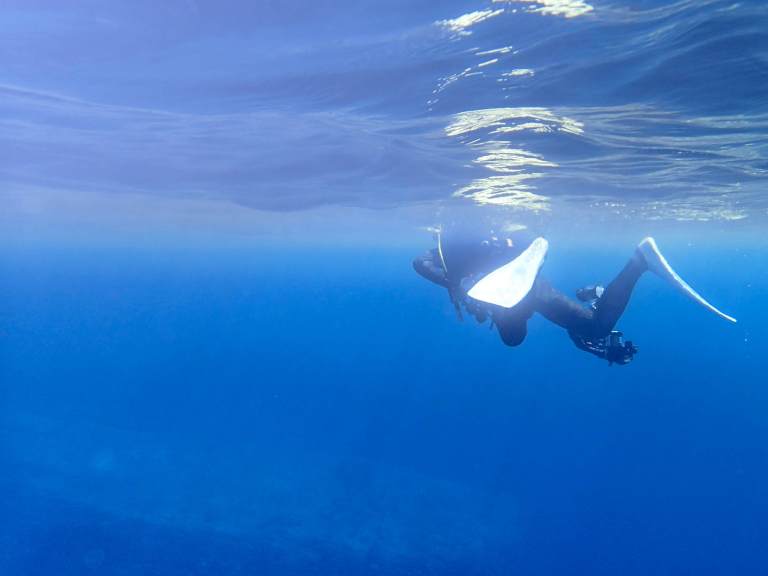
In September 2024, after touring Europe for 9 months, I realized I needed a new challenge. I had no routine back then, but I was itching for something that would push me out of my comfort zone. I hesitated between picking up rollerblading again, something familiar and nostalgic, or diving into something completely new.

As someone captivated by the ocean and its many mysteries, I started thinking why not do something with that? That’s how I got into scuba diving.

Now, I knew absolutely nothing about scuba diving. I’d snorkeled a million times before, sure, but as I quickly learned, scuba is a different beast altogether.

There was one small problem, though: I was only going to be around for a couple of weeks before heading off on a another road trip through Belgium, the Netherlands, Germany, and Luxembourg, before eventually visiting friends in Strasbourg and Romans. Not exactly the ideal time to start something new.

Still, I called the local dive club and got through to P. I think he’s the president, though I’m not entirely sure. What I do know is that he’s an experienced instructor and sounded like a genuinely nice guy. I told him I’d have to disappear for a couple of months after my first session, and he just said, “No problem. We’ll pick it up from there when you’re back in December.” That put me at ease.

Before leaving, I squeezed in my first-ever scuba dive in the pool, and let’s just say it didn’t go smoothly.

At barely two meters deep, the pressure was too much for my ears. We had to resurface twice before I could finally stay down. I was tense, bloated, and extremely uncomfortable, definitely not my finest hour. I left with more doubts than confidence. But I had two months to reflect, refocus, and maybe strengthen my Eustachian tube.

When I came back in December, I jumped right back in. The group had changed, most of the other “newbies” weren’t so new anymore, and they all seemed to know each other pretty well. I didn’t mind. P was there and made sure I was comfortable. Besides, I’ve always been a bit of an outsider anyway.

So, the second session? A total game changer. Thanks to the dryland workouts P had recommended, I was way more relaxed, and my ears cooperated this time. I actually enjoyed myself. It was the confidence boost I needed.

But not so fast.

Session three was a swim session. And here’s something I may have mentioned on this blog before: I’ve always wanted to learn how to swim properly, but never got around to it. Growing up by the sea, I swam “freestyle” almost every summer. My dad first threw me in the water at age 5. He’s always been a strong swimmer but me? Not so much. Or not at all!

So during that swim session, the lack of technique finally caught up with me. Everyone else swam like they knew what they were doing. I felt like I was flailing.

When I remember the most from that session was that the instructor on duty that day wasn’t exactly kind about it. However, another one quietly pulled me aside, explained what I was doing wrong, and gave me tips on how to improve. That five-minute exchange was all I needed.

Then came the sting.

At the end of the session, I overheard some instructors talking to P, my “supervisor.” Let’s just say that they were extremely harsh. I knew that I wasn’t ready, that I could barely float, that I couldn’t swim, but the stuff and the way they said it was just mean. But in hindsight, that moment made me push through to prove them wrong. I had no doubt that I would improve. Talk is cheap.

Right after that incident, I started taking proper swimming lessons outside of scuba. I practiced every chance I got. Little by little, things started clicking.

Weeks went by. My scuba technique improved. I got more confident in the water. I stopped feeling like I was just surviving and started actually enjoying it.

And just this past weekend, I went on my first dive in nature.

It was amazing.

Sure, I lost my weight belt (50 bucks gone in a splash) but I didn’t care. The dive itself was beautiful. I was paired with G, a quiet guy who knows his stuff. Not a chatterbox, but full of good advice. I also really like E, another club member. Super chill and probably the nicest guy there, even though I don’t see him often.

Now summer is right around the corner. In a few weeks, we have a diving weekend coming up, and I can’t wait. I’m close to getting my first-level certification. It’s been tough, my technique was abysmal when I started, but I’ve grown a lot. I’m feeling more comfortable, more daring.

My instructors helped me a lot. But I’m also proud of the work I put in. I earned this progress.

Will I continue next year? I think so. I want to see where this journey goes.

We’ll see what happens once the season ends.

Thanks for reading!

Teekay