Cu Chi tunnels

The Bomb Craters That Became Bunkers Beneath Cu Chi

On the American War, working with nature and the remarkable ingenuity of the Vietnamese resistance

Of the three things I wanted to see around Saigon (Ho Chi Minh City), Cu Chi was the one I almost didn’t care about.

It was last on my list. It ended up being first in my mind.

I thought I knew the American War in Vietnam fairly well.

Turns out, I barely knew anything.

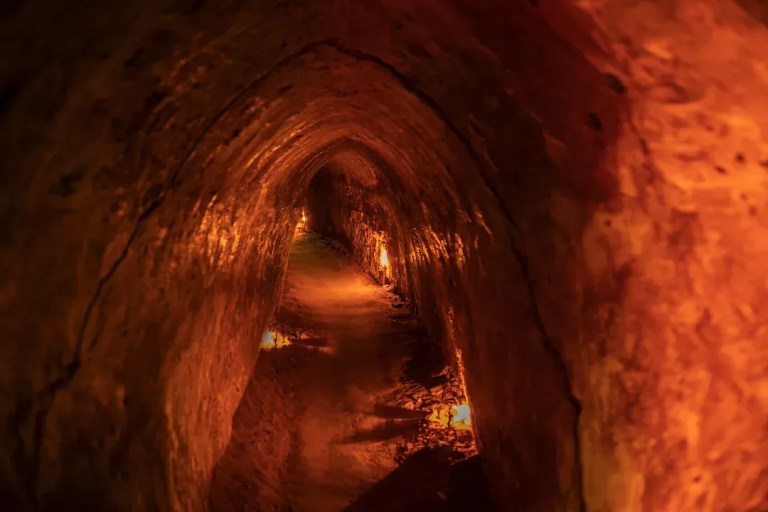
Cu Chi is a district outside Saigon where Vietnamese forces and civilians built a vast underground network during the American War. At its height, the tunnel system stretched for hundreds of kilometers beneath the jungle, allowing soldiers and civilians to live, move, fight and hide underground while American forces tried to destroy them from above.

Before I go any further, a special shoutout to our guide, Dragonking. Without his explanations, I would’ve walked away thinking I’d visited a fascinating historical site. Instead, I left with an entirely different way of looking at war, nature and human ingenuity.

The first thing he explained completely changed the way I looked at the tunnels.

Most people imagine that someone simply decided to dig more than 250 kilometers of tunnels beneath the jungle.

That’s not how it happened.

When American bombs carved enormous craters into the earth, the Vietnamese didn’t waste time filling them back in.

They used them.

A bomb crater became a bunker, built in a single night, without electricity, without machinery, without floodlights. The crater became the room. Trees, bamboo and clay hid it from above. Once the bunker was finished, they dug a tunnel to the next crater, then the next, then the next. Little by little, hundreds of isolated shelters became one of the most extraordinary underground networks ever built.

I kept waiting for Dragonking to move on to the next fact, the next date, the next number. He didn’t. He kept circling back to that same crater, that same night, as if the story wasn’t really about tunnels at all.

It wasn’t.

Along this trip, I realized I wasn’t learning about tunnels. I was learning about a completely different relationship with the world.

The deeper he went into the explanations, the more I noticed the same pattern repeating itself, over and over, in everything he described. Nothing existed on its own. Everything worked together.

The clay hid the entrances. The bamboo became pipes, supports and traps. The trees concealed the bunkers. Termite mounds inspired ventilation shafts that disappeared into the landscape. Some exits near the Saigon River even benefited from the natural movement of the tides to help circulate fresh air.

Smoke from cooking, something that could reveal an entire position, wasn’t simply vented into the air. It traveled through long underground channels before escaping so gradually that it blended into the morning mist rising through the forest.

None of it was borrowed and none of it was forced. Every part of the jungle already had a use, and they just had to notice it. Standing there, I couldn’t think of it as people surviving despite their surroundings. They were becoming part of them.

The tunnels themselves followed exactly the same philosophy. They weren’t designed to be comfortable. They were designed to favor the people who knew them.

Three underground levels housed kitchens, meeting rooms, hospitals, workshops, sleeping quarters and armories. Above them lay a maze of narrow passages, hidden doors and deadly traps. Punji stake pits, swinging spike traps and concealed trapdoors meant that even if an American soldier managed to enter, he had no idea where he was, where he was going or what waited around the next corner.

The jungle wasn’t protecting the tunnels. The tunnels were an extension of the jungle.

Then came the underground workshops, and this part genuinely left me speechless. When American bombs, artillery shells or rockets failed to explode, the Vietnamese collected them. They emptied the explosives to manufacture land mines. They cut up the steel to make traps. The enemy’s weapons became the tools of their own resistance.

Again, the same idea. Nothing was wasted. Everything was transformed.

By then, I stopped seeing individual examples. I started seeing a philosophy.

One side arrived with industrial warfare. Bombers. Napalm. Heavy machinery. The belief that overwhelming force could solve everything.

The other answered with clay, with bamboo, with rivers, with trees, with insects, with patience, with an intimate knowledge of the land they called home.

That’s probably why Cu Chi affected me so much. It wasn’t simply a story about winning a war. It was a story about understanding your environment so deeply that it becomes part of you.

Modern warfare usually leaves behind dead forests, poisoned rivers and landscapes stripped of life. Cu Chi tells another story. It reminds us that our greatest strength has never been our ability to dominate nature. It’s been our ability to work with it.

The Vietnamese didn’t separate themselves from the forest. They became an extension of it.

None of that erases what freedom cost here. No one should ever romanticize war, and nothing about those tunnels was easy or bloodless. But standing in them, one thing became impossible to ignore. The Vietnamese didn’t defeat a superpower by having more. They won by understanding something their enemy never truly could.

The land beneath their feet.

Thanks for reading.

Teekay
Backpacking

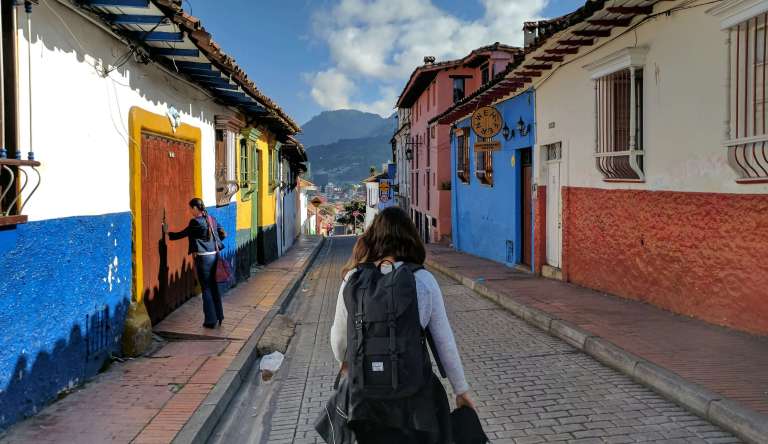
Backpacking lost its soul

On the ego that turned exploration into consumption.

People often ask why I spend weeks in one place when I could be crossing several countries off my list instead. I suppose I’ve never understood how moving more is supposed to mean seeing more.

I don’t travel to collect countries.

I travel to disappear into one.

Backpackers don’t stay anywhere anymore.

They arrive. They sleep. They photograph. They publish. They leave.

Then they repeat the process somewhere else until the trip ends and they return home exhausted, convinced they’ve seen the world because they were physically present in it.

They haven’t.

They’ve consumed it.

That’s what backpacking has become.

Not exploration.

Consumption.

Call me a gatekeeper if you want, but I don’t think making travel accessible to everyone was a good thing.

Some things deserve to remain difficult.

Difficulty isn’t just an obstacle.

It’s a filter.

Backpacking once demanded uncertainty. You hitchhiked because there wasn’t another option. You camped because you couldn’t afford hotels. You got lost because Google Maps didn’t exist. You depended on strangers because there was nobody else.

You didn’t stay three weeks because slow travel was fashionable.

You stayed because leaving wasn’t simple.

That difficulty selected people.

Not better people.

People with different motivations.

People who wanted to understand rather than display.

Then technology removed almost every barrier.

Flights became cheap.

Hostels multiplied.

Google Maps eliminated uncertainty.

Translation apps eliminated effort.

Social media eliminated the need to tell stories because photographs could pretend to tell them for you.

The filter disappeared.

The culture changed.

Today, travel isn’t sold as curiosity.

It’s sold as identity.

The tourism industry doesn’t ask what a country might teach you.

It asks who you’ll become once other people know you’ve been there.

Travel has become one of the cheapest ways to manufacture an identity.

You don’t need to become interesting.

You just need to stand somewhere interesting.

That’s why so many people return with bigger egos instead of broader minds.

Ask them what they learned.

Most will tell you what they saw.

Ask them about the people.

They’ll tell you about the monuments.

Ask them about the language.

They’ll proudly repeat the three words they learned after spending 90 days crossing six countries.

They’re collecting locations, not understanding and certainly not growth.

Tourism has become another branch of consumerism.

Countries are products.

Experiences are products.

Cultures are products.

Even people become products.

Everything exists to be consumed, photographed and replaced by the next destination.

The strangest part is how proud we are of this.

I’ve been to 25 countries.

Why is that impressive?

Wouldn’t it be more impressive to deeply understand one?

To speak its language.

To know its neighborhoods instead of its viewpoints.

To have friends instead of recommendations.

To return home with your certainties broken instead of your passport filled.

Movement has become confused with growth.

They’re not the same thing.

Most people don’t travel to become different.

They travel to confirm the person they already believe themselves to be.

Travel becomes evidence.

Proof that they’re adventurous.

Proof of their supposed open-mindedness, despite the racist behavior they display toward locals.

Proof that they’re successful.

It’s ego disguised as curiosity.

The environmental hypocrisy follows naturally.

People cry in front of ancient forests before buying products linked to deforestation.

They snorkel around coral reefs while financing industries that destroy them.

They admire wild animals, then return home and continue consuming the system driving those animals toward extinction.

Nature isn’t changing them.

It’s entertaining them.

People tell me tourism creates conservation.

I think that’s backwards.

Conservation is usually the bill we pay after treating the natural world like a warehouse.

The less we consume, the less there is to rescue.

The same thing happens with culture.

We’re constantly told cultural exchange is inherently beautiful.

Sometimes it is.

Sometimes it spreads destructive habits faster than wisdom.

The world is becoming culturally flatter.

Walk through enough cities and they begin to blur together.

The same cafés.

The same apartment blocks.

The same shopping streets.

The same influencers taking the same photographs.

We’ve mistaken imitation for development.

We’ve decided that progress means looking like whoever industrialized first.

Traditional architecture disappears because concrete and glass looks richer.

Buildings that evolved over centuries to suit local climates are demolished so cities can resemble places they were never meant to resemble.

I don’t call that progress.

I call it forgetting.

A yurt isn’t inferior because it doesn’t resemble a skyscraper.

An earth house isn’t backward because it isn’t made of concrete.

Architecture should answer the climate before it answers fashion.

A society should adapt to its environment before adapting to global trends.

That’s my definition of progress.

Better adaptation.

Not better imitation.

The same principle applies everywhere.

The easier photography became, the less people learned photography.

The easier publishing became, the less people learned to write.

The easier backpacking became, the more it became tourism.

Convenience doesn’t simply allow more people to participate.

It changes why they participate.

And once the reason changes, the activity changes with it.

That’s what happened to travel.

The greatest journeys aren’t measured by distance.

They’re measured by transformation.

You should come home questioning yourself more than the people you visited.

If all you brought back were photographs, opinions and a stronger sense of your own importance, then you didn’t really travel.

You consumed another place.

The tragedy isn’t that the world became accessible.

The tragedy is that accessibility turned one of humanity’s greatest opportunities for humility into another marketplace for ego.

Backpacking didn’t disappear.

Its soul did.

Thanks for reading.

Teekay

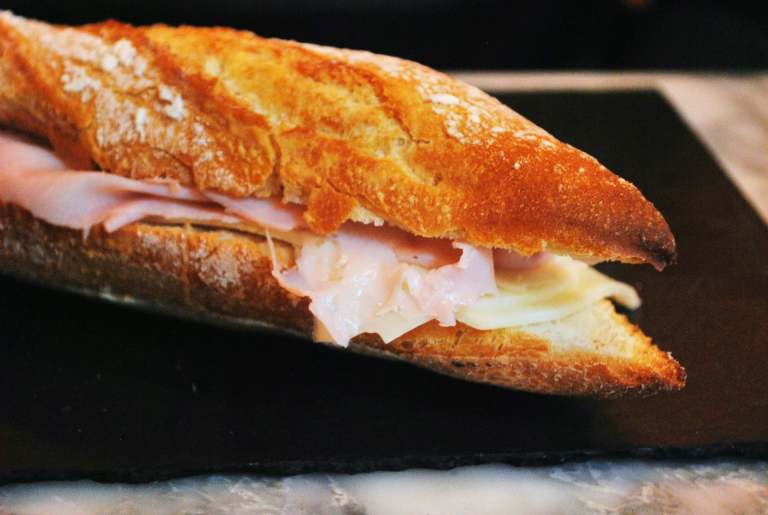
ham sandwich in a baguette

Every Wildfire Begins with a Sandwich

France braces for 5th heat wave since June.

France has barely extinguished one of its largest wildfires in decades. An area roughly the size of Hong Kong has burned, and we’re only halfway through the summer. But another heatwave is already here.

People ask how this keeps happening.

I think we’re asking the wrong question.

Every wildfire begins with a sandwich.

Not because a ham sandwich can physically ignite a forest, but because it represents the countless ordinary decisions that build the world in which forests burn.

The sandwich.

The cigarette.

The dairy ice cream we hand to our children without a second thought.

The Shein order arriving tomorrow.

The new backpack and notebooks bought every September even though last year’s are still perfectly usable.

Each decision appears harmless. Each is too small to matter. That is exactly how systems survive. It’s recreated every morning when we choose convenience over necessity, novelty over sufficiency, habit over reflection.

Every purchase is a vote. Not because one purchase changes the world overnight, but because billions of purchases, repeated every day, determine which industries grow, which disappear, and what kind of civilization we continue to finance.

One Amazon order won’t send a billionaire and his friends into space. One dairy ice cream won’t destroy a forest. One unnecessary notebook won’t fill a landfill.

But none of those things happens only once. They happen millions of times, every single day. Eventually those “insignificant” decisions become greenhouse gases, deforestation, polluted rivers, shrinking biodiversity, exhausted soils, expanding infrastructure and ecosystems pushed beyond their limits.

Then comes the heat. Then the drought. Then the spark.

And suddenly everyone becomes an environmentalist.

Hundreds of volunteers leave their homes to protect forests from the flames. They carry water, clear vegetation, do everything they can to stop the fire from reaching nearby villages. Most people see humanity at its finest.

I see humanity desperately trying to repair yesterday while continuing to finance it this morning.

The same people who volunteer their time and energy to protect the forest are then handed tables full of ham and butter sandwiches, soft drinks, sometimes cigarettes.

Volunteering is great. These people are giving their time to protect their homes, their communities, the forest around them. That matters. What bothers me is how easily we separate the emergency from everything that preceded it. We celebrate the person who runs toward the flames while treating the quieter forms of prevention as optional, eccentric, even ridiculous.

Refusing unnecessary consumption isn’t celebrated.

Reusing old supplies isn’t celebrated.

Eating less meat and dairy isn’t celebrated.

Living with less isn’t celebrated.

Those choices rarely earn applause because they happen long before the crisis, when there is no fire to fight and nobody watching. Yet they may matter far more than the dramatic moments that make the evening news.

We have confused loving the way nature makes us feel with caring about nature itself.

We hike through forests while eating products that contribute to the destruction of ecosystems. We photograph mountains while wrapped in disposable consumption. We defend a burning forest while continuing to finance the industries that place increasing pressure on forests around the world. We rush to fight the fire while throwing fuel onto it for the rest of the year. Economic fuel. Cultural fuel. Political fuel.

None of this means every choice weighs the same. A handful of industries and a handful of governments make decisions that outweigh what any individual could do in a lifetime, and no amount of reused notebooks cancels out a pipeline. But that asymmetry is not an excuse. It’s the reason our purchases are also our politics. Every dollar we hand to an industry is a small vote for its continued expansion, and the industries we’re describing don’t grow without millions of us feeding them first.

People often ask who is responsible for ecological collapse. The government? Corporations? Consumers? The uncomfortable answer is that there isn’t a single culprit. There is a chain, a chain in which every link seems too small to matter until the whole thing snaps.

That’s the butterfly effect.

A civilization is not destroyed by one catastrophic decision. It’ss destroyed by millions of ordinary ones.

And every wildfire begins with a sandwich.

Food for thought.

Teekay

You Don’t Need to Trust the Media to See Climate Change

Global warming is here to stay.

Climate change has become one of the most polarizing topics of our time.

Depending on who you ask, it’s either the greatest challenge humanity has ever faced or a problem that’s been exaggerated beyond recognition. Politicians argue about it. Television debates it. Social media turns it into another battleground.

But what if we stepped away from all of that for a moment?

What if, instead of asking what politicians, journalists or commentators think, we simply looked around us?

Sometimes, reality speaks for itself.

Over the past few years, I’ve watched rivers shrink, forests burn and heatwaves become increasingly common in places where they once felt exceptional. Friends living in different parts of the world tell similar stories. Farmers talk about unpredictable seasons. Water restrictions have become more frequent. Wildfires have intensified across multiple continents.

You don’t have to agree with every headline to notice that something is changing.

You don’t have to trust every report to observe what’s happening around you.

Talk to older relatives.

Talk to people who work the land.

Talk to fishermen, hikers or anyone who spends significant time outdoors.

Ask them whether the seasons still feel the same as they did twenty or thirty years ago.

Whether you trust politicians, journalists or climate scientists isn’t actually the point I’m making.

Reality exists independently of who reports it.

Climate change doesn’t care whether we’re conservative or progressive, religious or secular, rich or poor.

The atmosphere doesn’t vote.

Nature doesn’t negotiate.

The real question isn’t whether the climate is changing.

It’s how we choose to respond.

For me, the answer has less to do with waiting for revolutionary technologies than with rethinking the way we live.

We consume far more than we need.

We replace products that still work.

We normalize waste.

We chase convenience even when it comes at a tremendous environmental cost.

Modern consumerism has taught us that happiness comes from buying more.

The planet is telling us otherwise.

That doesn’t mean giving up comfort or returning to life centuries ago.

It means consuming more intentionally.

Buying fewer but better things.

Repairing instead of replacing.

Walking when we can.

Using public transportation more often.

Supporting companies that take sustainability seriously.

Reducing food waste.

Sharing resources instead of duplicating them.

Holding companies like banks accountable.

Many of these habits don’t just reduce our environmental impact.

They also save money, reduce stress and improve our quality of life.

That’s one of the reasons I was drawn to minimalism in the first place.

The same choices that help us live with less clutter often happen to be the same choices that place less strain on the planet.

Perhaps that isn’t a coincidence.

Maybe we’ve spent so long looking for complicated solutions that we’ve overlooked the simple ones.

Throughout history, humanity has repeatedly adapted to new challenges.

This one is no different.

The question isn’t whether change is coming.

It’s whether we’re willing to change with it.

Thanks for reading.

Teekay.