Climat action

Eat local is a comforting lie

Carbon offsetting, food choices and eating local

Walk into any farmers’ market or go to any “climate protest” and you’ll hear the same advice: eat local.

It’s sold as one of the simplest ways to reduce your carbon footprint. Buy beef from the farm down the road instead of the one shipped across the world and you’ve supposedly made an environmentally responsible choice.

You haven’t.

The phrase eat local has become one of the most successful pieces of green marketing ever created. Not because it’s entirely wrong, but because it distracts people with one of the smallest parts of the problem while protecting one of the largest.

Note: I use the same terminology as the studies I cite for consistency. That doesn’t mean I endorse it. Terms like beef and chicken are industry labels. They refer to the flesh of cows and hens who were killed, not something separate from the animals themselves.

The 6% illusion

Here’s the number almost nobody mentions.

Transport accounts for just 6% of global food emissions.

The other 94% comes from land use, farming, animal feed, methane, fertilizers and production itself. The truck is rarely the problem. The product is.

But not all products.

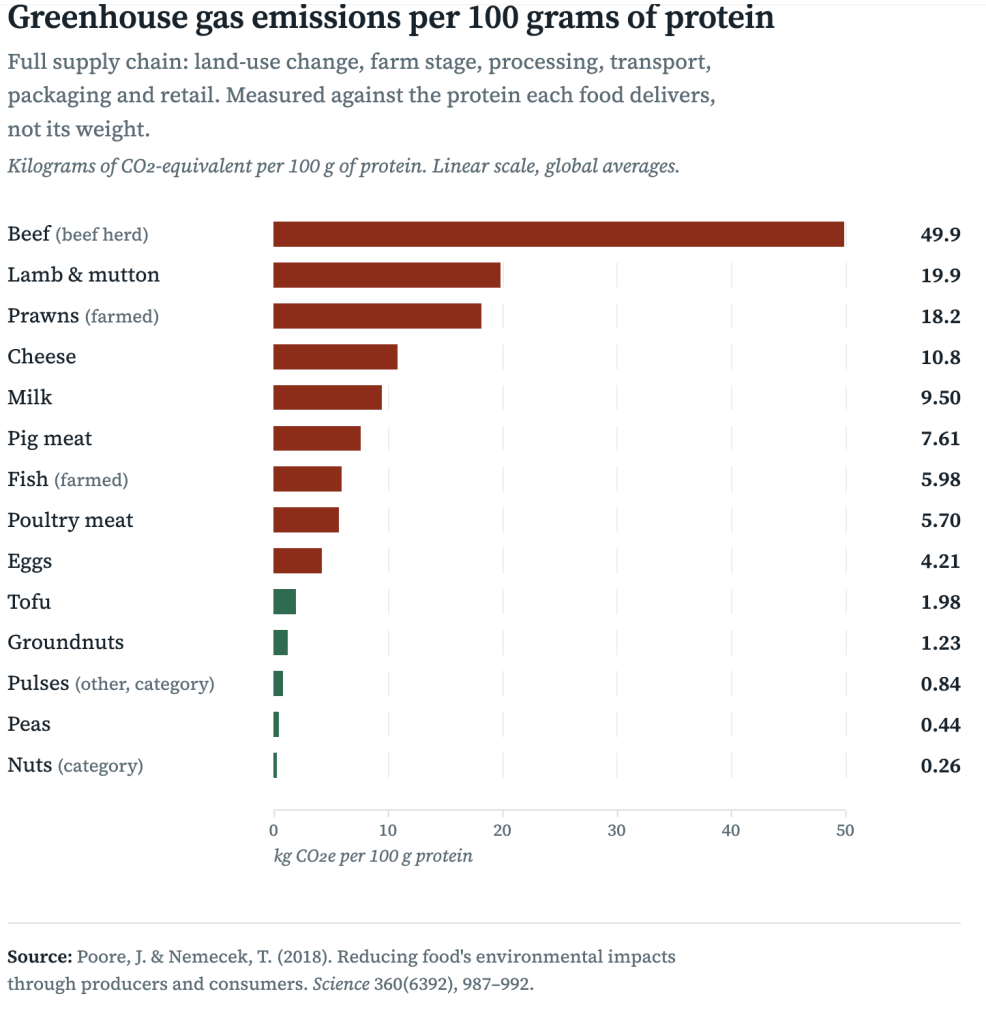
A kilogram of locally raised beef produces around 99 kg of greenhouse gases. Imported beans, lentils and peas produce between 1 and 2 kg.

That’s up to a 100-fold difference, even after crossing an ocean.

The climate doesn’t care whether the cow lived five kilometers away. It cares that it was a cow.

Transport accounts for just 6% of global food emissions, and roughly 1.5 to 2% of global emissions. In comparison, food waste alone is responsible for around 6% of all global greenhouse gas emissions.

Methane changes everything

Animal agriculture isn’t only a carbon problem.

Cattle release methane, a greenhouse gas that’s about 80 times more powerful than CO2 over a 20-year period. It remains in the atmosphere for a much shorter time than carbon dioxide, but its short-term warming effect is devastating, making livestock one of the fastest sectors where emissions should be reduced.

When people argue about food miles while ignoring methane, they’re arguing over the receipt instead of the bill.
The resources we’re running out of

Climate is only one consequence.

Livestock occupies 77% of the world’s farmland and gives back 18% of its calories and 37% of its protein. Most of that land isn’t feeding people. It’s feeding animals that were raised for the wrong reasons.

The cost is easier to see in reverse. If the world shifted to plant-based diets, agricultural land use would fall by about 75%, from roughly 4 billion hectares to 1 billion. Three quarters of all the farmland on Earth could go back to forest, wetland and grassland.

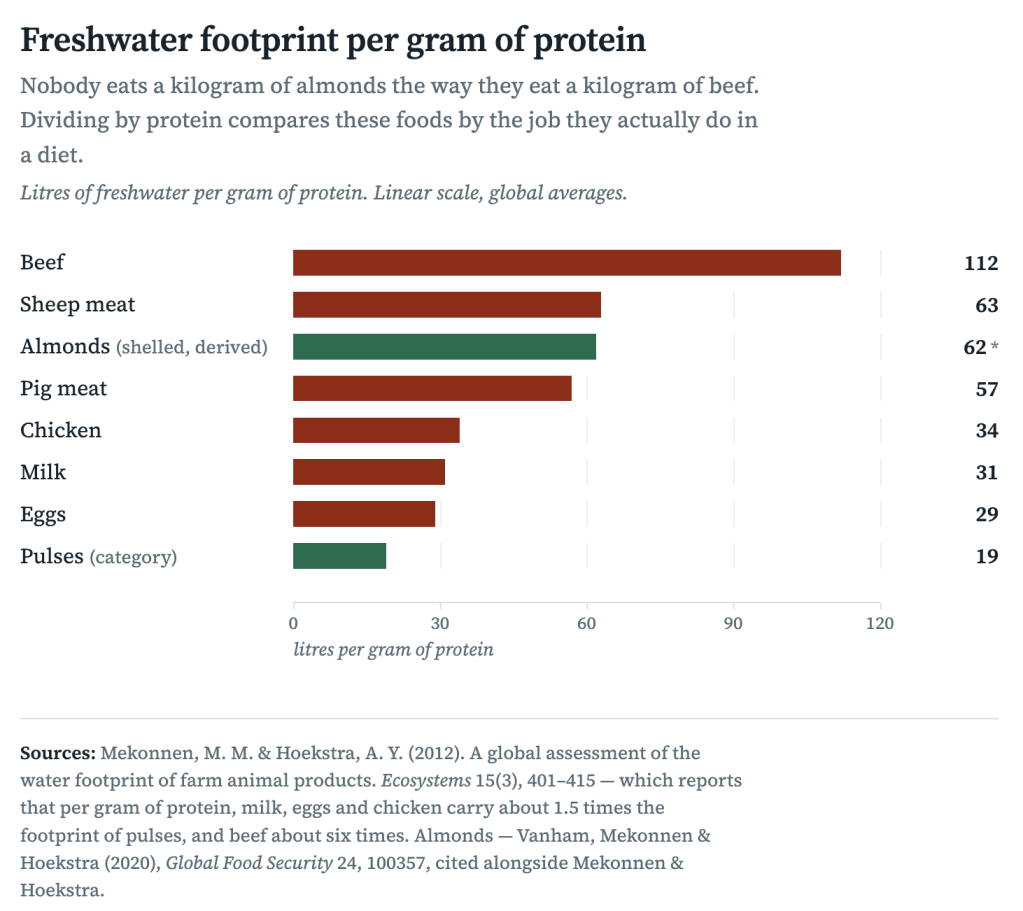
In simpler words, producing a gram of protein from beef or lamb takes up to 100 times the land that peas or tofu do. It also consumes staggering amounts of freshwater.
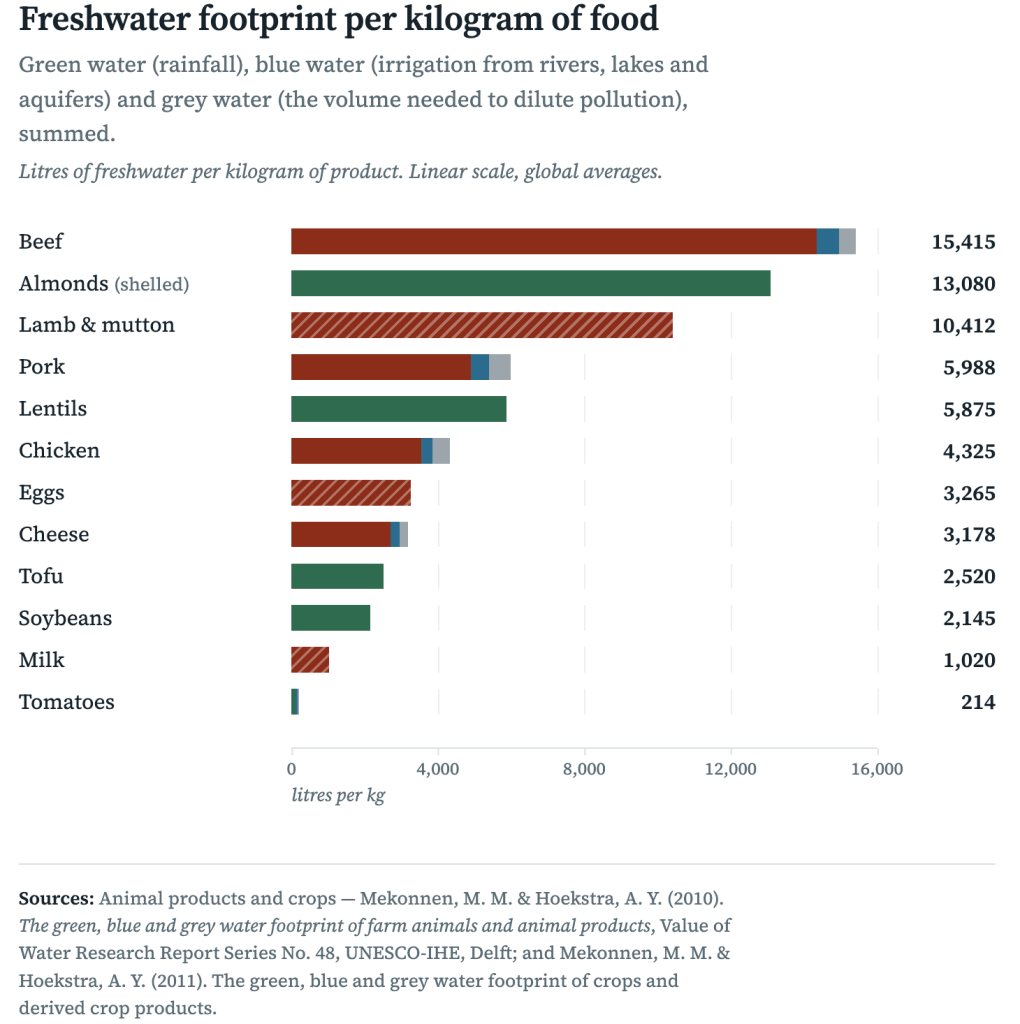
Producing one kilogram of beef requires around 15000 liters of water, while lentils require around 5900.

As such, per gram of protein, beef’s footprint is about six times that of pulses (legumes etc). At a time when droughts are intensifying and freshwater is becoming one of humanity’s most valuable resources, wasting it on livestock is becoming increasingly irrational and borderline suicidal.

Water should sustain people and ecosystems, not industrial animal farming.

It destroys our carbon sinks

The greatest (growing) hypocrisy is this: lots of people obsess over reducing transport emissions while defending the industry that destroys the very systems that absorb them.

I’m not saying we don’t need better transportation systems, but healthy oceans absorb about a quarter of humanity’s CO2 emissions every year already. Forests and other land ecosystems absorb close to a third. Together, they are Earth’s two largest natural carbon sinks. Maybe our focus must go to the right causes first, and it all starts with the same industry.

Then comes an even greater loss.

Mangroves, seagrass meadows and salt marshes, known as blue carbon ecosystems, store up to five times more carbon per square meter than tropical forests. Yet they’re disappearing through coastal development, agricultural pollution and increasingly severe droughts that dry out wetlands and accelerate their collapse.

Animal agriculture doesn’t only emit greenhouse gases. It replaces forests with pasture, pollutes rivers with billions of tonnes of manure, fuels green algae blooms that suffocate coastal waters and degrades wetlands that have protected our climate for thousands of years.

We’re not just adding carbon to the atmosphere, we’re destroying the planet’s ability to remove it.

The avocado argument

This is where the conversation becomes laughable.

Critics love pointing at avocados and almonds as if they’ve uncovered some fatal flaw in veganism.

It’s absurd for two reasons.

First, you don’t need to eat any of them to be vegan. Avocados and almonds are optional foods, not pillars of a plant-based diet. Lentils, beans, peas, potatoes, oats and countless other staples make the argument collapse before it even begins.

Second, even the numbers destroy the criticism.

A kilogram of beef requires around 15000 liters of water. Avocados use roughly 2000 liters. But sure, almonds are among the thirstiest plant foods on Earth at about 13000 liters, except nobody eats almonds by the kilogram.

Per gram of protein, beef still costs nearly twice as much water as almonds, and six times as much as pulses.

That said, not every animal product loses on every measure. Chicken uses less water per kilogram than lentils, and pointing that out doesn’t make a chicken farm a solution to anything.
So the comparison isn’t between perfect and imperfect.

It’s between one of the most resource-intensive plant foods and one of the most environmentally destructive foods on Earth.

Pointing at avocados while defending beef isn’t environmentalism. It’s deflection.

Stop confusing proximity with sustainability

None of this means local food has no value.

Supporting nearby farmers can strengthen rural communities, improve food resilience and reduce dependence on fragile global supply chains. Those are legitimate political and economic arguments.

Climate isn’t one of them.

If we’re serious about reducing environmental damage, the priorities are obvious:

  • Replace animal products with plants.
  • Restore forests, wetlands and mangroves.
  • Protect healthy oceans from pollution and overexploitation.
  • Move freight from roads to rail wherever possible.
  • Build reliable and affordable public transport.
  • Design walkable cities with safe cycling infrastructure.
  • Construct buildings that consume far less energy.

These solutions don’t compete. They reinforce one another.

The real environmental question was never how far did my food travel?

It was always what did it cost the planet to produce it?

P.S.: This essay focuses exclusively on the environmental impact of animal agriculture and carbon offsetting. The ethical question of animal wellbeing deserves its own discussion, and reducing living beings to emissions data alone misses a much deeper issue.

Thanks for reading.

Teekay
stop eating animals

Every road leads to the same slaughterhouse

Why are you vegan?

People ask me why I’m vegan more than almost any other question.

They expect a simple answer, one reason. The animals. The climate. Health.

The truth is less convenient.

A documentary started it. I watched Cowspiracy expecting to feel informed for an evening and come out the other side unchanged. That’s not what happened. Something in me actually shifted, and it didn’t shift back. It’s not a perfect film, a few of its numbers got oversimplified to the point of losing context, but the core of what it lays out is factual and well researched, and it did enough to make me curious.

It was the door. I went down the rabbit hole, and every subject I cared enough to study kept leading me to the same place. Climate change, ocean conservation, water scarcity, public health, colonial exploitation, every one of them led there.

The more I learned, the harder it became to justify participating in an industry that sits at the center of so many crises at once.

Sentience isn’t a seasoning

Everything else comes second.

A cow doesn’t want to be slaughtered. A pig fights for its life. Chickens recognize dozens of individuals and form complex social hierarchies. Octopuses solve puzzles. Fish remember routes, cooperate, and avoid painful experiences. The scientific debate is no longer whether many animals are sentient. It’s how rich their inner lives actually are.

An estimated 80 billion land animals are slaughtered every year for food. That number doesn’t include fish, whose deaths are measured in the trillions because they’re counted by weight rather than as individuals.

Modern language hides this. We say beef instead of cow, pork instead of pig, seafood instead of animals. We call slaughterhouses processing plants and carcasses products. The vocabulary exists to make violence feel industrial instead of personal.

If another being can suffer, the burden of proof should never sit on compassion. It should sit on exploitation.

The net effect

The ocean made me rethink everything.

I dive, and most of the people I dived with aren’t vegan. Ask them and they’ll tell you they love the ocean, and I don’t doubt they mean it. But loving an ecosystem while still funding the industries gutting it is a contradiction worth sitting with, not a small one, and it’s one very few divers ever examine.

We often imagine plastic bottles floating on the surface as the defining image of marine pollution. They matter, but they’re not the whole story. A large share of the plastic mass in the Great Pacific Garbage Patch, by most estimates close to half, is abandoned or discarded fishing gear. Nets keep killing animals for years after being lost, a phenomenon known as ghost fishing.

Then there’s bottom trawling.

Imagine dragging a weighted net across an ancient forest, flattening everything in its path, then throwing most of the wildlife back dead because it has no commercial value. That’s essentially what industrial trawling does to the seabed. Coral gardens, sponges, and countless species disappear beneath steel chains because efficiency demands it.

Every year, an estimated hundreds of thousands of dolphins, turtles, sharks, and seabirds die as bycatch. They were never the target. They’re collateral damage.

The ocean isn’t being emptied because billions of ordinary people fish with small boats. It’s being emptied because industrial fleets have turned living ecosystems into extraction zones.

Catch of the day

Fishing is also a story about power.

Countries with enormous industrial fleets don’t limit themselves to their own waters. They travel thousands of kilometers into the waters of poorer nations through unequal agreements, weak enforcement or outright illegal fishing.

In Senegal, fish has long been the foundation of both culture and nutrition. Yet many local fishers return with smaller catches than previous generations because industrial vessels remove fish on an entirely different scale. The result isn’t simply environmental decline. It’s food insecurity, unemployment, and ultimately migration.

When communities that have fished sustainably for centuries start struggling to feed themselves while foreign ships export their catch across continents, it’s hard to call that free trade. It looks much closer to colonial extraction wearing a modern suit.

The ocean belongs to no empire.

Empire and industry run on the same logic. Whoever holds power decides which lives count as resources and which don’t. That logic doesn’t start with the ocean. It starts with the animal on the plate, the first life reduced to a commodity, the template every later extraction gets copied from. Stop treating animals as property and the whole chain of domination loses the argument it was built on.

But soy

People still blame vegans for soy.

It’s one of the most successful and ridiculous myths ever created.

Every estimate lands well north of three quarters of the world’s soy grown to feed livestock, not people eating tofu or soy milk.

Chickens, pigs, and cattle consume astonishing quantities of crops before becoming meat. We don’t destroy forests because humans suddenly developed a love for edamame. We destroy them because billions of farmed animals need feeding.

The Amazon illustrates this perfectly.

Cattle ranching remains the largest driver of deforestation there. Forests are cleared for pasture, while surrounding land increasingly becomes monoculture growing feed for animals. Fire is often the cheapest way to erase thousands of years of biodiversity in a matter of hours.

The images are almost unbearable. Trees burning. Birds unable to escape. Mammals trapped by flames moving faster than they can run. Entire ecosystems reduced to ash so empty grass can replace living forest.

We call it development.

I call it extinction.

Green algae

People often argue over percentages. Was livestock responsible for 14 percent of emissions or 18 percent?

Here’s what the argument over the exact number misses. Whichever figure turns out to be more accurate, both put livestock among the two largest contributors to global emissions, alongside fossil fuels. Fighting over four percentage points doesn’t change which industries need to shrink.

Food systems account for roughly a third of global greenhouse gas emissions, and livestock is one of the largest pieces of that share through methane, deforestation, feed production and land use. Methane matters especially because it traps heat far more effectively than carbon dioxide in the short term.

The damage doesn’t stop at the atmosphere. It ends up in the water too.

Industrial farms produce mountains of manure. When nitrogen and phosphorus run into rivers, lakes, and coastal waters, algae multiply out of control. As they decompose, oxygen disappears and aquatic life suffocates.

Few places show this as clearly as Brittany, in France. Every summer, vast blooms of green algae cover its beaches. As the algae rot, they release hydrogen sulfide, a toxic gas that has been linked to the deaths of wild animals and, in a small number of documented cases, humans. This isn’t a natural disaster. It’s the predictable consequence of decades of intensive livestock farming and fertilizer runoff.

And the warming comes back around to the animals themselves. During recent heatwaves across Europe, thousands of farm animals died trapped inside industrial sheds and trucks before reaching slaughter. They survived neither nature nor the system built to profit from them.

The victims of climate change increasingly include those forced to produce it.

The side effects

I didn’t become vegan for my health.

It became an unexpected consequence.

The strongest scientific evidence is remarkably consistent. Diets centered on legumes, whole grains, fruits, vegetables, nuts, and seeds are associated with lower risks of cardiovascular disease, hypertension, and type 2 diabetes. Consumption of processed meat increases the risk of several cancers.

That doesn’t mean every vegan is healthy. French fries are vegan. Some donuts are vegan. Ethics and nutrition are different conversations.

The point isn’t that plants are magic. It’s that our healthiest dietary patterns consistently lean more on them and less on animals.

The next pandemic has a farm address

Humanity keeps building the perfect laboratory for new diseases.

When thousands of genetically similar animals are confined together, viruses evolve more easily. The closer the contact between stressed animals and humans, the greater the chance for pathogens to jump species.

Many of history’s most significant infectious diseases are zoonotic. They originated through animal to human transmission, even if each followed a different path.

Alongside this sits a quieter crisis. Antibiotics are routinely used in livestock around the world, not only to treat disease but often to prevent it in intensive systems. This accelerates antimicrobial resistance, letting bacteria evolve past medicines that once saved millions of lives.

We talk about the next pandemic as if it will arrive from nowhere. Often, we’re building it ourselves.

Burning calories to make calories

Perhaps the strangest part of all this is how inefficient it is.

We grow enormous quantities of edible crops, feed them to animals, lose most of the calories and protein during that biological conversion, then wonder why feeding humanity keeps getting harder.

Animal protein is one of the least efficient ways to produce food from land, water and crops. Producing protein directly from plants generally takes dramatically fewer resources while leaving more room for forests, wildlife and carbon storage.

Hunger has never been purely an agricultural problem. It’s always been a political one.

Life, itemized

The deeper I looked, the more one pattern kept repeating.

A forest became timber.

An ocean became a resource.

A river became a waste channel.

A cow became a machine for milk.

A chicken became a production unit.

A fish became tonnage.

Capitalism has an extraordinary ability to rename living beings until they sound like inventory. Once something becomes a commodity, its suffering disappears behind spreadsheets, shipping containers and quarterly profits. Dead bodies cross continents refrigerated inside trucks and cargo ships while consumers rarely think about the individual lives those numbers once represented.

The system depends on distance.

Distance between the slaughterhouse and the supermarket.

Distance between the fishing fleet and the village it impoverishes.

Distance between the burning forest and the burger.

Distance makes almost anything feel normal.

All roads lead to veganism

People still ask why I’m vegan.

I could say it’s for the animals, and that would be true.

I could say it’s for the climate, and that would also be true.

I could say it’s for cleaner rivers, living oceans, public health, or the communities losing their fisheries to industrial extraction. Every answer would be incomplete on its own.

Because veganism was never one road.

It was the destination where all the roads met.

The more I learned about suffering, the more impossible it became to justify taking part in it when another choice existed.

That’s why I’m vegan.

Teekay

ham sandwich in a baguette

Every Wildfire Begins with a Sandwich

France braces for 5th heat wave since June.

France has barely extinguished one of its largest wildfires in decades. An area roughly the size of Hong Kong has burned, and we’re only halfway through the summer. But another heatwave is already here.

People ask how this keeps happening.

I think we’re asking the wrong question.

Every wildfire begins with a sandwich.

Not because a ham sandwich can physically ignite a forest, but because it represents the countless ordinary decisions that build the world in which forests burn.

The sandwich.

The cigarette.

The dairy ice cream we hand to our children without a second thought.

The Shein order arriving tomorrow.

The new backpack and notebooks bought every September even though last year’s are still perfectly usable.

Each decision appears harmless. Each is too small to matter. That is exactly how systems survive. It’s recreated every morning when we choose convenience over necessity, novelty over sufficiency, habit over reflection.

Every purchase is a vote. Not because one purchase changes the world overnight, but because billions of purchases, repeated every day, determine which industries grow, which disappear, and what kind of civilization we continue to finance.

One Amazon order won’t send a billionaire and his friends into space. One dairy ice cream won’t destroy a forest. One unnecessary notebook won’t fill a landfill.

But none of those things happens only once. They happen millions of times, every single day. Eventually those “insignificant” decisions become greenhouse gases, deforestation, polluted rivers, shrinking biodiversity, exhausted soils, expanding infrastructure and ecosystems pushed beyond their limits.

Then comes the heat. Then the drought. Then the spark.

And suddenly everyone becomes an environmentalist.

Hundreds of volunteers leave their homes to protect forests from the flames. They carry water, clear vegetation, do everything they can to stop the fire from reaching nearby villages. Most people see humanity at its finest.

I see humanity desperately trying to repair yesterday while continuing to finance it this morning.

The same people who volunteer their time and energy to protect the forest are then handed tables full of ham and butter sandwiches, soft drinks, sometimes cigarettes.

Volunteering is great. These people are giving their time to protect their homes, their communities, the forest around them. That matters. What bothers me is how easily we separate the emergency from everything that preceded it. We celebrate the person who runs toward the flames while treating the quieter forms of prevention as optional, eccentric, even ridiculous.

Refusing unnecessary consumption isn’t celebrated.

Reusing old supplies isn’t celebrated.

Eating less meat and dairy isn’t celebrated.

Living with less isn’t celebrated.

Those choices rarely earn applause because they happen long before the crisis, when there is no fire to fight and nobody watching. Yet they may matter far more than the dramatic moments that make the evening news.

We have confused loving the way nature makes us feel with caring about nature itself.

We hike through forests while eating products that contribute to the destruction of ecosystems. We photograph mountains while wrapped in disposable consumption. We defend a burning forest while continuing to finance the industries that place increasing pressure on forests around the world. We rush to fight the fire while throwing fuel onto it for the rest of the year. Economic fuel. Cultural fuel. Political fuel.

None of this means every choice weighs the same. A handful of industries and a handful of governments make decisions that outweigh what any individual could do in a lifetime, and no amount of reused notebooks cancels out a pipeline. But that asymmetry is not an excuse. It’s the reason our purchases are also our politics. Every dollar we hand to an industry is a small vote for its continued expansion, and the industries we’re describing don’t grow without millions of us feeding them first.

People often ask who is responsible for ecological collapse. The government? Corporations? Consumers? The uncomfortable answer is that there isn’t a single culprit. There is a chain, a chain in which every link seems too small to matter until the whole thing snaps.

That’s the butterfly effect.

A civilization is not destroyed by one catastrophic decision. It’ss destroyed by millions of ordinary ones.

And every wildfire begins with a sandwich.

Food for thought.

Teekay