Climat action

Eat local is a comforting lie

Carbon offsetting, food choices and eating local

Walk into any farmers’ market or go to any “climate protest” and you’ll hear the same advice: eat local.

It’s sold as one of the simplest ways to reduce your carbon footprint. Buy beef from the farm down the road instead of the one shipped across the world and you’ve supposedly made an environmentally responsible choice.

You haven’t.

The phrase eat local has become one of the most successful pieces of green marketing ever created. Not because it’s entirely wrong, but because it distracts people with one of the smallest parts of the problem while protecting one of the largest.

Note: I use the same terminology as the studies I cite for consistency. That doesn’t mean I endorse it. Terms like beef and chicken are industry labels. They refer to the flesh of cows and hens who were killed, not something separate from the animals themselves.

The 6% illusion

Here’s the number almost nobody mentions.

Transport accounts for just 6% of global food emissions.

The other 94% comes from land use, farming, animal feed, methane, fertilizers and production itself. The truck is rarely the problem. The product is.

But not all products.

A kilogram of locally raised beef produces around 99 kg of greenhouse gases. Imported beans, lentils and peas produce between 1 and 2 kg.

That’s up to a 100-fold difference, even after crossing an ocean.

The climate doesn’t care whether the cow lived five kilometers away. It cares that it was a cow.

Transport accounts for just 6% of global food emissions, and roughly 1.5 to 2% of global emissions. In comparison, food waste alone is responsible for around 6% of all global greenhouse gas emissions.

Methane changes everything

Animal agriculture isn’t only a carbon problem.

Cattle release methane, a greenhouse gas that’s about 80 times more powerful than CO2 over a 20-year period. It remains in the atmosphere for a much shorter time than carbon dioxide, but its short-term warming effect is devastating, making livestock one of the fastest sectors where emissions should be reduced.

When people argue about food miles while ignoring methane, they’re arguing over the receipt instead of the bill.
The resources we’re running out of

Climate is only one consequence.

Livestock occupies 77% of the world’s farmland and gives back 18% of its calories and 37% of its protein. Most of that land isn’t feeding people. It’s feeding animals that were raised for the wrong reasons.

The cost is easier to see in reverse. If the world shifted to plant-based diets, agricultural land use would fall by about 75%, from roughly 4 billion hectares to 1 billion. Three quarters of all the farmland on Earth could go back to forest, wetland and grassland.

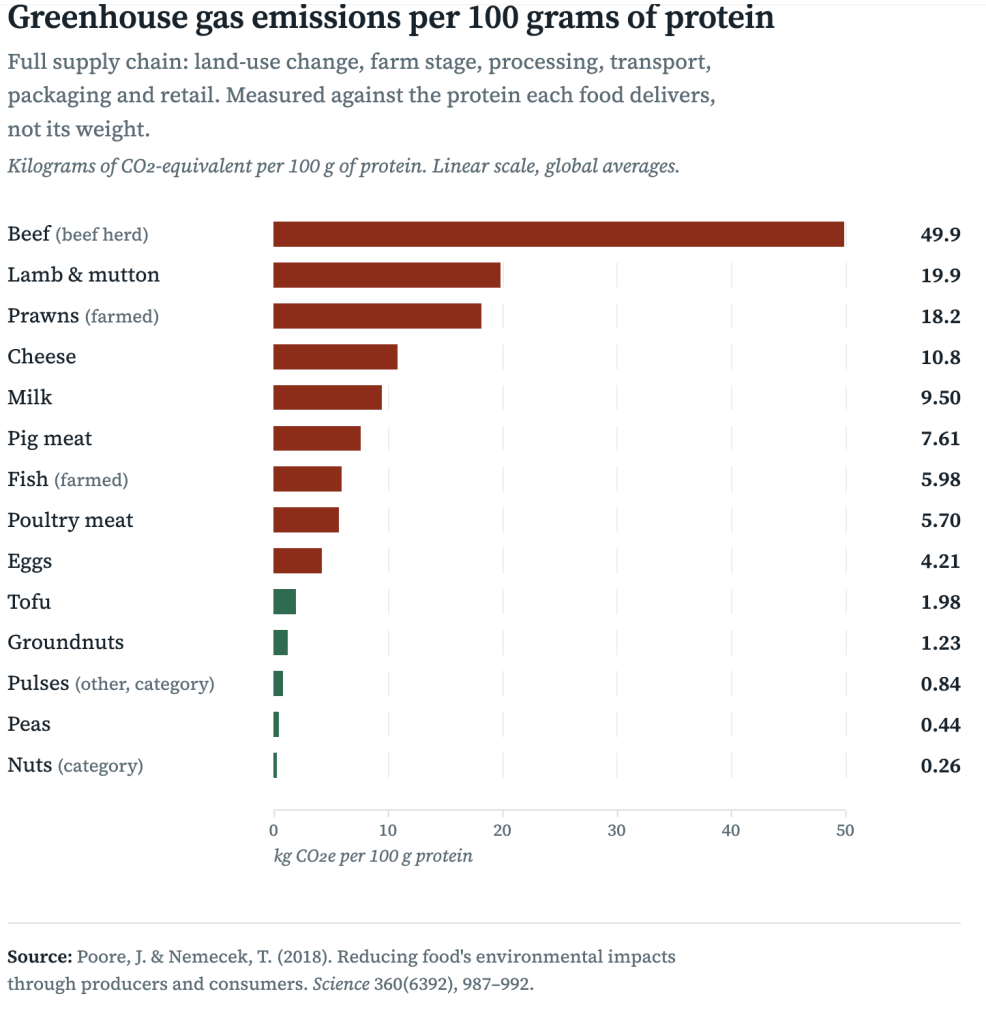
In simpler words, producing a gram of protein from beef or lamb takes up to 100 times the land that peas or tofu do. It also consumes staggering amounts of freshwater.
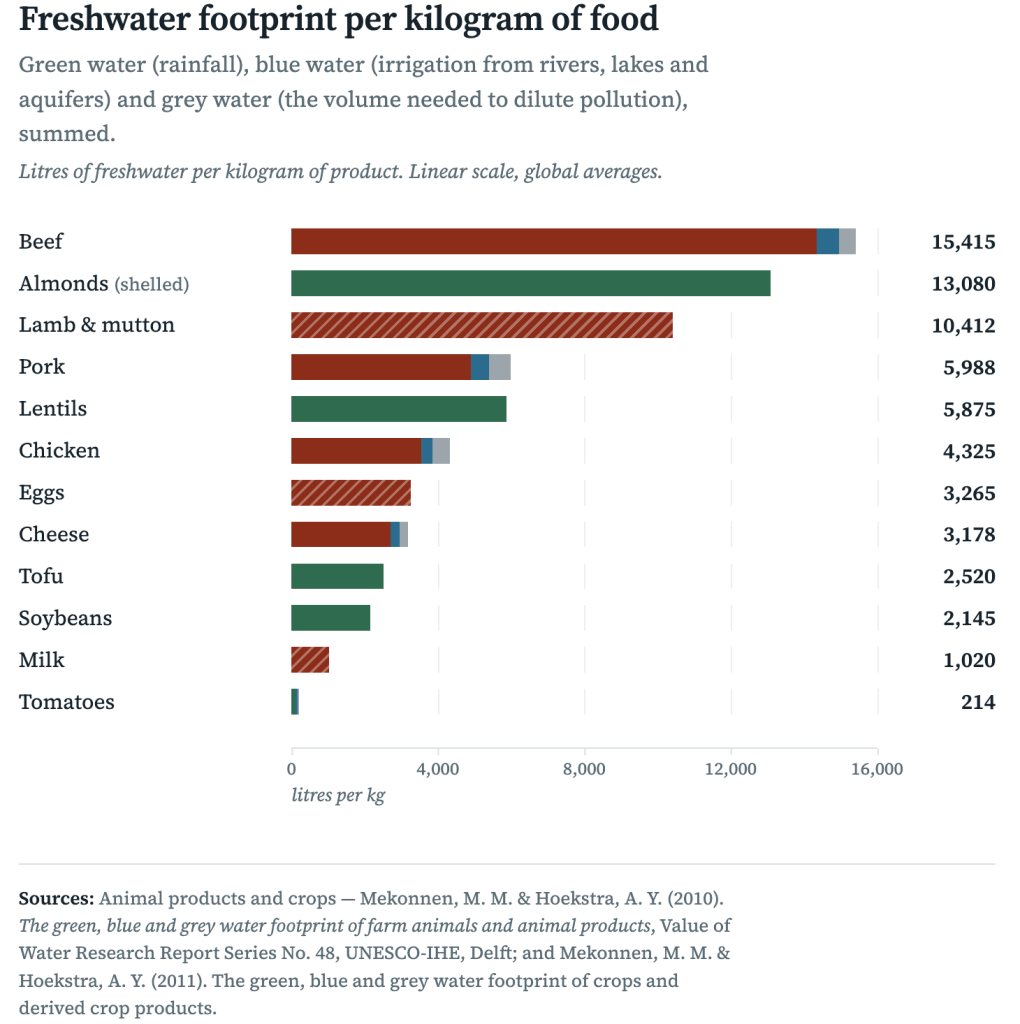
Producing one kilogram of beef requires around 15000 liters of water, while lentils require around 5900.

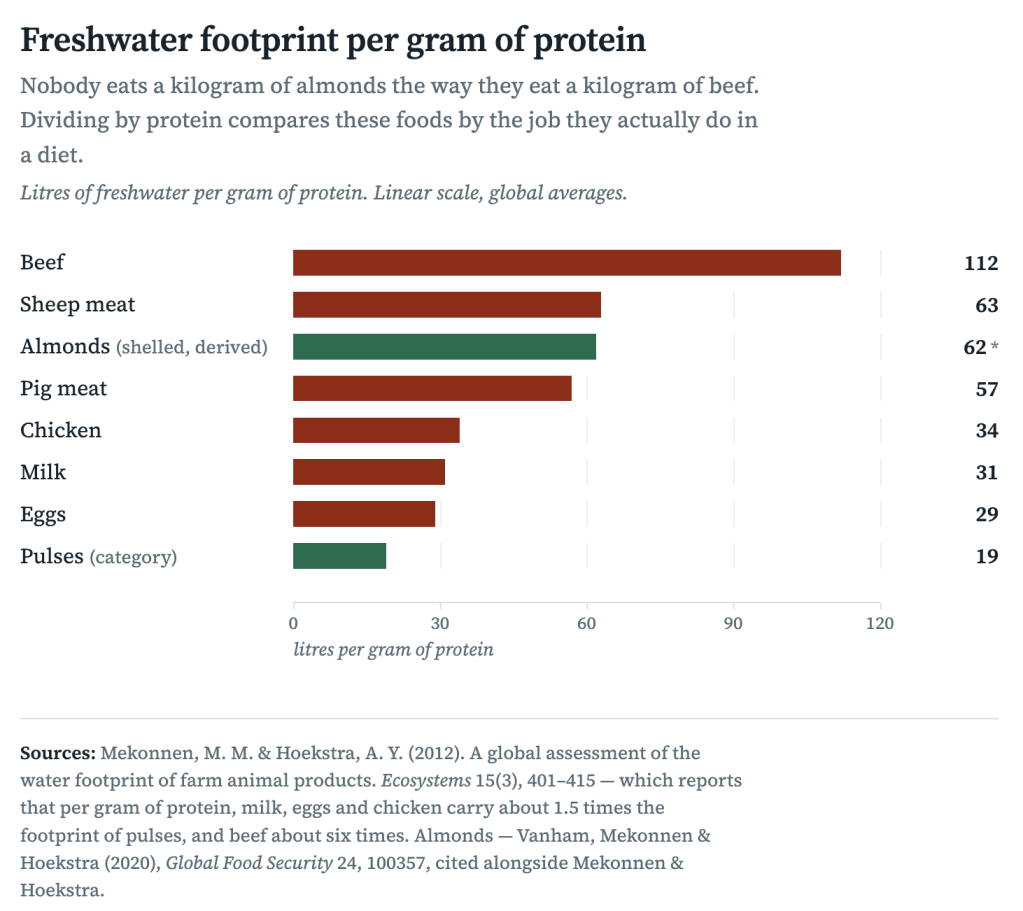
As such, per gram of protein, beef’s footprint is about six times that of pulses (legumes etc). At a time when droughts are intensifying and freshwater is becoming one of humanity’s most valuable resources, wasting it on livestock is becoming increasingly irrational and borderline suicidal.

Water should sustain people and ecosystems, not industrial animal farming.

It destroys our carbon sinks

The greatest (growing) hypocrisy is this: lots of people obsess over reducing transport emissions while defending the industry that destroys the very systems that absorb them.

I’m not saying we don’t need better transportation systems, but healthy oceans absorb about a quarter of humanity’s CO2 emissions every year already. Forests and other land ecosystems absorb close to a third. Together, they are Earth’s two largest natural carbon sinks. Maybe our focus must go to the right causes first, and it all starts with the same industry.

Then comes an even greater loss.

Mangroves, seagrass meadows and salt marshes, known as blue carbon ecosystems, store up to five times more carbon per square meter than tropical forests. Yet they’re disappearing through coastal development, agricultural pollution and increasingly severe droughts that dry out wetlands and accelerate their collapse.

Animal agriculture doesn’t only emit greenhouse gases. It replaces forests with pasture, pollutes rivers with billions of tonnes of manure, fuels green algae blooms that suffocate coastal waters and degrades wetlands that have protected our climate for thousands of years.

We’re not just adding carbon to the atmosphere, we’re destroying the planet’s ability to remove it.

The avocado argument

This is where the conversation becomes laughable.

Critics love pointing at avocados and almonds as if they’ve uncovered some fatal flaw in veganism.

It’s absurd for two reasons.

First, you don’t need to eat any of them to be vegan. Avocados and almonds are optional foods, not pillars of a plant-based diet. Lentils, beans, peas, potatoes, oats and countless other staples make the argument collapse before it even begins.

Second, even the numbers destroy the criticism.

A kilogram of beef requires around 15000 liters of water. Avocados use roughly 2000 liters. But sure, almonds are among the thirstiest plant foods on Earth at about 13000 liters, except nobody eats almonds by the kilogram.

Per gram of protein, beef still costs nearly twice as much water as almonds, and six times as much as pulses.

That said, not every animal product loses on every measure. Chicken uses less water per kilogram than lentils, and pointing that out doesn’t make a chicken farm a solution to anything.
So the comparison isn’t between perfect and imperfect.

It’s between one of the most resource-intensive plant foods and one of the most environmentally destructive foods on Earth.

Pointing at avocados while defending beef isn’t environmentalism. It’s deflection.

Stop confusing proximity with sustainability

None of this means local food has no value.

Supporting nearby farmers can strengthen rural communities, improve food resilience and reduce dependence on fragile global supply chains. Those are legitimate political and economic arguments.

Climate isn’t one of them.

If we’re serious about reducing environmental damage, the priorities are obvious:

  • Replace animal products with plants.
  • Restore forests, wetlands and mangroves.
  • Protect healthy oceans from pollution and overexploitation.
  • Move freight from roads to rail wherever possible.
  • Build reliable and affordable public transport.
  • Design walkable cities with safe cycling infrastructure.
  • Construct buildings that consume far less energy.

These solutions don’t compete. They reinforce one another.

The real environmental question was never how far did my food travel?

It was always what did it cost the planet to produce it?

P.S.: This essay focuses exclusively on the environmental impact of animal agriculture and carbon offsetting. The ethical question of animal wellbeing deserves its own discussion, and reducing living beings to emissions data alone misses a much deeper issue.

Thanks for reading.

Teekay
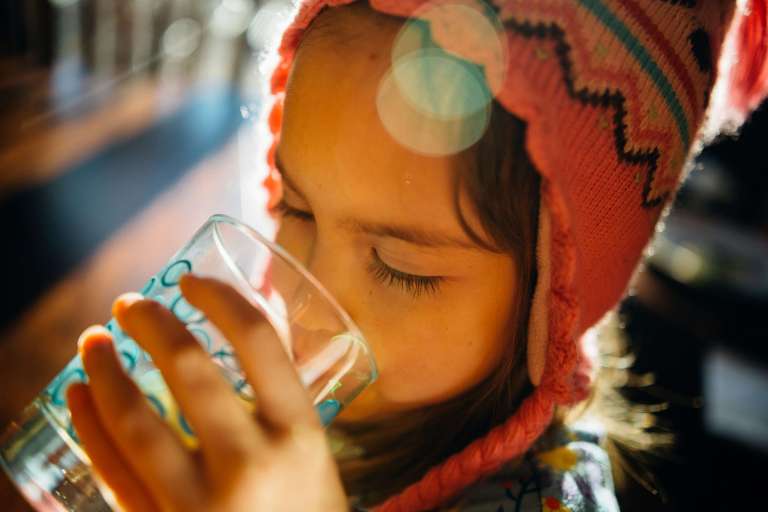
water magic

Water speaks in ways we ignore

A memory, a teacher, a traveler from space.

Once upon a time, exactly 4.5 billion years ago, Earth was a violent place.

There were no oceans. No rivers, no rain, no life. Just a molten ball of fire and gas, spinning restlessly in space.

And then it came. Not as a storm or a miracle, but as dust, rock, and ice, hurtling through space and crashing into this young planet during what scientists now call the Late Heavy Bombardment.

Over millions of years, icy asteroids and meteorites may have delivered what Earth itself couldn’t produce on its own: water. Drop by drop, this alien substance transformed our planet, cooling its surface, filling its craters, and laying the foundation for every living thing that would ever exist.

In other words, the water in your glass, in your blood, in your tears, may not be from Earth.

This is a common theory among scientists, but how do they back it up?

Well, simply put, traces of deuterium (a form of hydrogen) in Earth’s water match those found in carbon-rich meteorites, not in Earth’s original atmosphere. In other words, water could well be extraterrestrial and we’re walking oceans, born of stardust and comets.

Pretty cool.

“A water molecule is made up of one atom of oxygen and two of hydrogen. Hydrogen was created in the Big Bang, and oxygen in the cores of stars more massive than the Sun. Enormous amounts of water, in gaseous form, exist in the vast stellar nurseries of our galaxy.” – NASA

All that being said, new discoveries have challenged that theory. Science doesn’t care about romance and poetry..

But that’s only the beginning of the story.

Water is alive in ways we’re still discovering

Science has always viewed water as simple H₂O. But the more we look, the more mysterious it becomes.

Water doesn’t just hydrate, it reacts. It listens, and it may even remember!

Case in point, when scientists drill into glaciers in Antarctica or Greenland, they’re not just pulling out ice. They’re pulling out history. Inside those frozen cores are bubbles of ancient air, particles of volcanoes and wildfires, records of rainfall, drought, and dust storms, all preserved in perfect detail. These layers tell us the climate story of Earth going back hundreds of thousands of years.

So yeah, water stores information. It has a memory. It IS a memory, not metaphorically but quite literally.

But what if water also stores something more subtle?

Can water feel ? Like, does it have feelings?

The late Dr. Masaru Emoto, a Japanese researcher, believed it did. In his famous (and controversial) experiments, he exposed water to different words, prayers, music, and intentions, then froze it and photographed the crystals that formed.

On one hand, water blessed with words like “love” or “gratitude” formed stunning, symmetrical snowflake-like shapes. On the other, water exposed to hate, anger, or pollution formed distorted, chaotic patterns.

His work was dismissed by many in the scientific community, as they do. But for others, it cracked open a door. A possibility that consciousness and water might be connected in ways we don’t yet understand.

The mystery of memory in water

In 2009, Luc Montagnier, the Nobel Prize–winning virologist who co-discovered HIV, published a paper suggesting that highly diluted DNA in water emits electromagnetic signals, and that water retains this information even when the DNA is gone.

Another researcher and Swiss chemist, Louis Rey, studied water’s “memory” through thermoluminescence and noticed changes depending on what the water had previously been exposed to.

These findings are controversial, but they echo something ancient cultures have always known:

That water is not just a substance, it’s a carrier. A messenger. A mirror.

Water in religion & spirituality

Across every tradition and belief system, water is sacred.

• In Islam, it is said in the Qur’an: “We made from water every living thing” (21:30). Before drinking or washing, Muslims say “Bismillah”, or In the name of God, inviting His name to bless the water. Then there is the water of Zamzam, a sacred well in Mecca, believed to have sprung miraculously for Hagar and her son Ishmael in the desert. This water is revered for its purity and spiritual significance, and pilgrims often drink it during Hajj and Umrah, and take it home as a cherished gift.

• In Christianity, water baptizes, purifies, rebirths.

• In Buddhism and Taoism, water is a symbol of humility and transformation. It yields but wears down mountains.

• And Bruce Lee, blending martial arts with Eastern philosophy, famously said:

“Be like water, my friend.”

Meaning: stay flexible, formless, adaptive, like the element that takes the shape of whatever holds it, and yet remains itself.

Water teaches us to flow, to remember, and to release.

Our bodies remember too

Our body is made up of about 60% water. Our brain? Closer to 75%.

We are, quite literally, a walking river. Every cell depends on water, not just to survive, but to communicate, to regenerate, to feel.

Our emotions, hormones, sleep, focus, creativity, they all ride on the flow of water inside us.

And yet, for something so vital, we’ve forgotten how rare it is.

Water is scarce and under threat

Earth may be covered in water, but only 0.007% of it is drinkable and accessible. The rest is locked away in oceans, glaciers, or underground.

Meanwhile, pollution, overconsumption, and climate change are drying up and polluting a resource that our very existence relies on. Every environmental campaign is focused on the pollution of air (which causes 7 million deaths a year), which is great, but most campaigns don’t even touch on the irreversible pollution of water (mostly due to the fashion industry and animal breeding). Why? The air is much easier to clean than our fresh water streams. and yet..

Meanwhile, pollution, overconsumption, and climate change are depleting and contaminating a resource essential to our very survival: water. Most environmental campaigns rightly focus on air pollution, which causes 7 million deaths each year btw, but rarely address the irreversible pollution of our freshwater sources, much of it driven by the fashion industry and industrial animal farming. Why? I mean if anything, air is far easier to clean than our streams, rivers, and aquifers..

• The fashion industry produces 20% of global industrial water pollution. Dyes and synthetic materials poison rivers from Asia to South America.

• The meat industry is one of the biggest consumers and polluters of water. One single beef burger requires over 2,000 liters of water to produce. But that’s not it: Waste from livestock contaminates rivers and groundwater. Read about the Green Tide, aka Killer Slime or green algae, a magic seaweed that can kill you in SECONDS, another scandal brushed under the rug because a certain lobby is too powerful to let it be mediatized.

Food production accounts for over a quarter (26%) of global greenhouse gas emissions. 18% of those are due to livestock production. – Stanford

• Plastic and pesticides enter our lakes and oceans at alarming rates. Microplastics have now been found in rainwater and even in unborn babies.

By 2030, the United Nations warns that 40% of people could face severe water scarcity if we don’t act.

Water is strong. It’s self-purifying, patient, ancient. But even it has limits.

A call to return to reverence

We live in a world where water comes from a tap, which is why we forget how sacred it is. We wear clothes made in countries we’ll never visit, eat food raised on land we’ll never see, throw away plastics that outlive us by centuries, and we don’t see the water trails behind them.

But now we know better.

We know that water is more than H₂O. It holds the blueprint of life and the story of our planet. It listens. It reflects us.

So what can we do?

• Plant trees.

• Eat more plants and less dead flesh.

• Repair our clothes.

• Use less plastic and ban single use plastics.

• Speak blessings into our glass.

• Treat water like the rare, cosmic treasure that it is.

Because every drop of water you drink has seen stars. It’s been ice. It’s been vapor. It’s fallen as rain, flowed through rivers, and run through the veins of everything that has ever lived.

And maybe, just maybe, when you speak to it, it remembers you too.

Thanks for reading.

Tee.