Carbon offsetting, food choices and eating local
Walk into any farmers’ market or go to any “climate protest” and you’ll hear the same advice: eat local.
It’s sold as one of the simplest ways to reduce your carbon footprint. Buy beef from the farm down the road instead of the one shipped across the world and you’ve supposedly made an environmentally responsible choice.
You haven’t.
The phrase eat local has become one of the most successful pieces of green marketing ever created. Not because it’s entirely wrong, but because it distracts people with one of the smallest parts of the problem while protecting one of the largest.
Note: I use the same terminology as the studies I cite for consistency. That doesn’t mean I endorse it. Terms like beef and chicken are industry labels. They refer to the flesh of cows and hens who were killed, not something separate from the animals themselves.
The 6% illusion
Here’s the number almost nobody mentions.
Transport accounts for just 6% of global food emissions.
The other 94% comes from land use, farming, animal feed, methane, fertilizers and production itself. The truck is rarely the problem. The product is.
But not all products.
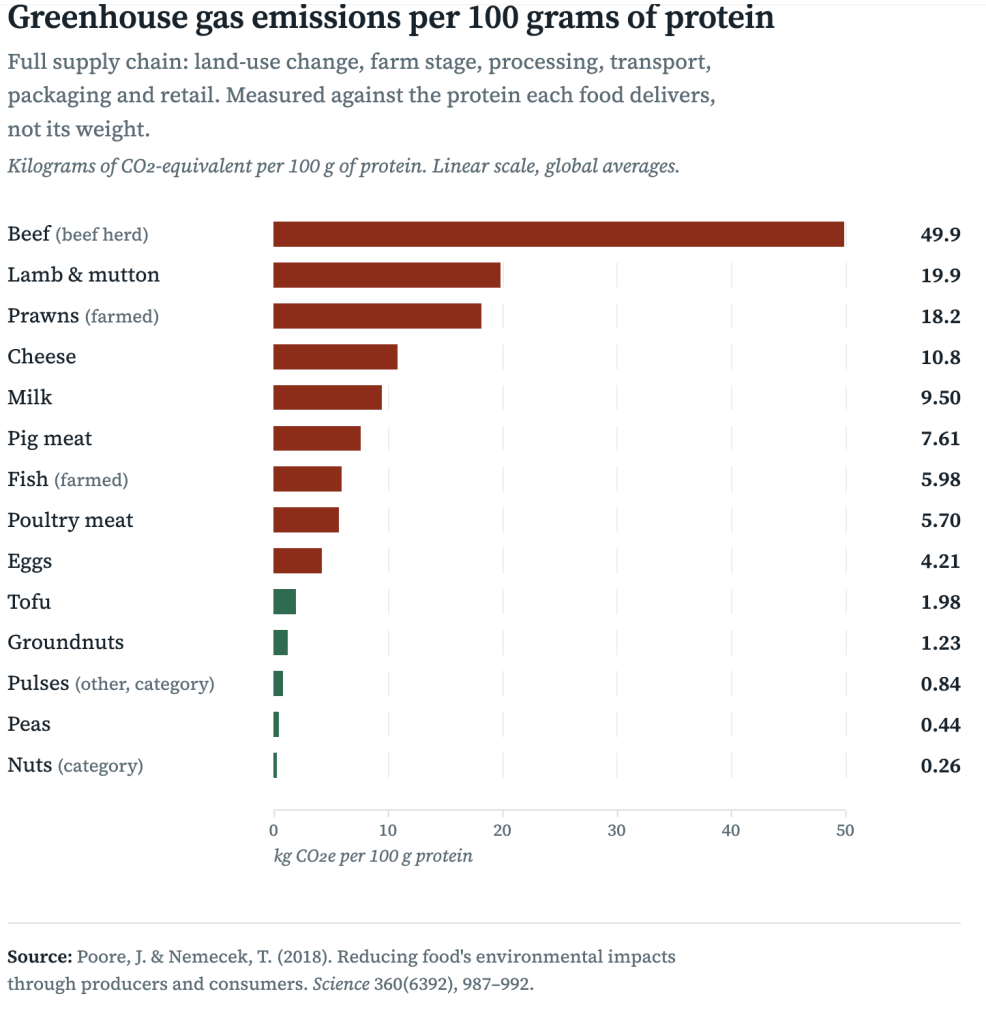
A kilogram of locally raised beef produces around 99 kg of greenhouse gases. Imported beans, lentils and peas produce between 1 and 2 kg.
That’s up to a 100-fold difference, even after crossing an ocean.
The climate doesn’t care whether the cow lived five kilometers away. It cares that it was a cow.
Transport accounts for just 6% of global food emissions, and roughly 1.5 to 2% of global emissions. In comparison, food waste alone is responsible for around 6% of all global greenhouse gas emissions.
Methane changes everything
Animal agriculture isn’t only a carbon problem.
Cattle release methane, a greenhouse gas that’s about 80 times more powerful than CO2 over a 20-year period. It remains in the atmosphere for a much shorter time than carbon dioxide, but its short-term warming effect is devastating, making livestock one of the fastest sectors where emissions should be reduced.
When people argue about food miles while ignoring methane, they’re arguing over the receipt instead of the bill.
The resources we’re running out of
Climate is only one consequence.
Livestock occupies 77% of the world’s farmland and gives back 18% of its calories and 37% of its protein. Most of that land isn’t feeding people. It’s feeding animals that were raised for the wrong reasons.
The cost is easier to see in reverse. If the world shifted to plant-based diets, agricultural land use would fall by about 75%, from roughly 4 billion hectares to 1 billion. Three quarters of all the farmland on Earth could go back to forest, wetland and grassland.
In simpler words, producing a gram of protein from beef or lamb takes up to 100 times the land that peas or tofu do. It also consumes staggering amounts of freshwater.
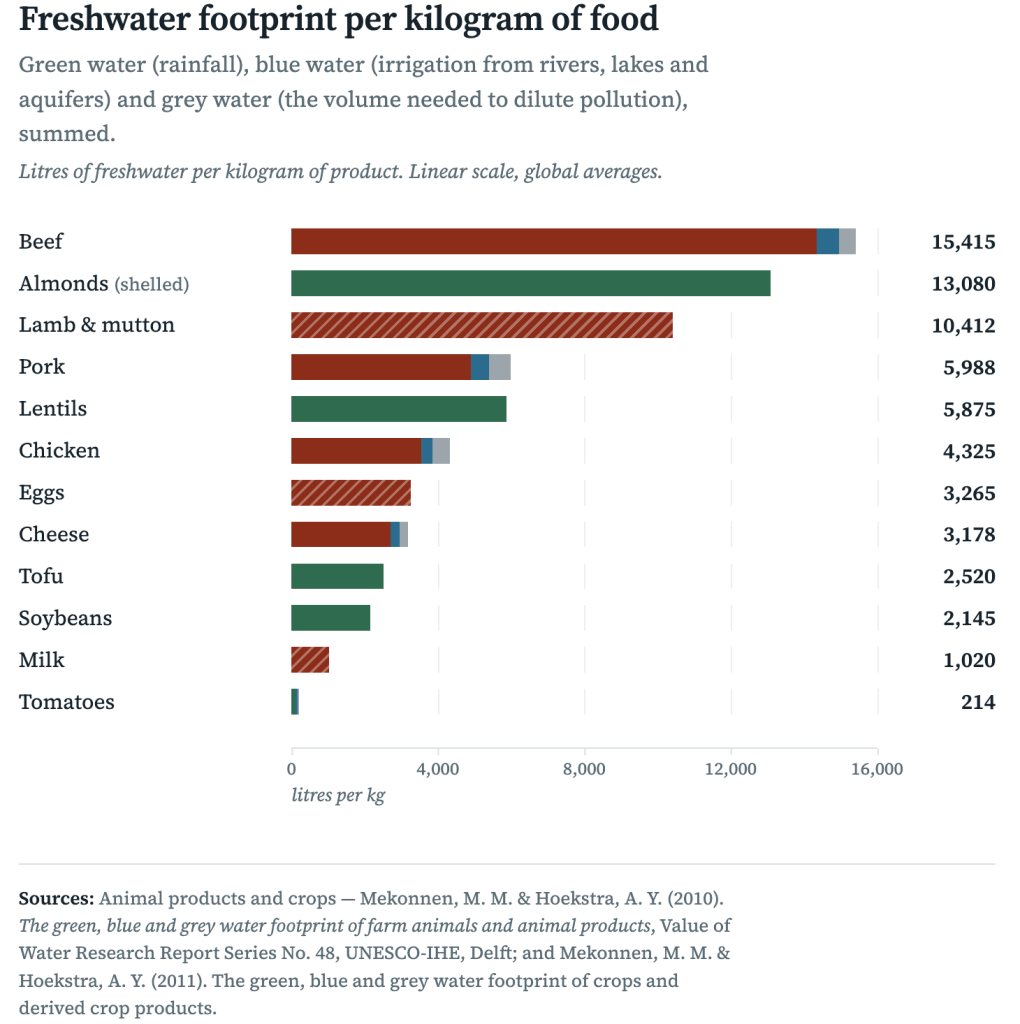
Producing one kilogram of beef requires around 15000 liters of water, while lentils require around 5900.
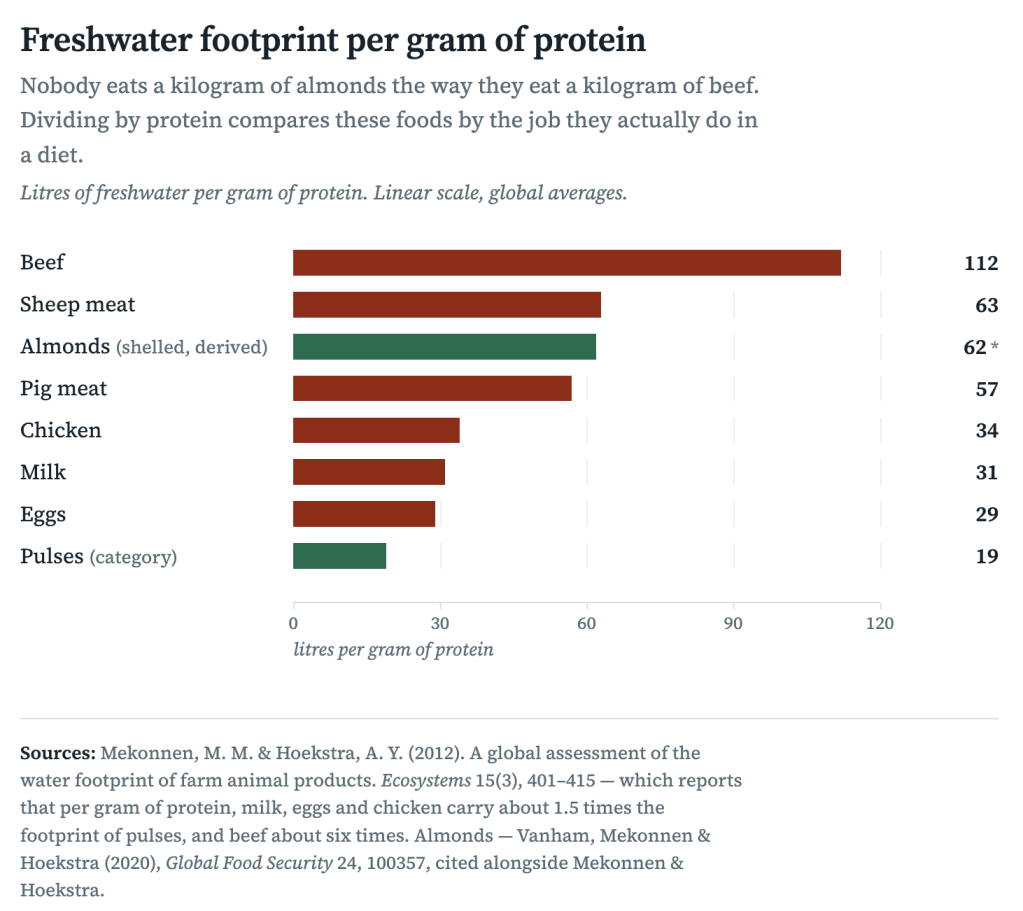
As such, per gram of protein, beef’s footprint is about six times that of pulses (legumes etc). At a time when droughts are intensifying and freshwater is becoming one of humanity’s most valuable resources, wasting it on livestock is becoming increasingly irrational and borderline suicidal.
Water should sustain people and ecosystems, not industrial animal farming.
It destroys our carbon sinks
The greatest (growing) hypocrisy is this: lots of people obsess over reducing transport emissions while defending the industry that destroys the very systems that absorb them.
I’m not saying we don’t need better transportation systems, but healthy oceans absorb about a quarter of humanity’s CO2 emissions every year already. Forests and other land ecosystems absorb close to a third. Together, they are Earth’s two largest natural carbon sinks. Maybe our focus must go to the right causes first, and it all starts with the same industry.
Then comes an even greater loss.
Mangroves, seagrass meadows and salt marshes, known as blue carbon ecosystems, store up to five times more carbon per square meter than tropical forests. Yet they’re disappearing through coastal development, agricultural pollution and increasingly severe droughts that dry out wetlands and accelerate their collapse.
Animal agriculture doesn’t only emit greenhouse gases. It replaces forests with pasture, pollutes rivers with billions of tonnes of manure, fuels green algae blooms that suffocate coastal waters and degrades wetlands that have protected our climate for thousands of years.
We’re not just adding carbon to the atmosphere, we’re destroying the planet’s ability to remove it.
The avocado argument
This is where the conversation becomes laughable.
Critics love pointing at avocados and almonds as if they’ve uncovered some fatal flaw in veganism.
It’s absurd for two reasons.
First, you don’t need to eat any of them to be vegan. Avocados and almonds are optional foods, not pillars of a plant-based diet. Lentils, beans, peas, potatoes, oats and countless other staples make the argument collapse before it even begins.
Second, even the numbers destroy the criticism.
A kilogram of beef requires around 15000 liters of water. Avocados use roughly 2000 liters. But sure, almonds are among the thirstiest plant foods on Earth at about 13000 liters, except nobody eats almonds by the kilogram.
Per gram of protein, beef still costs nearly twice as much water as almonds, and six times as much as pulses.
That said, not every animal product loses on every measure. Chicken uses less water per kilogram than lentils, and pointing that out doesn’t make a chicken farm a solution to anything.
So the comparison isn’t between perfect and imperfect.
It’s between one of the most resource-intensive plant foods and one of the most environmentally destructive foods on Earth.
Pointing at avocados while defending beef isn’t environmentalism. It’s deflection.
Stop confusing proximity with sustainability
None of this means local food has no value.
Supporting nearby farmers can strengthen rural communities, improve food resilience and reduce dependence on fragile global supply chains. Those are legitimate political and economic arguments.
Climate isn’t one of them.
If we’re serious about reducing environmental damage, the priorities are obvious:
- Replace animal products with plants.
- Restore forests, wetlands and mangroves.
- Protect healthy oceans from pollution and overexploitation.
- Move freight from roads to rail wherever possible.
- Build reliable and affordable public transport.
- Design walkable cities with safe cycling infrastructure.
- Construct buildings that consume far less energy.
These solutions don’t compete. They reinforce one another.
The real environmental question was never how far did my food travel?
It was always what did it cost the planet to produce it?
P.S.: This essay focuses exclusively on the environmental impact of animal agriculture and carbon offsetting. The ethical question of animal wellbeing deserves its own discussion, and reducing living beings to emissions data alone misses a much deeper issue.
Thanks for reading.
Teekay
Discover more from Teekay Rezeau-Merah
Subscribe to get the latest posts sent to your email.

