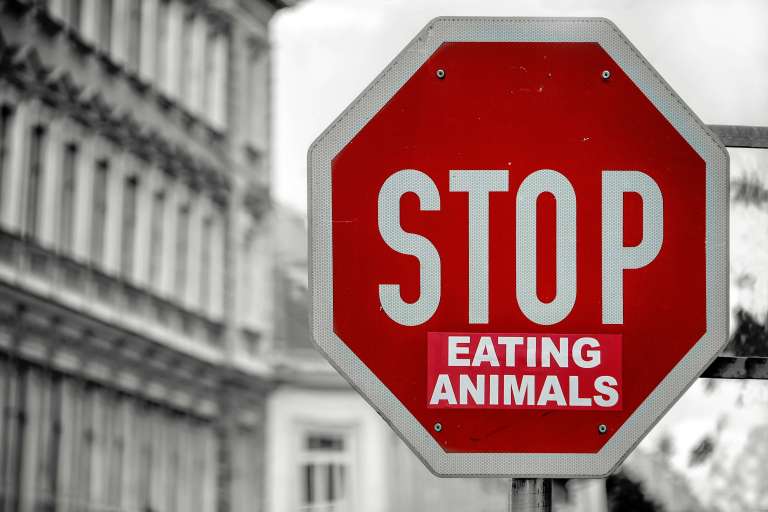
Why are you vegan?
People ask me why I’m vegan more than almost any other question.
They expect a simple answer, one reason. The animals. The climate. Health.
The truth is less convenient.
A documentary started it. I watched Cowspiracy expecting to feel informed for an evening and come out the other side unchanged. That’s not what happened. Something in me actually shifted, and it didn’t shift back. It’s not a perfect film, a few of its numbers got oversimplified to the point of losing context, but the core of what it lays out is factual and well researched, and it did enough to make me curious.
It was the door. I went down the rabbit hole, and every subject I cared enough to study kept leading me to the same place. Climate change, ocean conservation, water scarcity, public health, colonial exploitation, every one of them led there.
The more I learned, the harder it became to justify participating in an industry that sits at the center of so many crises at once.
Sentience isn’t a seasoning
Everything else comes second.
A cow doesn’t want to be slaughtered. A pig fights for its life. Chickens recognize dozens of individuals and form complex social hierarchies. Octopuses solve puzzles. Fish remember routes, cooperate, and avoid painful experiences. The scientific debate is no longer whether many animals are sentient. It’s how rich their inner lives actually are.
An estimated 80 billion land animals are slaughtered every year for food. That number doesn’t include fish, whose deaths are measured in the trillions because they’re counted by weight rather than as individuals.
Modern language hides this. We say beef instead of cow, pork instead of pig, seafood instead of animals. We call slaughterhouses processing plants and carcasses products. The vocabulary exists to make violence feel industrial instead of personal.
If another being can suffer, the burden of proof should never sit on compassion. It should sit on exploitation.
The net effect
The ocean made me rethink everything.
I dive, and most of the people I dived with aren’t vegan. Ask them and they’ll tell you they love the ocean, and I don’t doubt they mean it. But loving an ecosystem while still funding the industries gutting it is a contradiction worth sitting with, not a small one, and it’s one very few divers ever examine.
We often imagine plastic bottles floating on the surface as the defining image of marine pollution. They matter, but they’re not the whole story. A large share of the plastic mass in the Great Pacific Garbage Patch, by most estimates close to half, is abandoned or discarded fishing gear. Nets keep killing animals for years after being lost, a phenomenon known as ghost fishing.
Then there’s bottom trawling.
Imagine dragging a weighted net across an ancient forest, flattening everything in its path, then throwing most of the wildlife back dead because it has no commercial value. That’s essentially what industrial trawling does to the seabed. Coral gardens, sponges, and countless species disappear beneath steel chains because efficiency demands it.
Every year, an estimated hundreds of thousands of dolphins, turtles, sharks, and seabirds die as bycatch. They were never the target. They’re collateral damage.
The ocean isn’t being emptied because billions of ordinary people fish with small boats. It’s being emptied because industrial fleets have turned living ecosystems into extraction zones.
Catch of the day
Fishing is also a story about power.
Countries with enormous industrial fleets don’t limit themselves to their own waters. They travel thousands of kilometers into the waters of poorer nations through unequal agreements, weak enforcement or outright illegal fishing.
In Senegal, fish has long been the foundation of both culture and nutrition. Yet many local fishers return with smaller catches than previous generations because industrial vessels remove fish on an entirely different scale. The result isn’t simply environmental decline. It’s food insecurity, unemployment, and ultimately migration.
When communities that have fished sustainably for centuries start struggling to feed themselves while foreign ships export their catch across continents, it’s hard to call that free trade. It looks much closer to colonial extraction wearing a modern suit.
The ocean belongs to no empire.
Empire and industry run on the same logic. Whoever holds power decides which lives count as resources and which don’t. That logic doesn’t start with the ocean. It starts with the animal on the plate, the first life reduced to a commodity, the template every later extraction gets copied from. Stop treating animals as property and the whole chain of domination loses the argument it was built on.
But soy
People still blame vegans for soy.
It’s one of the most successful and ridiculous myths ever created.
Every estimate lands well north of three quarters of the world’s soy grown to feed livestock, not people eating tofu or soy milk.
Chickens, pigs, and cattle consume astonishing quantities of crops before becoming meat. We don’t destroy forests because humans suddenly developed a love for edamame. We destroy them because billions of farmed animals need feeding.
The Amazon illustrates this perfectly.
Cattle ranching remains the largest driver of deforestation there. Forests are cleared for pasture, while surrounding land increasingly becomes monoculture growing feed for animals. Fire is often the cheapest way to erase thousands of years of biodiversity in a matter of hours.
The images are almost unbearable. Trees burning. Birds unable to escape. Mammals trapped by flames moving faster than they can run. Entire ecosystems reduced to ash so empty grass can replace living forest.
We call it development.
I call it extinction.
Green algae
People often argue over percentages. Was livestock responsible for 14 percent of emissions or 18 percent?
Here’s what the argument over the exact number misses. Whichever figure turns out to be more accurate, both put livestock among the two largest contributors to global emissions, alongside fossil fuels. Fighting over four percentage points doesn’t change which industries need to shrink.
Food systems account for roughly a third of global greenhouse gas emissions, and livestock is one of the largest pieces of that share through methane, deforestation, feed production and land use. Methane matters especially because it traps heat far more effectively than carbon dioxide in the short term.
The damage doesn’t stop at the atmosphere. It ends up in the water too.
Industrial farms produce mountains of manure. When nitrogen and phosphorus run into rivers, lakes, and coastal waters, algae multiply out of control. As they decompose, oxygen disappears and aquatic life suffocates.
Few places show this as clearly as Brittany, in France. Every summer, vast blooms of green algae cover its beaches. As the algae rot, they release hydrogen sulfide, a toxic gas that has been linked to the deaths of wild animals and, in a small number of documented cases, humans. This isn’t a natural disaster. It’s the predictable consequence of decades of intensive livestock farming and fertilizer runoff.
And the warming comes back around to the animals themselves. During recent heatwaves across Europe, thousands of farm animals died trapped inside industrial sheds and trucks before reaching slaughter. They survived neither nature nor the system built to profit from them.
The victims of climate change increasingly include those forced to produce it.
The side effects
I didn’t become vegan for my health.
It became an unexpected consequence.
The strongest scientific evidence is remarkably consistent. Diets centered on legumes, whole grains, fruits, vegetables, nuts, and seeds are associated with lower risks of cardiovascular disease, hypertension, and type 2 diabetes. Consumption of processed meat increases the risk of several cancers.
That doesn’t mean every vegan is healthy. French fries are vegan. Some donuts are vegan. Ethics and nutrition are different conversations.
The point isn’t that plants are magic. It’s that our healthiest dietary patterns consistently lean more on them and less on animals.
The next pandemic has a farm address
Humanity keeps building the perfect laboratory for new diseases.
When thousands of genetically similar animals are confined together, viruses evolve more easily. The closer the contact between stressed animals and humans, the greater the chance for pathogens to jump species.
Many of history’s most significant infectious diseases are zoonotic. They originated through animal to human transmission, even if each followed a different path.
Alongside this sits a quieter crisis. Antibiotics are routinely used in livestock around the world, not only to treat disease but often to prevent it in intensive systems. This accelerates antimicrobial resistance, letting bacteria evolve past medicines that once saved millions of lives.
We talk about the next pandemic as if it will arrive from nowhere. Often, we’re building it ourselves.
Burning calories to make calories
Perhaps the strangest part of all this is how inefficient it is.
We grow enormous quantities of edible crops, feed them to animals, lose most of the calories and protein during that biological conversion, then wonder why feeding humanity keeps getting harder.
Animal protein is one of the least efficient ways to produce food from land, water and crops. Producing protein directly from plants generally takes dramatically fewer resources while leaving more room for forests, wildlife and carbon storage.
Hunger has never been purely an agricultural problem. It’s always been a political one.
Life, itemized
The deeper I looked, the more one pattern kept repeating.
A forest became timber.
An ocean became a resource.
A river became a waste channel.
A cow became a machine for milk.
A chicken became a production unit.
A fish became tonnage.
Capitalism has an extraordinary ability to rename living beings until they sound like inventory. Once something becomes a commodity, its suffering disappears behind spreadsheets, shipping containers and quarterly profits. Dead bodies cross continents refrigerated inside trucks and cargo ships while consumers rarely think about the individual lives those numbers once represented.
The system depends on distance.
Distance between the slaughterhouse and the supermarket.
Distance between the fishing fleet and the village it impoverishes.
Distance between the burning forest and the burger.
Distance makes almost anything feel normal.
All roads lead to veganism
People still ask why I’m vegan.
I could say it’s for the animals, and that would be true.
I could say it’s for the climate, and that would also be true.
I could say it’s for cleaner rivers, living oceans, public health, or the communities losing their fisheries to industrial extraction. Every answer would be incomplete on its own.
Because veganism was never one road.
It was the destination where all the roads met.
The more I learned about suffering, the more impossible it became to justify taking part in it when another choice existed.
That’s why I’m vegan.
Teekay