On the American War, working with nature and the remarkable ingenuity of the Vietnamese resistance
Of the three things I wanted to see around Saigon (Ho Chi Minh City), Cu Chi was the one I almost didn’t care about.
It was last on my list. It ended up being first in my mind.
I thought I knew the American War in Vietnam fairly well.
Turns out, I barely knew anything.
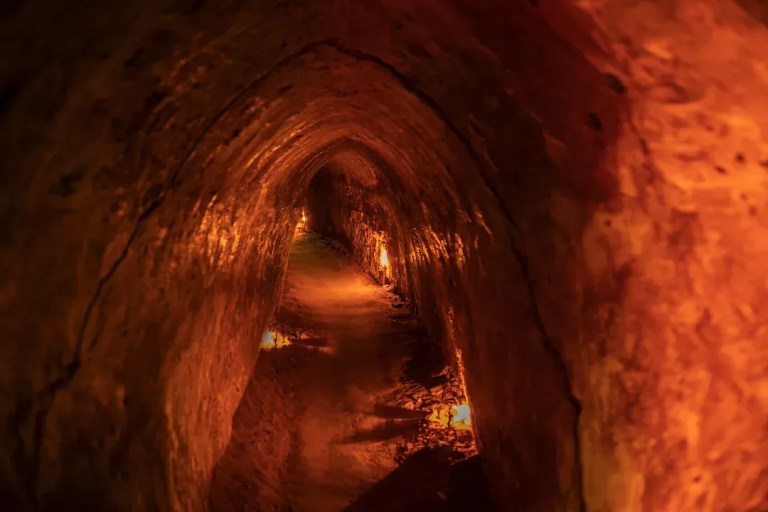
Cu Chi is a district outside Saigon where Vietnamese forces and civilians built a vast underground network during the American War. At its height, the tunnel system stretched for hundreds of kilometers beneath the jungle, allowing soldiers and civilians to live, move, fight and hide underground while American forces tried to destroy them from above.
Before I go any further, a special shoutout to our guide, Dragonking. Without his explanations, I would’ve walked away thinking I’d visited a fascinating historical site. Instead, I left with an entirely different way of looking at war, nature and human ingenuity.
The first thing he explained completely changed the way I looked at the tunnels.
Most people imagine that someone simply decided to dig more than 250 kilometers of tunnels beneath the jungle.
That’s not how it happened.
When American bombs carved enormous craters into the earth, the Vietnamese didn’t waste time filling them back in.
They used them.
A bomb crater became a bunker, built in a single night, without electricity, without machinery, without floodlights. The crater became the room. Trees, bamboo and clay hid it from above. Once the bunker was finished, they dug a tunnel to the next crater, then the next, then the next. Little by little, hundreds of isolated shelters became one of the most extraordinary underground networks ever built.
I kept waiting for Dragonking to move on to the next fact, the next date, the next number. He didn’t. He kept circling back to that same crater, that same night, as if the story wasn’t really about tunnels at all.
It wasn’t.
Along this trip, I realized I wasn’t learning about tunnels. I was learning about a completely different relationship with the world.
The deeper he went into the explanations, the more I noticed the same pattern repeating itself, over and over, in everything he described. Nothing existed on its own. Everything worked together.
The clay hid the entrances. The bamboo became pipes, supports and traps. The trees concealed the bunkers. Termite mounds inspired ventilation shafts that disappeared into the landscape. Some exits near the Saigon River even benefited from the natural movement of the tides to help circulate fresh air.
Smoke from cooking, something that could reveal an entire position, wasn’t simply vented into the air. It traveled through long underground channels before escaping so gradually that it blended into the morning mist rising through the forest.
None of it was borrowed and none of it was forced. Every part of the jungle already had a use, and they just had to notice it. Standing there, I couldn’t think of it as people surviving despite their surroundings. They were becoming part of them.
The tunnels themselves followed exactly the same philosophy. They weren’t designed to be comfortable. They were designed to favor the people who knew them.
Three underground levels housed kitchens, meeting rooms, hospitals, workshops, sleeping quarters and armories. Above them lay a maze of narrow passages, hidden doors and deadly traps. Punji stake pits, swinging spike traps and concealed trapdoors meant that even if an American soldier managed to enter, he had no idea where he was, where he was going or what waited around the next corner.
The jungle wasn’t protecting the tunnels. The tunnels were an extension of the jungle.
Then came the underground workshops, and this part genuinely left me speechless. When American bombs, artillery shells or rockets failed to explode, the Vietnamese collected them. They emptied the explosives to manufacture land mines. They cut up the steel to make traps. The enemy’s weapons became the tools of their own resistance.
Again, the same idea. Nothing was wasted. Everything was transformed.
By then, I stopped seeing individual examples. I started seeing a philosophy.
One side arrived with industrial warfare. Bombers. Napalm. Heavy machinery. The belief that overwhelming force could solve everything.
The other answered with clay, with bamboo, with rivers, with trees, with insects, with patience, with an intimate knowledge of the land they called home.
That’s probably why Cu Chi affected me so much. It wasn’t simply a story about winning a war. It was a story about understanding your environment so deeply that it becomes part of you.
Modern warfare usually leaves behind dead forests, poisoned rivers and landscapes stripped of life. Cu Chi tells another story. It reminds us that our greatest strength has never been our ability to dominate nature. It’s been our ability to work with it.
The Vietnamese didn’t separate themselves from the forest. They became an extension of it.
None of that erases what freedom cost here. No one should ever romanticize war, and nothing about those tunnels was easy or bloodless. But standing in them, one thing became impossible to ignore. The Vietnamese didn’t defeat a superpower by having more. They won by understanding something their enemy never truly could.
The land beneath their feet.
Thanks for reading.
Teekay

