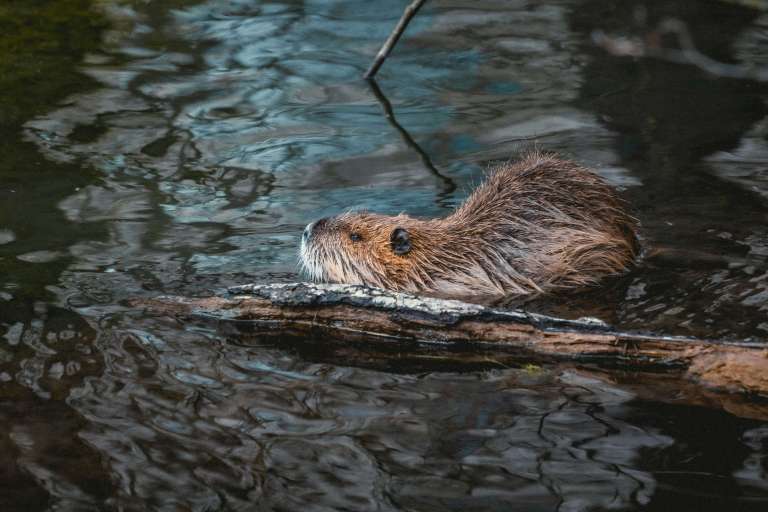
And how unlikely engineers are fixing what we broke.
Somewhere between dams, drains and forgotten beaver ponds, we taught water to behave unnaturally.
For centuries, rivers weren’t linear channels cutting through land. They were living systems with multiple rhythms. They had (some still do) a normal bed, a medium bed and a larger floodplain. During certain periods, rivers would overflow into nearby fields and forests, depositing sediments, organic matter and nutrients. They would slow down, spread out, feed themselves and recharge the surrounding soils before returning to their usual course. Water lingered. Land absorbed it like a sponge. Life depended on that slowness.
Modern (human) engineering broke this balance. To protect infrastructure, agriculture and urban areas, rivers were straightened, dredged and confined between embankments. Their wider beds were erased. This caused for river channels to deepen because the straighter a river is, the faster it goes, and the faster it goes, the more it digs under itself, thus lowering its bed. This phenom’ had two immediate consequences. First, rivers stopped feeding themselves. Cut off from floodplains, they no longer collect organic matter, sediments and nutrients that once sustained aquatic ecosystems. Second, and more critically, they stopped feeding the land around them. The earth lost its role as a sponge.
When soils are regularly rehydrated by slow, spreading water, they remain loose, alive and porous. Microorganisms thrive. Roots penetrate deeply. Organic matter accumulates.
When this process is interrupted, soils dry out and compact. They become stiff and tight. Rain no longer infiltrates. It slides across the surface, picking up speed, eroding topsoil and rushing straight into rivers, then quickly into the ocean. Water is no longer stored in landscapes but evacuated as quickly as possible. What we call floods and droughts are often two sides of the same engineered mistake.
This acceleration of water is a massive stress on the planet. Freshwater ecosystems collapse. Groundwater reserves fail to recharge. Agricultural soils lose fertility. Coastal zones receive sudden, polluted surges of freshwater and sediments. The problem is not a lack of rain but a lack of time. Water is not allowed to stay.
Nature, left to itself, mirrors its creator’s perfection. So naturally, solutions do exist, and one of the most powerful allies in restoring hydrological balance is none other than the beaver.
Often dismissed as a nuisance or a pest, the beaver is in fact a master engineer, working in harmony with natural laws rather than against them. By building “dams”, beavers slow water down. They raise river levels back toward their natural height. They reconnect streams with floodplains. They recreate the layered beds that humans spent centuries destroying, and still are.
Beaver dams create chains of small wetlands and ponds, true oases across landscapes. These wetlands filter water by trapping sediments and pollutants. They store water during wet periods and release it slowly during dry ones, reducing both floods and droughts. They soften the surrounding soils, allowing water to infiltrate deeply and recharge aquifers. Land regains its sponge-like function.
The ecological benefits are extraordinary. Beaver wetlands provide habitat for fish, amphibians, aquatic insects, birds and mammals. Frogs, salamanders, dragonflies, trout, ducks and herons all thrive in these environments. Biodiversity increases not despite the dams but because of them. Even forests benefit, as higher groundwater levels support healthier trees and reduce vulnerability to fires.
Beavers don’t build for profit, efficiency or short-term control. They build for stability. Their work reverses, piece by piece, the damage caused by rigid, fast and extractive water management systems, built by us.
Where humans forced rivers to behave like drains, beavers restore them as living systems.
Reintroducing and protecting beavers is not a romantic gesture or a return to some imagined past. It’s a practical, science-backed response to centuries of bad engineering. Beavers show that the solution to water crises is not always more concrete, deeper channels or faster flows. Sometimes, the solution is to slow down, raise water back into the land and let ecosystems do what they have always done best.
If we’re serious about restoring soils, securing water and easing the planetary stress we created, we should stop fighting nature’s intelligence and start learning from it.
In that lesson, the beaver is the blueprint.
Food for thought.
Thank you for stopping by.
Teekay
 Teekay Rezeau-Merah