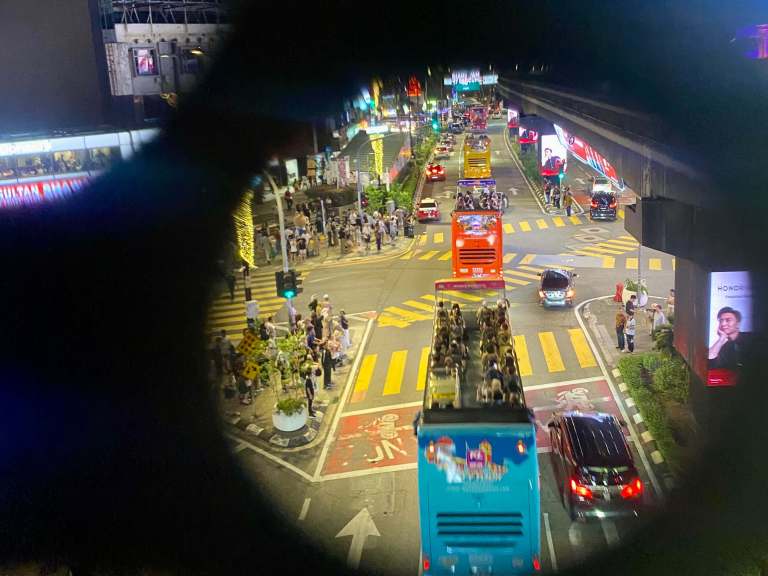
Cost of living, weather, walkability, safety, let’s unpack everything.
I first came to Malaysia more than ten years ago, on a family trip to Kuala Lumpur, Penang and the Perhentian Islands. It was the last time my family traveled together like that. I came back alone a few months later, younger, rebuilding after two rough years, right around when my anxiety and panic attacks started.
Ten years later I’m back for the third time: a month in Kuala Lumpur, more time in Penang. I still really like this place. Here’s why, and why I still wouldn’t move here.
Cost of living in Kuala Lumpur
Cheap Food, Expensive Rent.
KL makes everyday life easy. It’s safe, affordable without feeling cheap, and English gets you through almost anything.
Food is where that shows most. A meal at a hawker centre or food court easily comes in under 20myr; 25myr gets you a genuinely good casual meal. You’re not sacrificing quality to save money. KL also has luxury restaurants and high-end malls if you want to spend more. The city runs at both ends.
Rent doesn’t follow the same logic. As a foreigner, budget around 3000myr/month for a decent studio with a kitchenette, more or less depending on neighborhood, building and negotiation (in-person deals beat arranging things from abroad).
That’s the real surprise of KL’s cost of living: you can eat for 10myr and cross the city for pocket change, but your apartment still runs several thousand ringgit a month, because KL’s housing market behaves like the international city it is.
Getting around without a car
The rail network (LRT, MRT, monorail, buses, feeder buses) covers most of the city. For a foreigner staying a month or more, the Rapid Bulanan pass is worth knowing: 170myr (not 150 as advertised) for 30 days of unlimited travel across RapidKL’s network. I bought one and used it every day, though I could have gotten by without it.
150myr isn’t cheap, but it’s one less thing to think about. Shorter Rapid Kembara passes exist for visitors too.
So no, you don’t need a car in KL. The problem is the city wasn’t really built for people who don’t have one.
You can also use Grab, which is relatively cheap, but not the best option for the environement.
Is Kuala Lumpur walkable? Not really
This is my biggest complaint. Around KLCC and the newer developments, pedestrian infrastructure is genuinely good. Then the sidewalk just disappears. You cross a road and you’re suddenly walking beside six lanes of traffic with no clear way across.
A 15-minute walk on Google Maps can feel much longer at 32C and full humidity, next to traffic, with no shade.
So people take Grab, or drive, and the cycle feeds itself. Poor walkability pushes people into cars, more cars mean more congestion and heat, and the city gets even less pleasant to walk in.
KL has invested heavily in public transport, which is great, but it’s not the same as good urban mobility. You still have to get from your door to the station, and from the station to wherever you’re going. What this city needs is continuous sidewalks, real crossings, cycling infrastructure and shade. This city definitely needs shade!
Weather and humidity in Kuala Lumpur
Heat doesn’t bother me. Humidity does, and KL has plenty of it, the kind that wraps you in a warm wet towel after five minutes outside. Then you walk into a mall and you’re freezing, because electricity is cheap here and air conditioning runs generously everywhere: offices, malls, restaurants, hotels.
Step back outside and you’re sweating again within minutes.
The city cools its indoors to compensate for outdoor heat it can’t control, then adds more heat back into the air through cars and AC units running constantly.
Noise
KL is alive, and rarely quiet. Cars, motorcycles, construction, modified exhausts, air conditioners, honking. It’s less that any one sound is unbearable and more that there are so many of them your brain never fully switches off.
If you’re used to the quiet of certain places, KL isn’t for you.
Malaysia’s multiculturalism
This is what I love most about Malaysia beyond the food. It’s a predominantly Muslim country, but Chinese, Indian and other communities have been part of Malaysian society for generations, and the religious diversity is something you see everywhere. I’ve prayed in mosques with Taoist temples visible from the windows, walked through Little India surrounded by Hindu temples, and seen Chinese churches standing beside other places of worship. It’s not something you have to seek out. It’s simply part of everyday life. This is far from the norm in most countries around the world.
Malaysia has religious and ethnic tensions, like anywhere, and it would be naive to pretend otherwise. But the everyday coexistence, people working, eating and running businesses together across lines that are treated as much more divisive elsewhere is genuinely refreshing.
Women are also highly visible in economic life here. Managers, entrepreneurs, shop owners, decision-makers. Malaysia has a solid reputation as a safe destination for women traveling alone, and ironically, the worst safety stories I’ve heard came from expat circles.
Remote work in Kuala Lumpur
KL is amazing for remote work.
The internet is fast, reliable and widely available, and mobile data is cheap enough that staying connected isn’t something you really have to think about. Wifi is everywhere you’d expect it to be, from apartments and hotels to cafés and shopping malls.
When we landed at KLIA, we bought a CelcomDigi tourist SIM for 60myr. It gave us 30 days of unlimited internet in Malaysia plus 3GB that could be used elsewhere in Southeast Asia, which came in very handy when we went to Vietnam. Also, we paid exactly the same at the airport as we would’ve paid online or at an agency in town.
No contract, no expensive roaming and no worrying about getting connected when you land.
Then there’s the café culture. KL has no shortage of neighbourhood cafés, minimalist coffee shops and places where people can sit with a laptop for a few hours. You can work, get good coffee, eat something decent and stay connected without anyone bothering you.
The city also has a growing technology sector and is becoming an increasingly important regional hub for tech and data centres. So there’s a good fit between the infrastructure and the kind of work many remote workers actually do.
Car culture
Malaysia’s custom car scene is genuinely amazing, especially if you’re coming from Europe. Japanese and local cars, lowered, rebuilt, repainted, personalized. It’s not about owning something expensive, it’s about making the car yours, and there’s real creativity in it. Didn’t expect to love this part as much as I do.
KLIA and getting out of Kuala Lumpur
KL is a fantastic base for exploring Southeast Asia. KLIA reaches Singapore, Indonesia, Thailand, Vietnam, the Philippines, Cambodia, Laos and Myanmar easily. From KL Sentral, the airport coach is 15myr one way (as of August 2026); the KLIA Ekspres train is more expensive, still affordable and faster.
The bus takes 45 minutes to an hour depending on traffic. So convenient!
Vegan food in Kuala Lumpur
Malaysia is one of the easier places I’ve traveled as a vegan, mostly because vegetarian food is deeply embedded in several religious traditions here (Taoist, Hindu, and others), so vegetarian restaurants are everywhere.
The catch: vegetarian doesn’t mean vegan. Fish sauce, oyster sauce and other animal products turn up in dishes labelled vegetarian, so you have to ask.
Our favorite joint is definitely RightSide! Burgers, lobster rolls, tacos, milkshakes, matcha, ice cream, all vegan.
Try Vegelicious JR in Midvaley as well, it’s insanely good.
The plastic problem
Bottled water, plastic bags, cups, straws, takeaway containers, everything wrapped in something. Order one drink and you can walk away holding a cup, a bag, a straw and a separate wrapper.
Plastic is cheap, convenient, and works in this climate. Straws, for instance, often exist so you don’t put your mouth directly on a shared can, not just out of carelessness. But a country with this much modern infrastructure could do far more to normalize refill stations, household filtration and reusable containers. They’re there, but nowhere near widespread enough.
For anyone who thinks about waste, it’s hard to ignore.
Why I wouldn’t live in Kuala Lumpur
The weather would wear on me. The noise would wear on me. The plastic would drive me up the wall. And the lack of walkability would frustrate me more with every year. I want to walk out of my front door and just go, not along a six-lane highway, not 20 minutes to the nearest crossing. I want quiet, trees, nature, and an easy way out of the city. KL doesn’t offer any of that, unfortunately. Neither do most cities of this size.
Is Kuala Lumpur worth living in?
KL has almost everything. It’s modern, safe, multicultural, well connected and tech-forward. It’s also not finished figuring itself out, and I like that about it.
Would I live here permanently? I love my life in France, but even without that, KL wouldn’t be at the top of my list. The walkability, the noise, the plastic pollution, the air, the heat, none of them are dealbreakers on their own. Together, though, they add up to the one thing I won’t compromise on: my health.”
Would I come back? I already have, three times, and I doubt this is the last.
Thanks for reading,
Teekay
 Teekay Rezeau-Merah