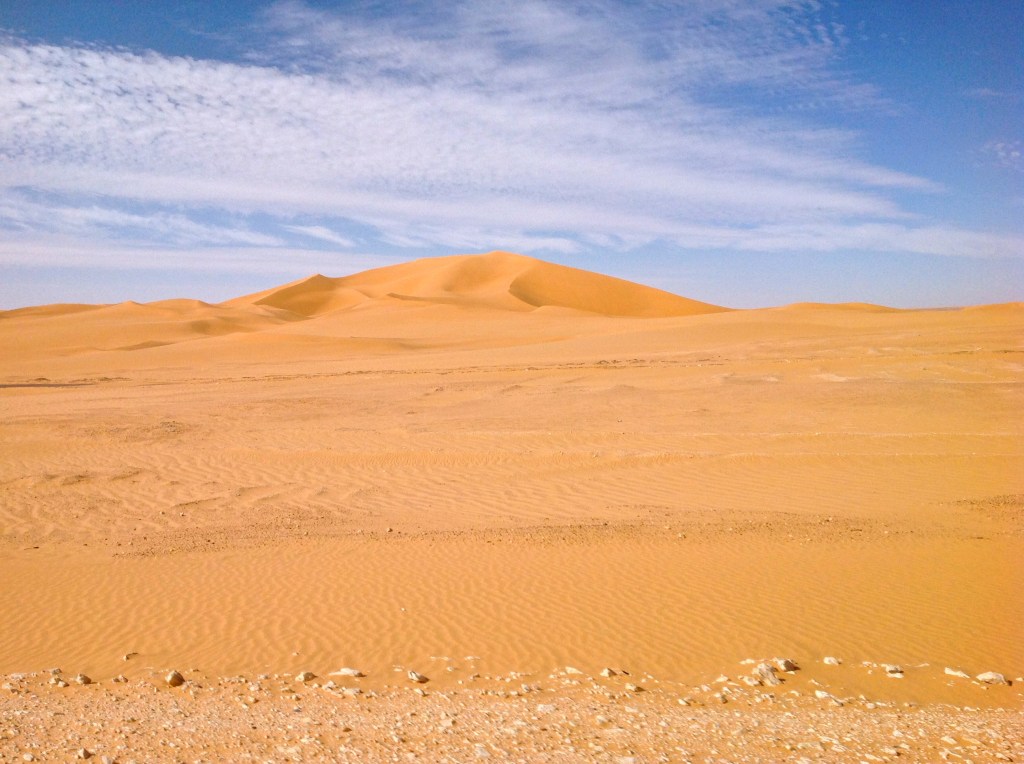
The Sahara Desert is the world’s largest hot desert and the third largest desert behind Antarctica and the Arctic.
Located in North Africa, it covers 9,200,000 square kilometers (3.6 million square miles), nearly a third of Africa.
My journey through a fraction of this majestic place was nothing short of sensational.
Trip route
The sand dunes, beautiful wild camels, excruciating heat, vastness, hospitable nomads and their stories..the magical spirits..a once in a lifetime experience.
Speaking of, here’s a fun fact about camels: a camelcan drink 200 liters (53 gallons) of water in three minutes !
That’s insane !
A bunch of camels chillin’ in a Canyon (Oasis), Chad
Anyway, I don’t know about y’all, but I love stories about supernatural creatures, angels and jinns.
What are jinns, exactly?
Jinns are usually known as genies (yeah, like the one in Aladdin) in western literature.
Jinns aremagical spirits who may appear in the form of a human or an animal and can take control of a person.
They’re said to inhabit caves, graveyards, deserted places and darkness. The Sahara Desert, like the ocean, is where many Jinns actually live. And believe me, it’s feelable (spooky!).
Jinns lead similar lives to us humans. While they’re believed to be invisible (mostly), jinns have the ability to eat, drink, sleep, breed and produce offspring that resemble their parents.
They also have free will to choose between good and evil. Therefor, jinns can be Muslim, Jewish, Christian, etc.
But unlike us, jinns have numerous powers that are exclusively theirs.
For instance, jinns are capable of moving extremely heavy objects with relative ease.
There’s always been some sort of air of mystery and mystique around the topic of jinns, and rightfully so.
Fun fact: Jinn means “hidden” or “concealed” in Arabic.
As per a hadith narrated by Ibn e Masood, there are 3 main types of jinn: those who fly, those who appear in the form of dogs and snakes, and those that stay in travel.
Jinns live much longer than us. It is said that they can live up to thousands of years.
Preferences
Jinns delight in punishing humans, intentionally or unintentionally, and are said to be responsible for many diseases and all kinds of accidents
It’s been said that jinns eat like humans, but instead of fresh food, they prefer rotten flesh and bones. Yuk!
Fun fact: King Solomon PBUH, one of God’s beloved prophets, was bestowed with many God-given gifts, including the ability to speak to animals and jinn.
While many people are aware of the existence of Jinns, Hinns, on the other hand, are barely ever talked about.
Here are a few interesting theories about the Hinn.
Theories
In early Islam, a common belief held that mankind is actually the successor of other intelligent creatures such as Jinn and Hinn. Medieval Muslim traditions referred to the Jinn as pre-Adamites, depicted as human-like in various ways.
According to Ibn Kathir, the hinn belongs (together with the jinn) to those creatures who shed blood on earth before humankind, causing the angels to question God’s command to place AdamPBUH as a vicegerent.
In his work Al-Bidāya wa-n-Nihāya (The Beginning and the End), Ibn Kathir relates that the Hinn (and binn) were exterminated by the jinn so that they could dwell on the earth.
Cigarettes take years off your life by just killing you (cancer). Social media takes years of your life by making you endlessly scroll, and lose your sense of purpose and time.
It’s sad to see what has become of interpersonal relationships, and activities in the ‘real world’ altogether.
I’ve decided to write this post to remind myself and my readers of the harms of excessive cellphone use and social media exposure. I also believe we need to push back and raise awareness against what’s happening in this realm.
It ain’t just about smartphones though, it’s about what’s in them.
Social Networks, gaming apps, dating apps, and so on are driving us away from the things that really matter. We’re losing our very humanity because of them.
Instant gratification and FOMO are this generations worst diseases, as discussed on this episode of my podcast with Deborah Cooper, columnist, author and relationships expert.
I believe we need to rethink the place of smartphones in our modern societies, and the way we interact with both technology and each other, bridge some gaps.
I also think we need to push for less addictive designs.
As a society, we must hold Big Tech responsible for their doings and encourage them to focus on making more functional and utilitarian platforms instead of addictive cash cows.
Furthermore, we must be more aware of how technology is affecting our brains and society as a whole.
It’s like we have billions and billions of people zonked out, consuming hours and hours on their phones without realizing that they’re wasting years of their life.
Something needs to be done here.
From a behavioral standpoint
Our smartphones are the cue, craving, response, and reward all at once. They’ve been designed to be addictive, easy to handle and ultimately became our go-to gadgets to find simulated happiness, always a swipe away from a dopamine hit.
Unfortunately, we aren’t aware enough of this, and when we are, we just dismiss it like we do with many harmful things (ask your smoker friends).
Internet addiction is a bigger problem, though. It’s a problem that nobody wants to admit and something that’s beyond individual control.
Funny thing is, it’s almost unreasonable to think it’s someone’s fault for developing this addiction, because at the end of the day, WE are the enablers.
How many kids do you see glued to an iPad at ages that seem ridiculous?
Remember just a couple years ago when big tech pretended to care about this problem with some half-baked features like screen time & limits on their platforms? It was laughable.
I’m obviously not against social media, dating and gaming apps, not one bit.
I’ve actually met the dearest person to my heart on one of these apps.
But with that being said, wisdom lies in moderation.
Furthermore, Social Networks are becoming increasingly invasive, and are a pervasive part of modern culture, which greatly affects our global mental health.
“Human beings find purpose in their responsibilities. Responsibilities aren’t a burden, they’re a gift and they give our lives meaning.”
So what can we do, collectively, to save people from becoming zombies ?
So, this is my favorite part and the reason I wrote this post.
There are dozens of activities that you could and probably should be doing right now if you weren’t on your phone.
Here’s a quick list of things that you must look into and that could potentially break your addiction and increase life satisfaction and connectedness with the world:
Hiking and trekking: hiking doesn’t require any training, gear (besides decent shoes) or entry fees
Picnics: with friends, your partner, family, your dog, picnics are fun and great way to meet like minded people in the real world
Ramble the town you live in, there are always some lovely hidden gems that are defo worth exploring
Chat in person with no schedule in mind, about anything, chill with your partner or your best friends, go for tea
Biking: not just to work or to run errands, but just for the sake of it
Do something whimsical like find handfuls of acorns to paint with cute smiley faces
Workout with friends
Go to your local shooting stand and learn how to handle weapons
Take up a new hobby: Yoga, Tai Chi, Knitting, Guitar playing, language learning, coding, drawing, blogging, writing, woodworking
Invest your time in charity work and/or teaching/mentoring
Dog/cat keeping whenever you’re free and don’t know what to do. Animals are a great way to fight stress and anxiety
Visit your local parks and cemeteries, go for a stroll there, use that time to reflect on your own life and how to improve your life and that of those around you
Play sports with your buddies, or join new groups with whom you can also hoop/play football
Explore your local libraries and their books
Write your own book
Learn how to cook and dabble with your diet. Learn more about what you’re putting in your body on a daily basis
But most importantly, make sure you always have something going on in your life to keep you pumped.
One of my podcast guests once told me “humans find purpose in their responsibilities. Responsibilities aren’t a burden, they’re a gift and they give our lives meaning“.
No truer words have ever been spoken.
There are so many useful ways to spend your free time, so don’t waste it scrolling endlessly.
Who would've thought "Cyber Cafes" or Internet Cafes would fit into our pockets someday ?
Millennial nostalgia
Back in ye olden days (late 90s, early 2000s), my friends and I used to spend hours outside. Riding our bikes around town, playing football in the street, freestyling, telling jokes, climbing trees, running or “working out”..
And whenever our finances matched our desires, which wasn’t that often, we’d grab a bite together and just .. talk.
No one was distracted while talking, because smartphones didn’t exist..yet !
At the risk of sounding old, those were definitely “the days, bro!”
P.S.: who would’ve thought “Cyber Cafes” or Internet Cafes would fit into our pockets someday ? It’s insane come to think of it.
I grew up in Cyber Cafe era, we used to hang out in cybers all the time, mostly playing video games (essentially Counter-Strike and Red Alert)
Here’s what Red Alert looked like ^^
Shit was mad dope, I ain’t gonna lie !
So why the sudden change ?
Tech companies leveraged smartphone ecosystems by using gamification and behavioral economics as their tactics to trick our brains into consuming more and more on our phones.
This is common knowledge but such strategies were inspired by casinos, the devil’s ground and masters of addiction.
Psychologists like Dan Ariely and Daniel Kahneman have had a major influence on how tech apps have been constructed to have addicting rewards systems.
In closing
I genuinely hope that people realize social media isn’t a substitute for real connection.
As a species, we must have a better understanding of ourselves if we want to keep evolving and find genuine happiness. It may not seem like it but we’re still as primitive as a man from the first century AD, only with more gadgets around us.
But it’s fascinating how slow death never gets a bad rep, though.
Most of the stuff we buy throughout the years will either end up sold, donated or trashed.
It’s sad, but it’s also inevitable.
That’s one of the main reasons why I became a minimalist in for first place.
When I look at the number of things I owned throughout my life, I can’t help but feel guilty..
Guilty because most of it went out the window at one point or another, guilty because there definitely are people who can’t afford half the stuff we buy carelessly
Guilty because consumerism is so ingrained in our modern societies that we hardly question our spending habits.
Minimalism allowed me to shift my mindset completely, so the least I can do is simplify the process by sharing some of my tips with those looking to live mindfully and sustainably.
“But what do I do with all the stuff I own ? It’s already been made, bought and used (for most part)?”
That’s the type of question I usually get.
The answer is quite simple:
Sell: if you need the money and want your most valuable things to have a second life
Donate: if you don’t need the money and want your things to be repurposed and help people in need (Charity, NGOs, Homeless Shelters..)
Trash: everything that can’t be repurposed, sold or recycled. It’s unfortunate but don’t beat yourself up too much, it happens to the best of us.
Where to go from here?
Here’s a short list of things you can turn to if you want to minimize further. Some of these tips hint at frugalism as well.
Avoid eating out and getting take outs. Take out foods are usually less healthy and way more expensive than home cooked meals. Learning how and what to cook is a useful skill for a better life, health wise and financially as well
Stop “treating yourself” when you can’t even pay off your debt and loans. Focus on the things that truly matter to you, and things that could have a lasting effect. Perhaps you could treat yourself to some cooking or baking classes, that way you won’t have to overspend every time you crave something. Same goes with most skills (yoga, fitness, cooking, handywork..)
Stop seeking instant gratification. Instant gratification is one of our era’s worst nightmares. It’s responsible for depression, anxiety, people feeling lost, so on and so forth. Refraining from social media use is one of the best things you could do to heal from this disease, news fasts* are also very effective in that regard
Avoid fast fashion AT ALL COSTS. I know it’s convenient and cheap, but what comes easy never lasts. Also, it’s highly destructive to both nature and the humans behind it (btw click on the link if you’re not familiar with this industry, the video’s super dope and it’s only 8 mins long)
One grocery trip twice a month should be enough. Meal planning (and prepping) helps a lot as it decreases overspending, and waste, of course
Shopping online is better as it allows you to browse similar products to the ones you’re looking for, and find the ones that best fit your needs
Go organic as much as you can. Health is important and bad health is extremely costly !
Go for one time purchases. For example, start using linen napkins instead of paper towels
This one’s quite personal and something I’m working towards but I always try to favor cash instead of credit/debit cards
Minimize unnecessary subscriptions – cloud storage, streaming services, music services, apps, gym, website memberships, meal delivery, monthly installments.. I’m sure we all have subscriptions we hardly ever use
Beside all this, digital minimalism is also something you could look further into:
Unsubscribe from all the lists that keep sending you updates, offers and newsletters that you hardly ever read. It may not seem like it but most of that stuff is costly in mental energy (c.f. decision fatigue), carbon emissions and anxiety
Organize your photos in folders and delete all copies and similar photos
Disable unnecessary notifications, especially the ones on social media. I personally only kept incoming calls and text message, as those are the ones I use the most with my family and friends
Reach out to me or leave me a comment if you have any specific questions, I’m always happy to help 🙂
*A news fast implies opting out of watching the news on TV, listening the radio, reading newspapers, or following the news on social media and other internet outlets.







 Teekay Rezeau-Merah