You don’t hate winter, you hate how we live through it.
I’m such a winter person. I resisted that idea for years because I don’t particularly enjoy being cold and I absolutely hate humidity, but I’m done arguing with it now.
Winter is my favorite season, the one that makes me feel most alive. Fall comes close behind. Maybe I’m really a fall-first person who only settles once winter arrives. Fall feels like a threshold, a kind of preparation, while winter is the place it all leads to.
Most people say they hate winter, but I don’t even think that’s true. I think they hate winter under capitalism, which is a very different thing.
Winter isn’t simply December 21st to March 20th like we’re taught in school. December 21st is the winter solstice, the shortest day of the year, the deepest point of darkness. In many ways, that’s peak winter. It’s both the heart of it and the beginning of its slow release.
If you look at older seasonal systems, especially the Celtic calendar, winter is often understood differently. It begins around early November, with Samhain, and transitions toward spring around early February, with Imbolc. I’ve always intuitively aligned with this rhythm, a rhythm that feels more real in the body.
Winter always makes me nostalgic about my childhood. Where you grow up shapes your relationship to it. Below the equator, winter falls during what we call summer months. It’s shorter, less harsh. It’s still winter, but it doesn’t carry the same weight. Above the equator, winter has a presence. It changes everything.
Winter in New York, for example, is unmatched. But to understand it, you have to start with fall. Fall is special in a way that’s hard to replicate. The air sharpens, the leaves start falling, the temperature drops just enough to wake you up. School starts again. People return from summer scatteredness with a sense of purpose. There’s motivation, a quiet hope that something new can begin before the year closes.
Then come the holidays. I don’t celebrate them myself, but I can’t deny the atmosphere. Halloween, with kids everywhere. Thanksgiving, massive in New York. Then the Christmas season, with its films, its smells, its food. Cinnamon, baked goods, warmth. Fall is about getting cozy. It’s about preparing, consciously or not, for winter.
And then winter arrives.
One of my favorite childhood memories is hearing on the radio that a blizzard had shut everything down. Schools closed for days. Travel discouraged. The world paused. I remember the feeling of going back to bed, diving under the blanket, watching the snow fall outside. There was a kind of collective stillness. Everyone was home at the same time, in the middle of the week, which almost never happened.
Winter meant snowball fights with family and friends. Building snowmen. Coming back inside after hours in the cold to drink something hot, cinnamon-heavy or just a simple hot chocolate. Winter also meant shorter days, which I’ve always loved. There’s something honest about darkness arriving early. It forces you inward, and you simply sleep better. At least I do.
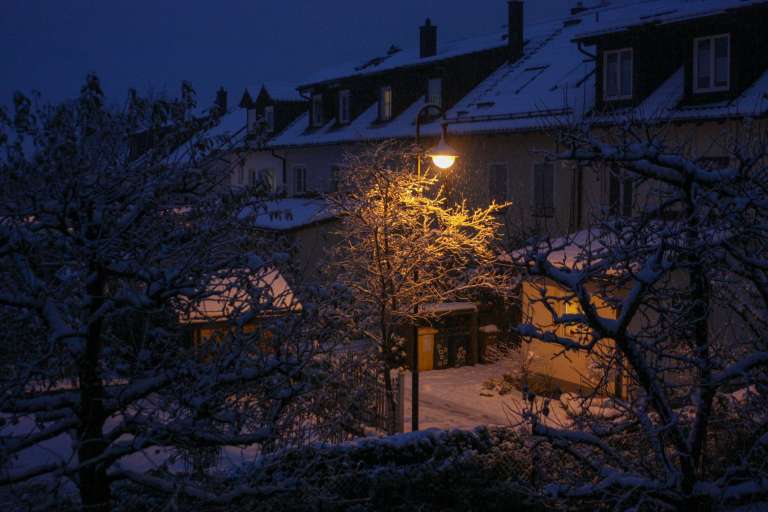
Now that I live in a coastal town, winter has taken on a different form. The place empties out. It becomes a ghost town. Only a few locals remain. I can walk through the streets, along the beach, into the forests, and not see anyone. Not hear anyone. Just space, and peace.
Fall here is also the perfect time for mushroom picking. There’s something deeply satisfying about finding your own food, bringing it home, cooking it. I don’t do it as often as I used to, but when I do, it reconnects me to something older than all of this.
Winter also brings unpredictability. Storms, floods, strong winds, snow.
I’ve always been fascinated by storms. There’s something humbling about them. They remind you how small you are without humiliating you. Just placing you back in proportion.
And this is where my relationship with winter becomes more than just aesthetic.
Winter, to me, is supposed to be a time of slowing down. A form of hibernation. Not complete inactivity, but a reduction. A softening. A withdrawal from constant output.
But winter under capitalism is the opposite of that.
It’s when everything accelerates. Black Friday. Christmas consumption. New Year’s, January sales. Valentine’s Day. It becomes a concentrated period of economic extraction. A time where people are pushed to spend more, move more, produce more, exactly when their bodies are asking for less.
I don’t adhere to that. I reject it.
Because biologically, intuitively, winter asks something else from us. Even illness patterns reflect that. People don’t just get sick because of viruses. They get sick because they keep pushing at summer pace in a winter body. They ignore the signal to slow down.
Historically, people understood this. They worked through the year, harvested their crops, prepared for winter. Around the end of October, they gathered, celebrated the end of harvest. And then life shifted. Maintenance replaced expansion. Survival replaced growth.
Nature does the same. Animals retreat. Bears hibernate. Bees cluster. Even plants withdraw into themselves. Winter is not death. It’s conservation.
I sometimes imagine a different life. A cabin. A cycle where summer is for harvesting, fall for preparing, winter for resting. Wood gathered. Food stored. Time spent simply maintaining what’s already there.
Life, at its core, is that simple. But systems built on constant expansion don’t allow simplicity to survive.
Winter, for me, is also about people. Not crowds, but closeness. Seeing friends, family. Sitting together, drinking tea, sharing time without urgency. There’s a different quality to connection in winter. It’s slower, deeper.
Even sports feel different. The air, the light, the coziness of it all. Everything sharpens.
And if I’m honest, part of why I love winter is personal. I’m introverted. I need that inward space. But it’s also something else. A fatigue with what humanity has become. The constant noise, the endless movement, the destruction of everything around us.
Winter feels like a counterforce.
It slows us down whether we like it or not. A storm doesn’t ask for permission. A blizzard doesn’t negotiate. When it hits, everything stops. And in that moment, we’re all equal. No one is above it.
There’s something powerful in that.
To me, winter restores balance. It interrupts the illusion that we can operate at maximum intensity all year long. The shortening of days, the stretching of nights, the way time itself feels heavier, slower, none of that is accidental. It’s a form of design.
Fighting that rhythm has consequences. You see it in people who try to live winter like summer. They burn out. They get anxious. They get sick.
I haven’t had a cold in years. That’s not just because I’m active or because of my diet, though those matter. It’s because I try, as much as possible, to align with that rhythm. To accept that winter is not the time to push.
Winter is about gathering. With nature, with people, with yourself. It’s not about peak productivity. It’s not about consumption. It’s not about proving anything.
It’s about remembering.
And maybe that’s why I love it so much. Because despite everything, despite the systems we’ve built to override it, winter still imposes itself. It reminds us, quietly or violently, that we are not in control of everything.
That there is a rhythm beyond us.
And that we’d probably be better off listening to it.
Thanks for reading.
Teekay.

 Teekay Rezeau-Merah