The greatest tragedy of global warming is not that the planet is getting hotter.
It’s that humanity is slowly abandoning the outdoors.
We’re sleepwalking into an indoor civilization where the sun becomes something we look at through glass, fresh air is replaced by recycled air, and daily life happens inside sealed boxes connected by roads built for machines instead of people.
We call this adaptation.
I call it surrender.
For most of human history, we survived heat and cold without turning the atmosphere into an appliance. Homes had thick walls and were oriented for natural cooling and heating. Streets were narrow and shaded. Courtyards created airflow. Trees cooled entire neighborhoods.
In the Sonoran desert, on the Arabian peninsula, across the Arctic circle, people lived for thousands of years in the harshest climates on earth, not by avoiding them but by designing for them. Architecture responded to climate because it had to.
Then something changed. Construction stopped answering to climate and started answering to speed and margin. Cheap materials, fast timelines, glass towers that look identical from Dubai to Shanghai to New York City.
This happens under different economic systems in different ways, but under capitalism specifically, the incentive is sharpest and the scale is biggest. We paved cities with concrete, cut down trees, covered skylines with heat trapping glass, and filled streets with cars that turn neighborhoods into furnaces.
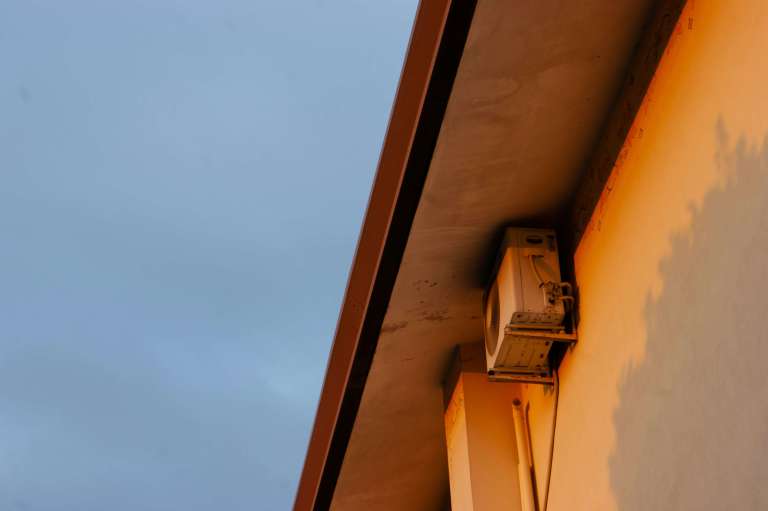
Instead of questioning the design, we invented a product to survive it. Every summer gets hotter. Every building gets another compressor. Every apartment becomes another sealed container.
The machine that promises relief quietly becomes part of the world that made relief necessary.
That machine is air conditioning, and naming it here isn’t a knock against it. In 1936, before home AC existed anywhere in the US, a heat wave killed close to five thousand people across the country, most of them in homes with no insulation, no shade, no relief.
That death toll wasn’t inevitable and it wasn’t just bad luck. It happened in the middle of the Dust Bowl, and the Dust Bowl was manufactured. Farmers had stripped the deep rooted native prairie grass, the kind that held moisture and cooled the ground through the plants themselves, and replaced it with shallow rooted wheat grown for profit.
When the drought came, there was nothing left to hold the land together and nothing left to cool it. Indigenous communities had farmed those same plains for centuries without triggering that collapse. The 1936 death toll wasn’t proof that hot places are hostile to humans. It was proof of what happens when land and housing get built for yield instead of for the climate they sit in.
AC didn’t create that problem. It arrived as a patch for a problem that profit driven land use and profit driven construction had manufactured, and it’s remained a patch ever since, papering over bad design instead of fixing it.
That’s the honest version of the argument. Not that AC invented the crisis, but that we reached for the machine instead of reaching for the wall thickness, the window placement, the shade, the airflow that would have made the machine unnecessary in the first place.
Spend time in many hot, humid cities today and you notice something unsettling. The day disappears. Life retreats to dawn and returns after sunset.
Office workers leave an air conditioned apartment, enter an elevator, board an air conditioned train, spend nine hours in an air conditioned office or mall, and return home after dark. Entire days pass without sunlight touching their skin.
Not because they hate nature. Because the city has made nature hostile.
Outside is heat that exhausts you within minutes. Humidity that clings to your lungs. Mosquitoes thriving in a warming climate, carrying diseases that turn an open window into a calculation of risk. Pollution hanging over traffic. The safest option becomes staying inside.
Home stops being shelter. It becomes life support.
The cost is much larger than vitamin D deficiency, though that’s where it starts. Less sun on skin means less vitamin D produced, and vitamin D deficiency is tied to low energy, low mood, and a weaker immune system, which is why people who spend their days sealed away from sunlight tend to get sick more often, not less.
Our bodies evolved with morning light, changing temperatures, wind on our skin, fresh moving air. Circadian rhythms sync to dawn, not to LED panels, and when that sync breaks down, sleep breaks down with it, and disrupted sleep drags hormonal cycles, mood, and energy down with it.
Recycled indoor air adds another layer on top. Research on indoor air quality has linked poor ventilation and recirculated air to worse asthma symptoms and higher rates of respiratory illness, especially in buildings that trade fresh air exchange for sealed, climate controlled comfort.
Even our eyeballs are stretching out of shape. Children who spend most of their days indoors under artificial light are developing myopia at rates that have doubled in some countries in a generation, while the ones who spend two hours a day outdoors are far less likely to need glasses at all.
There’s a crueler twist hiding underneath all of it. Studies comparing people who live in constantly air conditioned spaces to people who live with natural ventilation find that the AC group’s bodies lose the ability to handle heat at all, weaker sweat response, less tolerance, more discomfort at the same temperature a naturally ventilated body handles with ease.
The machine doesn’t just fail to fix our relationship with heat, it erodes our own built in defenses against it, so we need the machine more, not less, the longer we rely on it.
And a life spent moving between sealed rooms is a life spent sitting down. Outdoor space invites movement in a way four walls never will, and the sedentary indoor hours we’ve traded for it are independently linked to weight gain and rising obesity, on top of anything diet explains.
Sleep, mood, hormonal cycles, the air in our lungs, the shape of our eyeballs, our own tolerance for the climate we live in, our own bodies at rest, all bent out of shape by a relationship with the natural world that modern urban life steadily erases.
We’ve normalized breathing recycled air more often than fresh air. That should horrify us.
The cruelest part is the loop that follows. The hotter cities become, the more air conditioners we install. The more compressors run, the more waste heat gets dumped straight back into the streets.
Research on Phoenix Arizona has found that AC waste heat alone pushes nighttime outdoor temperatures up by more than one degree Celsius, right when the heat should be breaking. Elsewhere, modeling done on a city like Paris found that if every building ran AC to hold a comfortable indoor temperature, the waste heat could raise the temperature by up to three and a half degrees Celsius.
The same mechanism behind the Dust Bowl I mentioned earlier is still running quietly in American suburbs today. Grass and trees cool the air through evapotranspiration, water moving up through roots and out through leaves. Strip that away for pavement and clean-cut lawns and you lose all the moisture. The ground stops cooling itself the way it used to, so the heat just builds and kills the remaining grass.
Singapore has more air conditioners per capita than anywhere else in Southeast Asia, and it has also spent years planting rooftop gardens, vertical greenery, and tree canopy to bring outdoor temperatures down.
The greenery helps, but the heat from all those compressors doesn’t disappear just because there are more trees to stand under. As long as the AC stays, the waste heat stays with it. Greening a city while leaving mechanical cooling untouched isn’t the answer, it’s proof that the answer has to include using less of the machine, not just planting around it.
This is capitalism distilled into a single object.
Create the crisis. Sell the adaptation. Repeat.
The future should not be millions of homes humming behind permanently closed windows.
It should be cities dense with trees instead of parking lots. Buildings designed for cross ventilation, thermal mass, and passive solar heating and cooling instead of sealed glass that needs a machine to survive its own design. Public spaces that invite people outdoors instead of shopping malls that replace them. Fewer cars. Less concrete. More shade. More wind. More life.
We don’t need to get better at hiding from the climate. We need to build a world where hiding is no longer necessary, and stop mistaking climate control for control over the climate.
Global warming is not only melting glaciers. It’s melting the very idea of outside. If we accept air conditioned isolation as the endpoint of civilization, we’ve accepted far more than a hotter planet.
We’ve accepted the disappearance of human life beneath the open sky.
Teekay
Discover more from Teekay Rezeau-Merah
Subscribe to get the latest posts sent to your email.

