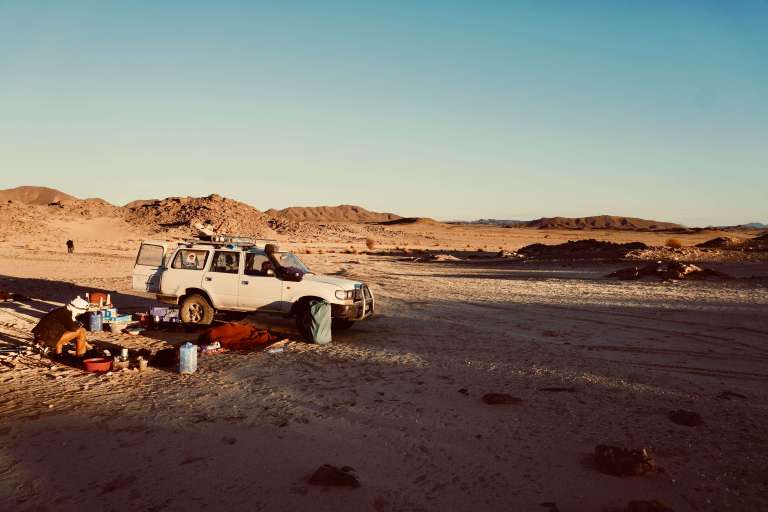
Hitchhiking across the Sahara for 700 dollars.
Noon, and the only shade for hours is the belly of a Land Cruiser.
I’m lying under it on my back. The engine ticks as it cools. A thin breeze finds my face. Somewhere past the tires, the driver is already asleep.
Nothing to see. Nothing to hear. Nothing needed from me.
I fall asleep too. I don’t decide to. Boredom decides for me.
The year I wanted out of
2014 was the hardest year of my life.
My studies had collapsed. I had to stop them after a medical accident and the surgery that followed.
I lost a grandmother that year. The second in less than a year. I couldn’t make it to her funeral.
I was living with my parents in Addis Ababa and fighting with my dad almost daily. I was hard on him. I blamed him for things that weren’t his fault.
The anxiety attacks were the worst I’ve ever had. I had no direction and nothing to point myself at.
Things were about to change for good. I just didn’t know it yet.
I wasn’t chasing profound truths or a new self. I needed out of my own reality for a while, and I’d have taken almost any exit.
Egypt was cheap and a few hours away by plane. I already knew Cairo and I’d fallen for Alexandria. My father’s closest colleague, who was Egyptian, swore I had to see Siwa Oasis.
So the plan was simple. Cairo, Siwa, Alexandria. Two weeks, no schedule.
Three nights in Siwa
I spent one night in Cairo, then headed west to Siwa. It’s a patch of palm groves and salt lakes near the Libyan border, and Alexander the Great once crossed the sand to consult its oracle.
I stayed three nights and talked to every guide who’d talk back. I asked about going deeper into the desert. They were amused. Some sounded like they were daring me, like they’d already decided I wouldn’t go.
Then they started rambling about the lakes of Ounianga. How beautiful they were. How the people there sold the best dates anywhere. They joked I should buy some for my family.
There were no brochures for it and no standard price. Nothing to measure a quote against.
They wanted around 1 400 dollars. They figured I couldn’t work out the exchange rate in my head. I could, and I didn’t hold it against them. A foreigner asking about a trip nobody sells is an easy mark, and everyone out there is making a living.
I said 700. Exactly half, and half joking, because I hadn’t made up my mind yet. One of them laughed and said a word I can’t recall. Insult or compliment on my negotiating, I still don’t know. They accepted.
700 is what I paid.
I could afford it. That’s about what a hotel in Alexandria would’ve cost me anyway.
I asked how long it would take and whether we’d be back in Siwa within eight days. That would leave me one day to get to Cairo and fly home to Addis.
I forgot to ask about accommodation, which turns out to be the priciest part after fuel. The 700 covered everything. The driver, the fuel, every place we slept.
So I went.
Caravans
It wasn’t a tour. It was hitchhiking with a price tag, with a crowd of men who wanted to show me how they lived.
Slowly the trip turned into riding with drivers and traders who cross these distances for a living. They call the convoys caravans. The camels got traded for Land Cruisers and Nissan Patrols, but the word stayed. We never rolled with fewer than three vehicles. For most of the way there was no road, and a distance that looked small on a map could swallow a day.
The Sahara is the largest hot desert on earth. Only the Arctic and Antarctica are bigger, and they’re cold deserts. It covers 9 200 000 square kilometers (3.6 million square miles), almost the size of the United States. I was about to see a small part of it.
We woke at four and were driving by five. At eleven the sun got too heavy, so we stopped until three. Then we drove again, sometimes until midnight.
The heat is dry and it feels like burning. After a few days you stop noticing.
I tried paying for my own food as much as I could. People often insisted on paying for me and the rest of their friends.
Dust
On the dirt tracks we couldn’t see much ahead. The vehicles followed each other and took turns at the front.
I kept thinking how strong those engines were. Hilux and Land Cruiser engines, running all day through that.
Even they needed to breathe. Every vehicle had a snorkel, a tube that rises past the windshield so the engine pulls its air from above the dust the wheels kick up. Some have a small cap on top that spins the air first and flings the heavy dust out before it reaches the filter.
Each vehicle also carried at least two spare tires on the back, with fuel and water cans strapped on top. Up front sat a solid bumper, because you never know when an animal will cross.
The border nobody mentioned
They told me we’d drive south and enter Chad from Egypt. I believed them and never checked a map, because I didn’t have one.
I spent most of the drive in the back seat with a sketchbook and a pair of headphones. Nobody announced a border. Nobody mentioned countries.
Years later, while I was pinning Al Jawf on Google Maps, I found out a pin landed in the Kufra region of southeastern Libya. Not Egypt.
I zoomed out. I zoomed back in. I checked the route twice, as if the map might have made a mistake.
I had crossed Libya in 2014 without knowing it.
Libya was coming apart that year, with rival governments, rival militias and foreign embassies packing up. And I was in the back seat, sketching.
At 22, I’d told myself I was safe because I’m not European. Come to think of it, I was simply lucky, or blessed.
I’d never have planned that route myself. It was an unnecessary risk.
From Al Jawf we drove for days toward the lakes of Ounianga Kébir. After that came Fada and finally Iriba.
After Al Jawf, the men I rode with were moving medicine and trading goods. They weren’t guiding a tourist. They were going to work. I was just another passenger, riding along with the cargo.
Bored out of my mind
Nobody warns you how boring the Sahara is.
We’d drive for hours without a single vehicle beyond our own, a tree, an animal or any sign anyone had ever been there. No landmarks. No road signs. No way to tell how far we’d come. The drivers read the terrain and never hesitated. I couldn’t have found my way to the horizon and back.
Everywhere I looked there was nothing. At times it felt like an endless dream. At times like an endless nightmare.
I sketched and wrote until I ran out of things to sketch and write about. I listened to what podcasts meant back then, which was replays of radio stations, and to some religious recordings I was into. Then I stared out the window.
I fell asleep without noticing. I’d wake up and the view hadn’t changed.
For the first couple of days, my head was busy with the wrong things. How do I make something out of this trip? Photos to post. Stories to bring home. A version of me who looked brave and adventurous to the people from my world.
I was in the middle of the Sahara and I was already writing the caption.
Then the boredom kicked my ass. A couple of days in, I noticed I’d stopped composing the story. I couldn’t tell you when. It leaked out of me.
Showing off looked pointless out there. Lame, even. I cringed at the guy who’d been planning it.
Then came the colder thought. Anything can happen in a place like that. If something happened to me, the only people who’d shed a tear were my parents and my siblings. Everyone else would carry on with their lives.
That should’ve scared me. It calmed me down instead. My life mattered to a handful of people and almost nobody was keeping score.
The same logic ate my stuff. I started to suspect most of what I thought I needed added nothing. I wasn’t ready to hear it. It took me five or six more years to accept it and become a minimalist. But the thought started right there.
You can’t fight something bigger than you. The sooner you see that, the better. You stop. You let yourself be. That’s when the noise goes quiet. You stop trying to impress.
The calm had limits, though.
A convoy stops when the convoy stops. If the lead driver didn’t pull over, I held it, because asking again when we’d stop felt worse than the cramps. Infinity outside the window and a full bladder inside the truck.
Nights weren’t kinder. A different patch of ground or a different seat every night, winging it, sleeping badly. You need to be fresh out there. I never was. I was exhausted from doing nothing.
I wasn’t with friends or a partner either. Nobody there knew me or had much reason to get along with me, and that part wasn’t easy.
I wasn’t afraid of the trip. I was afraid I’d come out of it the same.
Somewhere in a long dull afternoon I’d start thinking about Alexandria. A beach. People my age. Wouldn’t that have been the better plan?
It was too late to go back.
There’s something strange about the trust you give in that spot. You’re in the back of a truck with people whose slang and life you barely know, in a place you couldn’t leave alone. They seemed pious and there were far too many of us for anything to happen to me.
When there’s nothing else to do, trust is what’s left.
The man who came to my chair
Between Al Jawf and Ounianga Kébir, we pulled into one of those roadside places that’s a café, a restaurant and a fuel stop in one.
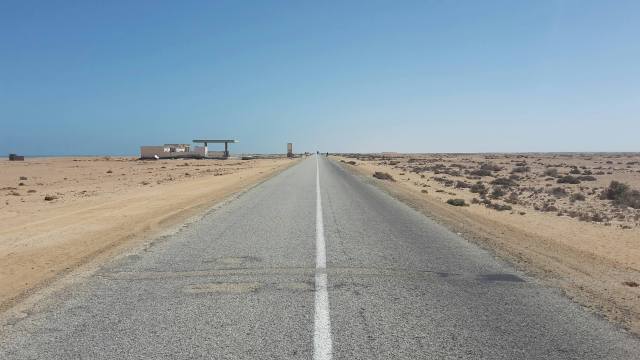
Sand on every side. No trees, no palms, no settlement in sight. A simple restaurant with old tables and plastic chairs, and two very old petrol pumps.
Behind it was the family’s living area. From what I was told, an extended family ran the place in shifts, trading off between the stop and the nearest town. The men served and waited tables. The women helped cook and looked after the children, who played behind the building.
No television. No landline. Barely any infrastructure beyond the place itself. Yet a stop like this can feed and fuel a lot of caravans in a day. It’s a lifeline with plastic chairs.
After we ate, everyone drifted into their own thing. The driver sat outside with his back against the wall and napped sitting up, one knee to his chest. The others prayed, read the Quran or did dhikr with their prayer beads.
I took a plastic chair by the entrance, one the sun had bleached of any color. I faced the car I’d ridden in so I wouldn’t miss it leaving. That was my biggest fear. I had no idea where we were.
That’s when a man with a beautiful smile walked in. He asked if he could sit by me.
He knew I wasn’t from around there. I was dressed very differently. We talked about what brought me there.
He barely spoke about himself. Every question I asked, he handed back to me, like a mirror.
So I talked. I told him I was having a rough year, and that the hospitality I’d received since arriving in Egypt had made me feel much better. He said some kind words and wished me a safe trip.
Then he left.
Soon after, everyone climbed back into the vehicles and we drove off. Somewhere down the road, Gamal, the man sitting next to me, asked what I’d done during the break. He was in his mid forties, a lover of coffee and a man who never passed up a joke.
I said I’d had a nice chat with a stranger, and described him.
Gamal told me the man wasn’t from there.
It made sense afterward. The man hadn’t come with our convoy. No new car had been parked out front. And he’d walked in at the exact moment everyone was busy praying, reading or sleeping, with nobody watching the door.
Around the fire
That night we gathered around the fire after dinner. Nights meant a circle of people who didn’t always know each other.
The talk started practical. Where everyone was headed. Business, trades, who needed what. Accidents on the road. People of the desert look after each other, even from far away, and they never stop connecting.
Then came the days. What each person had seen on the road.
What I loved was the slang. A Chadian could spot an Egyptian within two words, and the other way around. They’d tease each other by borrowing each other’s expressions and the whole circle would crack up. I speak standard Arabic and I missed three words out of ten. I laughed anyway.
Ask someone out there where he’s from and he’ll tell you, then shrug. We’re all brothers in Islam anyway. It doesn’t matter where you come from or what color your skin is.
The ones you can’t see
Nobody mentioned the jinn until I did.
I was the only foreigner, so I asked if anyone had an interesting story for me. They made fun of me first, lightly. Then they delivered.
Nobody ever said “I.” Someone else always saw it. Someone else always heard it. A cousin, a driver they knew, a man from another village. The stories ran long, wandered into tangents and found their way back.
If you only know jinn as genies, here’s the short version. In Islamic belief, they’re unseen beings made of smokeless fire. They live in caves, graveyards, deserted places and darkness. They have free will, so some are Muslim and some aren’t. The word jinn means “hidden.”
The desert, they told me, comes with rules.
Never answer a voice at night, especially one coming from afar. Sometimes it’s the wind. Sometimes it’s your own head. But there are familiar voices out there after dark, and people who aren’t used to them answer, walk toward them and end up lost. I never heard any.
Never sleep near abandoned structures. Ruins are exactly where jinn are said to settle.
Then Gamal told me to tell my story.
I told it. Nobody said what the man was. They let it be understood, subtly, that he wasn’t a man.
I don’t know if it was true or if they were pulling my leg. I believed it.
Everyone else’s stories belonged to someone else. This one had my name on it.
Hidden, remember. In a place with almost nothing to hide behind, where you can see for kilometers, someone had still come and gone unseen. And I’d told him about my struggles.
He listened. He gave every question back to me. He wished me a safe trip. Whatever he was, he was kind.
The rest of the time it was just a feeling. A presence. You don’t feel alone, which is the last thing you’d expect in the middle of nowhere. Sometimes you feel watched. Not all the time, but often enough.
I didn’t do anything differently. I prayed, same as everyone. Humans and jinn coexist. That’s the arrangement.
Ounianga Kébir
Then, finally, the lakes.
The guides in Siwa hadn’t exaggerated. Water, reeds and palm trees in the middle of a brutally dry landscape. The Lakes of Ounianga are eighteen lakes fed by groundwater, in a place that barely sees rain. UNESCO had already listed them as a World Heritage Site when I got there.
We spent two nights there. The first in a tent. The second with a large Toubou family.
The Toubou are native to this land. Their home stretches across the eastern Sahara, from Kufra in Libya into northern Chad. Arabic is the bridge language across the Sahel, but it isn’t their mother tongue. Everyone out there has one of their own, and Arabic is just the road they all drive on.
Many Toubou have settled in towns across the region. Others are still nomadic or somewhere in between. Either way, the knowledge to cross a desert that would swallow me whole is theirs.
I wish I could say I took it all in with an empty head. I didn’t.
The moment we reached the camp, the old noise came back. Everything around me was different from my world. All I could think was how much of it I could memorize and carry home. Which stories would land. Who I’d tell first.
The desert had talked me out of impressing people. A lake talked me back into it. Funny how that works.
What I do remember clearly is the hospitality. And the tea.
It came in three rounds. The first was the strongest and most bitter. The second was milder. The third was the lightest and sweetest, and my favorite.
There’s a saying about those three glasses, often credited to the Tuareg. The first is bitter as life. The second is strong as love. The third is sweet as death.
Tea was an occasion, not a drink. Nobody rushed. After the tea, everyone napped. The heat set the pace of the day and nobody fought it.
Then there were the prayers.
Several times a day I prayed beside people who’d been strangers hours earlier. No mosque. No walls. We lined up facing the same direction, with sand to the horizon on every side, and prayed as naturally as anyone would anywhere else.
Then we pushed on, through Fada and finally to Iriba.
The way back
Iriba was the end of the line.
The others kept going toward N’Djamena. I turned around with the first driver, the one from the way in. Our Land Cruiser headed back toward Siwa, this time in a convoy with other pickups.
He was silent again. Same shy smile whenever I tried to talk to him.
I’d bought dates in Ounianga, like the guides in Siwa had joked I should. I ate most of them on the way back.
I never made it to Alexandria.
What I took back
I was afraid I’d come out of it the same. Mostly, I did.
The change came late. It sat in me for five or six years before it turned into minimalism, and even then I couldn’t have told you where it started.
It started under a Land Cruiser at noon.
What I kept right away was smaller. The tea in three rounds. Prayers with strangers on open sand. A fire and a circle of men who never explained their traditions because nobody needed them explained. People with a different relationship to time.
I could make this trip sound life-changing. That’s the version I rehearsed for my first two days out there, the one with the caption. The true version is plainer. I was bored and I slept badly, but for a few days my head went quiet. That was priceless.
Twelve years later, I’m still telling the story, so I’d say the lesson isn’t fully in.
But I think about that noon in the shade. Nothing needed from me. Nobody watching. It took me years to see those were the same thing.
Discover more from Teekay Rezeau-Merah
Subscribe to get the latest posts sent to your email.


1 Comment