To Covid or not to Covid

I mean, with everything going on in the world right now, I decided to voice a rather unpopular (and informed) opinion about Covid vaccines: I personally don’t care whether people are vaxxed or not, I don’t.

However, I find it kinda strange that we’re all coerced to put a foreign biological preparation into our healthy bodies, no questions asked or else we don’t deserve some of our most basic human rights ?

Don’t you find that a bit weird?

Hear me out, I’m actually pro-vax.

Having always moved countries, my family and I are have been vaxxed more than the average person.

Case in point, if you’ve never left certain parts of Europe or North America, you may have never been vaxxed against the yellow fever. Yellow fever vaccines aren’t mandatory in many western countries.

But I have, and I’m glad that I did.

That’s just one example.

What I find weird about covid vaccines is all the propaganda and misinformation surrounding them. I hate that health matters are now being politicized. They shouldn’t be.

Same goes for topics like climate change. It shouldn’t be a right of left issue, it’s a human issue.

Anyway, I do understand that getting the shot may boost your immune system, help reduce the spread of this darned virus, decreases the chances of new mutations etc, what I don’t get is vaccine passports and vaccine mandates.

It’s even less comprehensive when you look at the potential risks and safety issues.

That being said, I may get vaxxed at some point, but long as I can do without, I won’t. Not because I’m anti-vax, not because I’m right or left-leaning, but rather because I don’t feel like I need it, nor do most HEALTHY people my age.

I think that makes perfect sense, don’t you ?

Thanks for reading.

Teekay

The most valuable lessons I’ve learned since becoming a minimalist 

Minimalism made me reevaluate what time means to me and how much of it is wasted doing essentially nonsense. 

Minimalism makes you wonder, do I enjoy spending all my free time cleaning and doing maintenance? Do I like spending so much time in stores? Do I enjoy working so many hours and/or side jobs to pay for stuff that is mostly wants or impulse buys instead of needs?

The beauty of minimalism is that it doesn’t force us to do anything, it’s all about the freedom to choose and the power that comes from making decisions based on awareness instead of being ruled by unconscious impulses and societal conditioning (hello neuromarketing).

I don’t know why it took me so long to realize this, but having fewer dishes or less clothes doesn’t allow it to pile up. If you want a clean plate or outfit, you have to keep them clean.

About that, here’s a short and yet perfect story on how to deal with laundry, by Matt d’Avella.

To take this a step further, since becoming a minimalist, I noticed that I now need less self-discipline, since there is no other option than to wash whatever is dirty, and since there isn’t much to maintain and keep up with.

This could be summed up in an extremely simple reasoning: minimizing entails having less work to do.

How ? A simple equation:

Less stuff = less work = less stress

When my go-to isn’t buying more or calling anyone for help, I become more resourceful and creative with what I have. 

The other amazing thing about minimalism is that the momentum of enthusiasm created by downsizing/organizing one area of your physical life carries over into others.  You want to experience the thrill of accomplishment again and again.

Moreover, as a minimalist, I’ve stopped ignoring my problems, and instead started focusing on them, and minimizing them.

Less stuff also means less decisions, which undoubtedly leads to less decision fatigue.

Once you do not use up your decision making power in non-essential things (such as what to wear or which cup to use) you have more energy in making more important decisions.

A personal uniform could be the answer for some, not necessarily something that works for me though ^^

Last but not least, I think minimalism promotes self-mastery.

Minimalism helps you question everything and consider how temporary the ecstasy of (insert thing) will be. 

I think that’s deep. 

Rastafarianism in a Nutshell

Having lived in Ethiopia for 4+1 years, I’ve had the privilege to experience rastafarianism first hand.

But before we get into that, let’s break down what rastafarianism is, its roots and what we can all learn from some rasta practices.

  • Rastafarianism in a Nutshell

Rastafarianism is a spiritual movement that began in the 1930s by Marcus Garvey, in Jamaica. Rastafarians believe that God makes himself known through humanity.

The supreme man in rastafarianism is His Imperial Majesty Haile Selassie I, crowned emperor of Ethiopia in 1930.

Many rastas believe this event to be the Second Coming of Christ who returned to redeem all Black people.

Rastafarianism combines Protestant Christianity (they read the bible selectively), mysticism, and a pan-African political consciousness.

  • Things I Love about Rastafarians

Rastas are pretty health conscious.

They consider their body to be a temple, based on the Old Testament teachings.

Rastas do not drink alcohol or eat food that is not nourishing to their body, which includes meat. Many follow a strict dietary law called “ital”, which states that all food must be completely natural and raw.

Meat is considered to be dead food so, according to Rastafarian belief, consuming it turns the body into a ‘cemetery’.

“Ital” is a vegetarian diet principally intended to improve health and energy. It is thought that being vegetarian is to be closer to the universal energy and life force and to avoid bringing death to God’s creatures.

The aim of healthy eating, using the freshest and most natural food possible, is to increase livity, or ‘life energy’, in Rasta terminology.

  • What is the real meaning of Zion

Rastas see Africa as a paradise on earth, and at the core of the movement is the belief that all people of the African diaspora should return to their homeland.

If you’ve been to Africa before, you know it’s the most beautiful continent on earth (with South America being close second).

Africa’s rich in culture, history, natural resources, animals, offers all types of climates and is the motherland of all humanity.

If there was such thing as a paradise on earth, Africa surely IS it.

Africa is often referred to as Zion, or Tsiyon in hebrew, which means “holy place” or “kingdom of heaven.”

  • What does it take to be a Rasta?

To be a Rasta, you have to be a true man with your words, a true man to the planet, a true man to the living, and a true man to everything that is good.

Rastas are generally very laid back, kind and humane people.

Having spent some of my best years in Ethiopia as a teen and later, I’ve had the pleasure to chat with lots of rastas about spirituality, pan-African political consciousness and black empowerment.

For rastas, the way you treat yourself, starting with your body and your mind, sets the tone for everything you do.

You can’t respect others if you don’t respect yourself, and you can’t live harmoniously if you’re not right in your body and in your head.

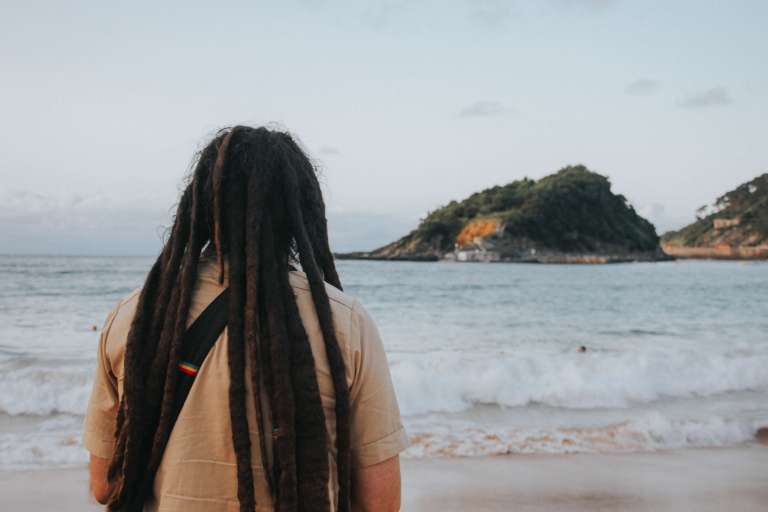
Rastas believe in the principle of balance lifestyle, which includes the wearing of long hair in its natural, uncombed state (dreadlocks), dressing in the colours of red, green, gold, and black, which respectively symbolize the life force of blood, herbs, royalty, and Africanness.

  • Religious practices

Religious rituals include prayer services, the smoking of ganja to achieve better “itation” (meditative state), and binghi (drum sessions).

  • Fun fact

The movement takes its name from the emperor’s pre-coronation name, Ras Tafari.

Minimalism: removing things that remove you from your life

From owning 51 pairs of shoes to less than 40 overall clothing items, how did I get here?

I could write a whole book about the many benefits of minimalism.

I talk a lot about minimalism and mindfulness on my podcast.

I truly and wholeheartedly believe this lifestyle can spark a change in the world, help people feel happier, lighter, achieve financial stability, work less and live more.

There are no good arguments against minimalism, just like there are none against veganism, but that’s another story.

That said, lately I’ve been exploring a different terminology. I felt as though the term “minimalism” wasn’t impactful enough.

Hear me out.

Most of us think we know what minimalism is, or what it entails. We don’t, not really.

The word “minimalism” is somewhat self-explanatory, which, IMHO, doesn’t do it justice.

This really got me thinking, so I decided to come up (or explain further) my own work-in-progress minimalism, which is a bit extreme, so I call it mindful essentialism, or just essentialism.

Why “essentialism” you ask? Simple: because I own the bare minimum, or rather, essentials only, no extras.

As an essentialist, one of the main focuses of my lifestyle is protecting the environment.

Consuming less leads to cutting down waste and living with a smaller ecological footprint. Simple.

I obviously still own and need some stuff, but the things I own and buy (when need be) are 100% environmentally friendly, and absolutely necessary. I also live frugally, and try to repair and repurpose all my belongings.

I’ve talked about this time and again on my podcast, but consuming less helps reduce the harmful impact of mindless consumerism on our planet. This makes essentialism a pro-environment and anti-consumption mindset and philosophy above everything else.

From shopping second hand and eco-friendly to investing in quality products (that last longer), my new shopping habits (close to nonexistent nowadays) help me reduce my carbon footprint significantly.

For instance, mindful shopping and making sure I don’t bring any unnecessary things into my life is the first thing on my mind when I’m out looking shopping;

Having the preservation of the planet in mind, essentialists like myself usually follow a vegan lifestyle as the two philosophies go hand in hand.

My other focus as an essentialist is to experience the world without getting tied down to a permanent place and financial burdens.

Instead of embracing materialism, I believe creating memories of my experiences is one of the two most important aspects of my life, the other one being giving (time and money) to charity and NPOs.

  • Travel-wise

As a lifelong traveler, I’ve always had trouble finding the right amount of things to pack up, so I always ended packing way more than I needed.

Since embracing this philosophy, I’ve noticed how traveling with fewer distractions allowed me to be more present and get the best out of each and every experience. It’s the little things, right?

For some nomadic minimalists, this lifestyle is just a practical way of moving around. For me, it’s challengingly fun to experience how little I (and now WE) can live with.

  • The mindful part of essentialism

As an essentialist, peace of mind is an integral part of why I chose this life.

Owning fewer things automatically reduced mental clutter for me, which is the number one cause of stress and anxiety for most people.

Owning less also reduces distractions and gives me the ability to focus on self-reflection (hence this post), self-love and personal development (once again, hence this post).

As a mindful essentialist, owning less possessions and being more present in the moment with my thoughts, my loved ones, my feelings and emotions has increased my quality of life in a significant manner. It’s made my life more meaningful and fulfilling.

Now, I’m not there yet, and I will keep working on shaping a better version of myself, pursuing excellence (a religious principle in my case) and adding value to other people’s lives.

I started my essentialist journey to escape the suffocation of stressful and expensive lifestyles, but I ended up finding a whole different facet of myself, a more relaxed and positive one.

In short:

Cutting down on “stuff” helped me become more mindful about self-care and my core values as well.

Essentialism has become a powerful tool in my journey of developing a better me. It’s helped me become more thoughtful as well.

Thank you for stopping by!

Here’s a short list of my favorite minimalists:

  • Leo Babauta from Zen Habits 
  • The minimalists
  • Sorelle Amore
  • Colin Write
  • Youheum from Heal your Living (personal fave)
  • and of course Matt D’Avella