glass tower

The most sustainable energy is not renewable.

It’s the energy your building never needs.

A few years back I interviewed an architect for my podcast. He spent an hour on something that should be obvious and somehow isn’t anymore, a building can heat and cool itself just by facing the right way.

I haven’t stopped thinking about it since.

We build homes that ignore where the sun rises, block the wind, and wrap them in glass that lets the sun in all day with no way to let the heat back out. Then we spend fifty years paying to undo it. Air conditioning in summer and heating in winter have both become so normal we forgot they’re solving a problem the building created for itself.

That energy has to come from somewhere, coal, gas, nuclear. Nuclear seemed like the cleanest way to produce electricity until the heat started warming the rivers it depends on. In France, several plants had to cut output during heatwaves this year because the river water was too warm to cool the reactors properly. Grids buckle under demand spikes exactly when everyone switches their AC on at once. The machine we built to save us from bad design turns out to have its own limits too, and those limits are only going to show up more often as summers get worse.

None of this is abstract for the people paying for it. In Albi, a 36 year old named Pauline Paredes describes her own apartment as a kettle after weeks of 40 degree heat, and says flatly she has to be out of it before next summer. She’s one of hundreds of people a French outlet interviewed this year alone about heat pushing them out of the places they live.

A geographer in Lyon estimates around 100000 people already leave French cities every year for the outskirts and the countryside because of it, and expects that number to double as the heatwaves keep stacking up.

Winter runs the same script in reverse. More than five million French households live in fuel poverty, a third of the country couldn’t properly heat their home this past winter, and three out of four households are now rationing their heating just to keep the bill within reach. None of that is a footnote to a design conversation. It’s what happens when a building depends entirely on a machine, and the machine gets too expensive to run or the grid buckles at the exact moment everyone needs it most.

Passive solar design isn’t futuristic. It’s ancient. For most of human history people built with the climate instead of against it, thick walls, shaded courtyards, windows placed on purpose, trees that dropped their leaves right when you needed the sun back. None of that was decoration.

We gave that up the moment cheap energy got easier than good design.

The shift has a start date. In 1952 the United Nations Secretariat went up in Manhattan as the first tower wrapped entirely in glass and cooled entirely by machine, followed a few years later by Lever House a few blocks down. Neither building was designed around the sun. Both were designed to look like the future, and cheap postwar energy is the only reason either one got away with it. Every glass tower built since has copied that template. Offices cooled that way now run about 60% higher in carbon emissions than ones that use natural or mechanical ventilation properly. We didn’t inherit bad buildings. We inherited a look, and we’re still paying the electric bill for it.

Every architect knows where the sun rises and sets. Yet, somehow most buildings are still designed like it doesn’t matter. In the northern hemisphere, your longest wall generally wants to face south. That one decision decides how much free heat you get in winter and how easily you can block it in summer, before a single brick goes down.

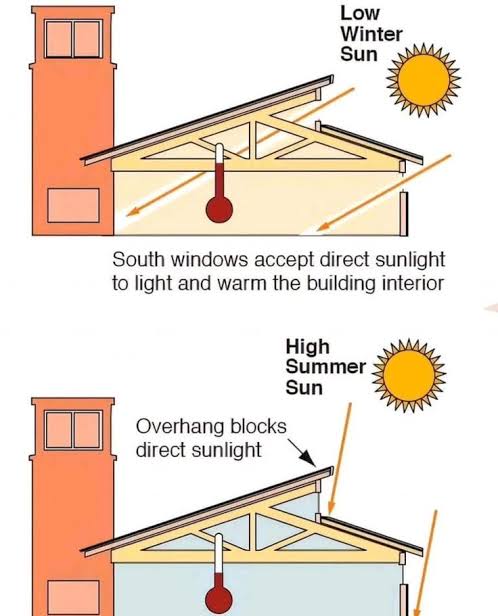
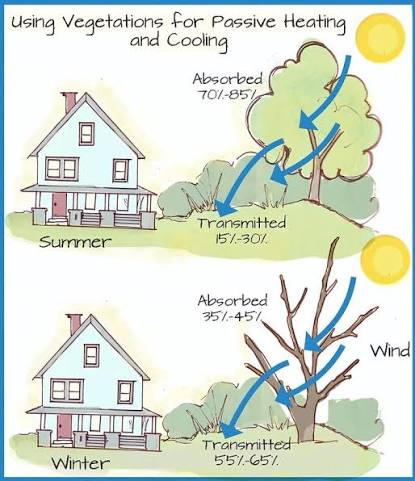
In winter the sun sits low. It travels under the roof overhang and warms the floor and the walls, which quietly hold onto that heat all day. Six months later the same window behaves completely differently. The summer sun sits high, the same overhang blocks it, the room stays bright without turning into an oven. Nothing moved. Nothing plugged in. The only technology was geometry.

Get the geometry wrong and inefficient turns into dangerous. London’s 20 Fenchurch Street tower, nicknamed the Walkie Talkie, curves its south face inward like a satellite dish. In 2013 that curve did exactly what a concave mirror does, it focused the sun into a single point on the street below. The hot spot passed 90 degrees Celsius. It melted panels on a parked Jaguar, warped a bike saddle, and set a doormat on fire outside a barbershop. The developers ended up bolting a permanent sunshade onto the building afterward, aluminum fins running from the third floor to the thirty fourth, a fix that cost millions of pounds because nobody modeled where the sun would actually land before they built it.

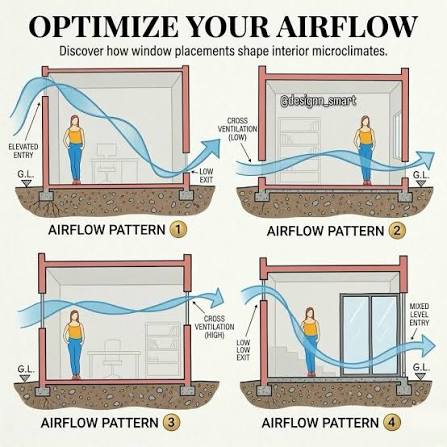
Cooling didn’t start with a compressor. It started with a window across from another window. Cross ventilation works on one idea, put openings on opposite sides of a space so air has somewhere to go. Wind comes in one side, pushes the stale heat out the other, and the building breathes on its own.

Older buildings understood this without needing to be told. Doors lined up with courtyards. Vents sat high to let hot air escape. Floor plans stayed narrow so every room caught moving air. A lot of modern apartments do the opposite, one glass wall and nowhere for heat to go. So we swap airflow for machinery and act surprised when cities burn through electricity every summer.

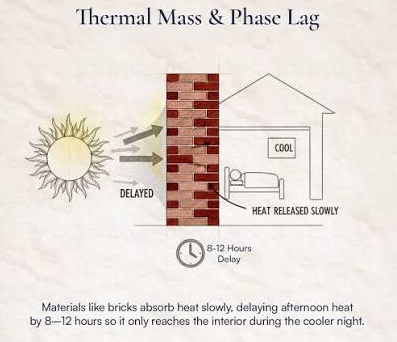
Thermal mass sounds technical. It’s actually closer to cooking. A cast iron pan stays hot long after it leaves the stove because it holds heat. Stone, brick, and concrete do the same job inside a building, soaking up warmth slowly, holding onto it for hours, letting it go once the temperature drops.

That’s why old stone houses stay cool through a scorching afternoon. The walls delay the heat instead of handing it straight to the room, then let it go outward once night air drops below the temperature of the stone, which is also why throwing every window open after dark was never superstition, just the last step of the same system.

A light building reacts to the weather. A heavy one negotiates with it. The difference is a few degrees you never had to pay for.

Somewhere along the way we split architecture from the landscape around it. That was the mistake. A mature deciduous tree, the kind that drops its leaves every winter, is one of the oldest climate technologies we have. In summer its leaves catch the sun before it reaches your roof. In winter those same leaves drop and let the light back in, right when you need it.

Compare that to a parking lot, which soaks up heat all day and radiates it back into the block long after dark. Trees do the opposite, they cool the air around them while they’re at it. During a heatwave, tree canopy runs eight to twelve degrees Celsius cooler than bare pavement, and a shaded sidewalk can feel up to 14 degrees cooler than one with nothing overhead. We keep shopping for smarter cooling systems while we cut down the oldest and most efficient ones.

None of this needs a backyard. A fifteen story block can face the right way and breathe on two sides just as easily as a bungalow, because the physics doesn’t care how many units are stacked on it. Sprawl is the real opposite of passive design, not density. Sprawl is what happens when a city spreads instead of stacks, and it only survives on a car in the driveway and a compressor on the wall.

People ask if insulation is the most important feature of an efficient building. Insulation matters, but it comes after the fundamentals. A well designed passive building stacks orientation, shading, ventilation, thermal mass, and insulation into one system where each part is quietly doing the others’ job too. Orientation catches the winter light. Overhangs block the summer sun. Trees add seasonal shade. Windows catch the wind. Walls bank the day’s heat. Insulation keeps all of it from leaking back out. None of this is new. It’s just been sitting there unused for about a century.

Climate change keeps exposing how badly we build. Our answer is always the same, a bigger unit, a stronger system, more electricity. We rarely ask if the building was ever designed with any of this in mind to begin with. Passive design offers something else, comfort you get from understanding a place instead of comfort you buy every month. Latitude, wind, trees, sunlight, seasons.

A building shouldn’t have to fight the place it’s standing in every single day, and for most of human history none of them did. Architecture was an extension of the land before it became a product line.

Pauline Paredes shouldn’t have to leave Albi to stop living in a kettle. The five million households rationing their own heat this winter shouldn’t have to choose between warmth and food. None of that is the weather’s fault alone. It’s the bill for a hundred years of buildings that were never asked to do their share of the work.

The most sustainable energy was never going to be the one we invent next. It was always the one we stopped needing the day we designed the building right the first time. We just built our way out of remembering that, one glass tower at a time.

Teekay

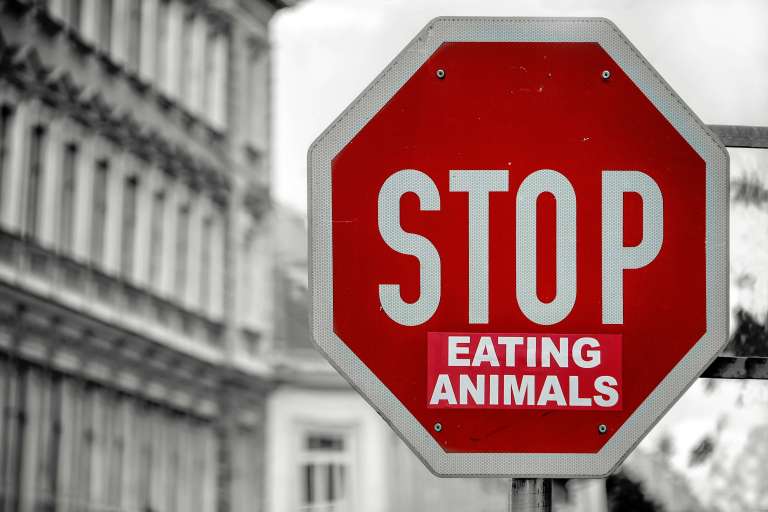
stop eating animals

Every road leads to the same slaughterhouse

Why are you vegan?

People ask me why I’m vegan more than almost any other question.

They expect a simple answer, one reason. The animals. The climate. Health.

The truth is less convenient.

A documentary started it. I watched Cowspiracy expecting to feel informed for an evening and come out the other side unchanged. That’s not what happened. Something in me actually shifted, and it didn’t shift back. It’s not a perfect film, a few of its numbers got oversimplified to the point of losing context, but the core of what it lays out is factual and well researched, and it did enough to make me curious.

It was the door. I went down the rabbit hole, and every subject I cared enough to study kept leading me to the same place. Climate change, ocean conservation, water scarcity, public health, colonial exploitation, every one of them led there.

The more I learned, the harder it became to justify participating in an industry that sits at the center of so many crises at once.

Sentience isn’t a seasoning

Everything else comes second.

A cow doesn’t want to be slaughtered. A pig fights for its life. Chickens recognize dozens of individuals and form complex social hierarchies. Octopuses solve puzzles. Fish remember routes, cooperate, and avoid painful experiences. The scientific debate is no longer whether many animals are sentient. It’s how rich their inner lives actually are.

An estimated 80 billion land animals are slaughtered every year for food. That number doesn’t include fish, whose deaths are measured in the trillions because they’re counted by weight rather than as individuals.

Modern language hides this. We say beef instead of cow, pork instead of pig, seafood instead of animals. We call slaughterhouses processing plants and carcasses products. The vocabulary exists to make violence feel industrial instead of personal.

If another being can suffer, the burden of proof should never sit on compassion. It should sit on exploitation.

The net effect

The ocean made me rethink everything.

I dive, and most of the people I dived with aren’t vegan. Ask them and they’ll tell you they love the ocean, and I don’t doubt they mean it. But loving an ecosystem while still funding the industries gutting it is a contradiction worth sitting with, not a small one, and it’s one very few divers ever examine.

We often imagine plastic bottles floating on the surface as the defining image of marine pollution. They matter, but they’re not the whole story. A large share of the plastic mass in the Great Pacific Garbage Patch, by most estimates close to half, is abandoned or discarded fishing gear. Nets keep killing animals for years after being lost, a phenomenon known as ghost fishing.

Then there’s bottom trawling.

Imagine dragging a weighted net across an ancient forest, flattening everything in its path, then throwing most of the wildlife back dead because it has no commercial value. That’s essentially what industrial trawling does to the seabed. Coral gardens, sponges, and countless species disappear beneath steel chains because efficiency demands it.

Every year, an estimated hundreds of thousands of dolphins, turtles, sharks, and seabirds die as bycatch. They were never the target. They’re collateral damage.

The ocean isn’t being emptied because billions of ordinary people fish with small boats. It’s being emptied because industrial fleets have turned living ecosystems into extraction zones.

Catch of the day

Fishing is also a story about power.

Countries with enormous industrial fleets don’t limit themselves to their own waters. They travel thousands of kilometers into the waters of poorer nations through unequal agreements, weak enforcement or outright illegal fishing.

In Senegal, fish has long been the foundation of both culture and nutrition. Yet many local fishers return with smaller catches than previous generations because industrial vessels remove fish on an entirely different scale. The result isn’t simply environmental decline. It’s food insecurity, unemployment, and ultimately migration.

When communities that have fished sustainably for centuries start struggling to feed themselves while foreign ships export their catch across continents, it’s hard to call that free trade. It looks much closer to colonial extraction wearing a modern suit.

The ocean belongs to no empire.

Empire and industry run on the same logic. Whoever holds power decides which lives count as resources and which don’t. That logic doesn’t start with the ocean. It starts with the animal on the plate, the first life reduced to a commodity, the template every later extraction gets copied from. Stop treating animals as property and the whole chain of domination loses the argument it was built on.

But soy

People still blame vegans for soy.

It’s one of the most successful and ridiculous myths ever created.

Every estimate lands well north of three quarters of the world’s soy grown to feed livestock, not people eating tofu or soy milk.

Chickens, pigs, and cattle consume astonishing quantities of crops before becoming meat. We don’t destroy forests because humans suddenly developed a love for edamame. We destroy them because billions of farmed animals need feeding.

The Amazon illustrates this perfectly.

Cattle ranching remains the largest driver of deforestation there. Forests are cleared for pasture, while surrounding land increasingly becomes monoculture growing feed for animals. Fire is often the cheapest way to erase thousands of years of biodiversity in a matter of hours.

The images are almost unbearable. Trees burning. Birds unable to escape. Mammals trapped by flames moving faster than they can run. Entire ecosystems reduced to ash so empty grass can replace living forest.

We call it development.

I call it extinction.

Green algae

People often argue over percentages. Was livestock responsible for 14 percent of emissions or 18 percent?

Here’s what the argument over the exact number misses. Whichever figure turns out to be more accurate, both put livestock among the two largest contributors to global emissions, alongside fossil fuels. Fighting over four percentage points doesn’t change which industries need to shrink.

Food systems account for roughly a third of global greenhouse gas emissions, and livestock is one of the largest pieces of that share through methane, deforestation, feed production and land use. Methane matters especially because it traps heat far more effectively than carbon dioxide in the short term.

The damage doesn’t stop at the atmosphere. It ends up in the water too.

Industrial farms produce mountains of manure. When nitrogen and phosphorus run into rivers, lakes, and coastal waters, algae multiply out of control. As they decompose, oxygen disappears and aquatic life suffocates.

Few places show this as clearly as Brittany, in France. Every summer, vast blooms of green algae cover its beaches. As the algae rot, they release hydrogen sulfide, a toxic gas that has been linked to the deaths of wild animals and, in a small number of documented cases, humans. This isn’t a natural disaster. It’s the predictable consequence of decades of intensive livestock farming and fertilizer runoff.

And the warming comes back around to the animals themselves. During recent heatwaves across Europe, thousands of farm animals died trapped inside industrial sheds and trucks before reaching slaughter. They survived neither nature nor the system built to profit from them.

The victims of climate change increasingly include those forced to produce it.

The side effects

I didn’t become vegan for my health.

It became an unexpected consequence.

The strongest scientific evidence is remarkably consistent. Diets centered on legumes, whole grains, fruits, vegetables, nuts, and seeds are associated with lower risks of cardiovascular disease, hypertension, and type 2 diabetes. Consumption of processed meat increases the risk of several cancers.

That doesn’t mean every vegan is healthy. French fries are vegan. Some donuts are vegan. Ethics and nutrition are different conversations.

The point isn’t that plants are magic. It’s that our healthiest dietary patterns consistently lean more on them and less on animals.

The next pandemic has a farm address

Humanity keeps building the perfect laboratory for new diseases.

When thousands of genetically similar animals are confined together, viruses evolve more easily. The closer the contact between stressed animals and humans, the greater the chance for pathogens to jump species.

Many of history’s most significant infectious diseases are zoonotic. They originated through animal to human transmission, even if each followed a different path.

Alongside this sits a quieter crisis. Antibiotics are routinely used in livestock around the world, not only to treat disease but often to prevent it in intensive systems. This accelerates antimicrobial resistance, letting bacteria evolve past medicines that once saved millions of lives.

We talk about the next pandemic as if it will arrive from nowhere. Often, we’re building it ourselves.

Burning calories to make calories

Perhaps the strangest part of all this is how inefficient it is.

We grow enormous quantities of edible crops, feed them to animals, lose most of the calories and protein during that biological conversion, then wonder why feeding humanity keeps getting harder.

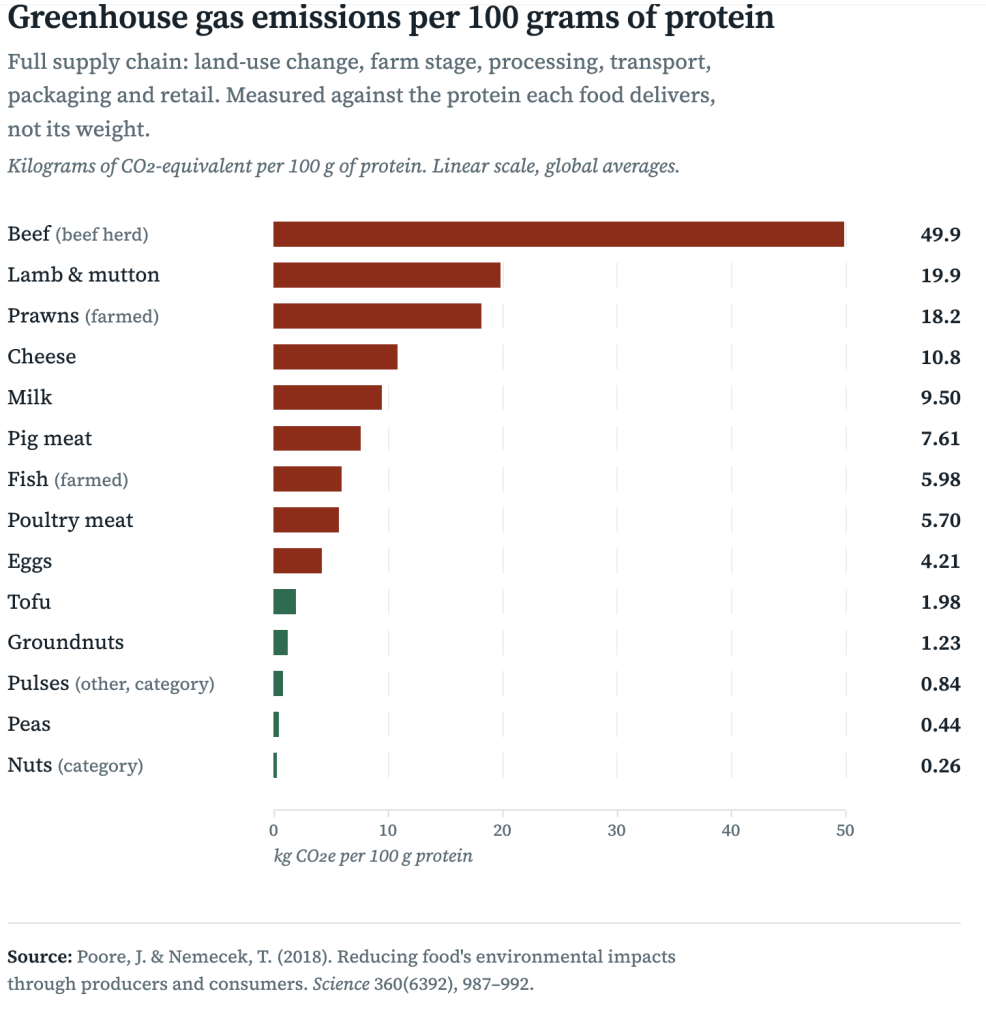
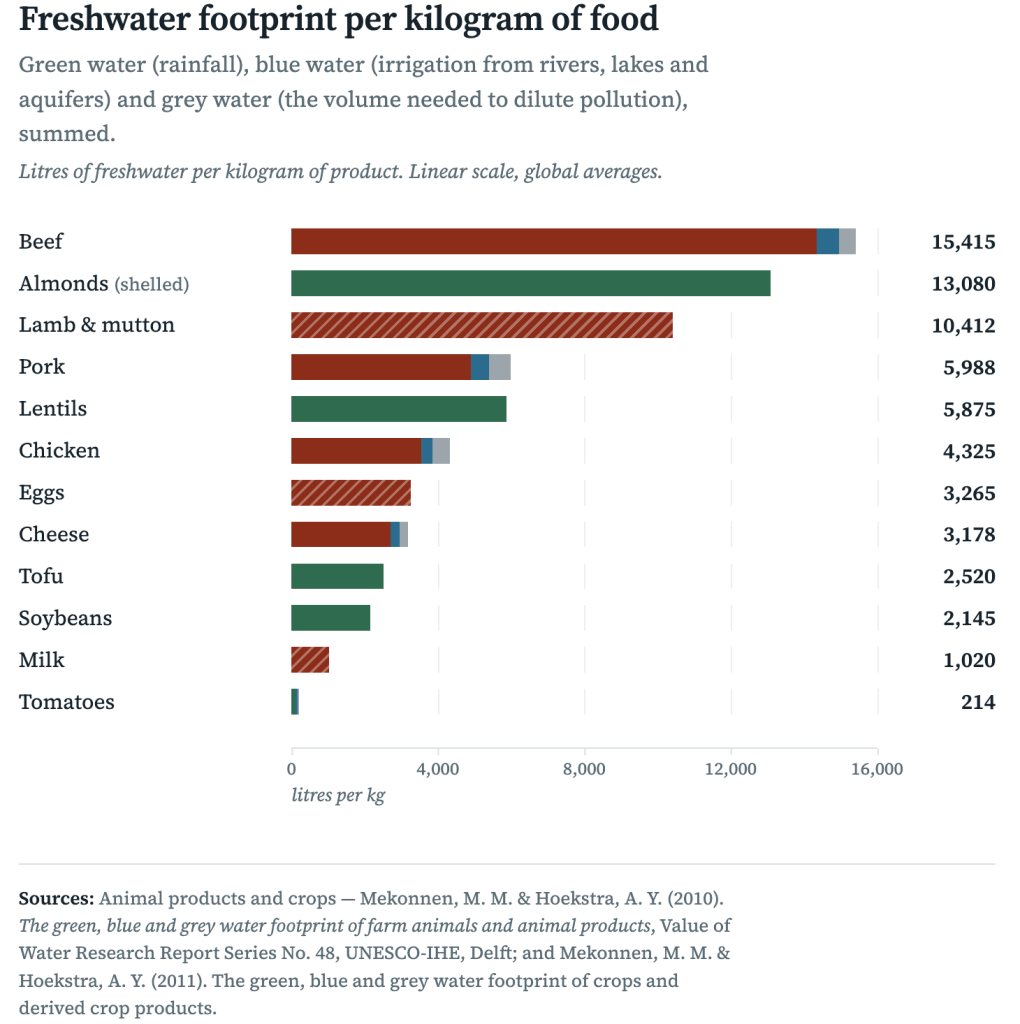
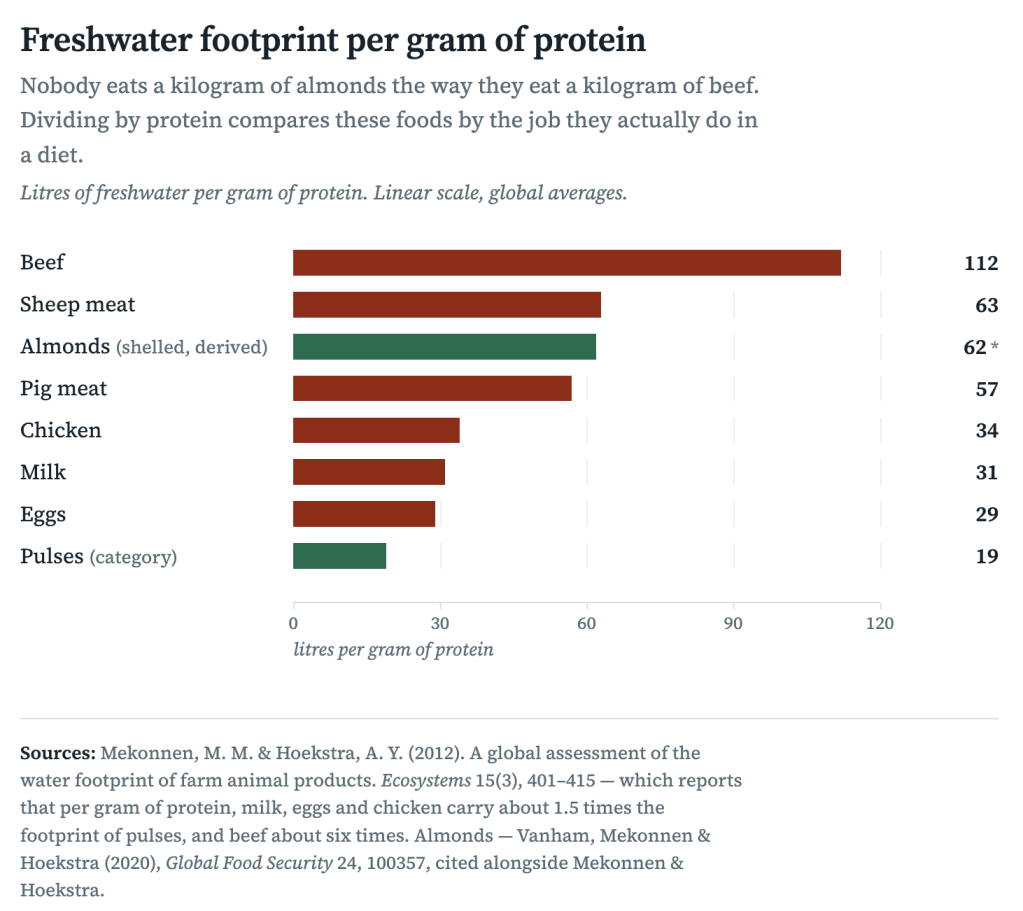
Animal protein is one of the least efficient ways to produce food from land, water and crops. Producing protein directly from plants generally takes dramatically fewer resources while leaving more room for forests, wildlife and carbon storage.

Hunger has never been purely an agricultural problem. It’s always been a political one.

Life, itemized

The deeper I looked, the more one pattern kept repeating.

A forest became timber.

An ocean became a resource.

A river became a waste channel.

A cow became a machine for milk.

A chicken became a production unit.

A fish became tonnage.

Capitalism has an extraordinary ability to rename living beings until they sound like inventory. Once something becomes a commodity, its suffering disappears behind spreadsheets, shipping containers and quarterly profits. Dead bodies cross continents refrigerated inside trucks and cargo ships while consumers rarely think about the individual lives those numbers once represented.

The system depends on distance.

Distance between the slaughterhouse and the supermarket.

Distance between the fishing fleet and the village it impoverishes.

Distance between the burning forest and the burger.

Distance makes almost anything feel normal.

All roads lead to veganism

People still ask why I’m vegan.

I could say it’s for the animals, and that would be true.

I could say it’s for the climate, and that would also be true.

I could say it’s for cleaner rivers, living oceans, public health, or the communities losing their fisheries to industrial extraction. Every answer would be incomplete on its own.

Because veganism was never one road.

It was the destination where all the roads met.

The more I learned about suffering, the more impossible it became to justify taking part in it when another choice existed.

That’s why I’m vegan.

Teekay
Money

Freedom begins by reducing dependence

Money is not the foundation of civilization.

It’s the receipt.

We spend our lives chasing numbers on a screen. GDP, stock markets, billionaires, inflation, currencies. We act as if money is the bedrock everything else stands on.

It’s not.

Food is.

Without food, there are no people. No workers, no soldiers, no consumers, no billionaires. Hunger has always been humanity’s first enemy, and every civilization was built around solving that one problem.

But there’s a truth hiding underneath it.

You can’t secure food without energy.

For tens of thousands of years, that energy came from human muscle, animals, rivers and wind. Then we found coal, oil and gas, and suddenly one machine could replace hundreds of people. Fossil fuels didn’t invent energy. They concentrated it. They turned power into something that could be owned, extracted and sold.

That’s when the game changed.

Whoever controls energy controls transport. Whoever controls transport controls food. Whoever controls food controls hunger. And whoever controls hunger controls nations. First it’s a national interest. Then a security interest. Then a reason to send an army.

That’s the real ledger. Everything else is cover. Democracy, freedom, human rights, security. Different century, same script, and the resource underneath it rarely changes. Energy-rich regions have a long history of becoming “unstable” right when a great power needs what’s under their ground. That’s not coincidence. That’s the pattern of intent.

The cruelest part is that even those of us who reject that history still run on its infrastructure. I oppose exploitation, yet I fill my tank and charge my phone. I criticize empire, yet I use electricity flowing through grids built on centuries of extraction. I condemn colonialism while still benefiting from resources mined thousands of kilometers away. None of us stand outside the machine, no matter how loudly we object to it.

Since I can’t opt out of the system, the next best thing is shrinking how much of my life it gets to run. That’s the actual reason I became a minimalist, not the aesthetic.

People think minimalism is white walls and linen shirts and empty apartments.

It’s not. It’s about dependence.

Every unnecessary possession draws on that same energy chain. Every gadget needs electricity. Every trend needs a factory, a cargo ship and something pulled out of the ground to make it. The more you need, the more someone else gets to set the terms of your life.

Freedom isn’t earning enough to consume without limit. Freedom is needing so little that scarcity loses its grip on you.

Markets are built to sell people infinite desires, because a person who always wants more is a person who can always be sold something. Minimalism breaks that loop. It won’t dismantle any empire by itself, but it quietly stops feeding it.

Own less. Need less. Depend less.

Because in a world where power runs on energy, the simplest resistance is deciding how much of it you hand over.

Teekay

ac unit

The end of outside

The greatest tragedy of global warming is not that the planet is getting hotter.

It’s that humanity is slowly abandoning the outdoors.

We’re sleepwalking into an indoor civilization where the sun becomes something we look at through glass, fresh air is replaced by recycled air, and daily life happens inside sealed boxes connected by roads built for machines instead of people.

We call this adaptation.

I call it surrender.

For most of human history, we survived heat and cold without turning the atmosphere into an appliance. Homes had thick walls and were oriented for natural cooling and heating. Streets were narrow and shaded. Courtyards created airflow. Trees cooled entire neighborhoods.

In the Sonoran desert, on the Arabian peninsula, across the Arctic circle, people lived for thousands of years in the harshest climates on earth, not by avoiding them but by designing for them. Architecture responded to climate because it had to.

Then something changed. Construction stopped answering to climate and started answering to speed and margin. Cheap materials, fast timelines, glass towers that look identical from Dubai to Shanghai to New York City.

This happens under different economic systems in different ways, but under capitalism specifically, the incentive is sharpest and the scale is biggest. We paved cities with concrete, cut down trees, covered skylines with heat trapping glass, and filled streets with cars that turn neighborhoods into furnaces.

Instead of questioning the design, we invented a product to survive it. Every summer gets hotter. Every building gets another compressor. Every apartment becomes another sealed container.

The machine that promises relief quietly becomes part of the world that made relief necessary.

That machine is air conditioning, and naming it here isn’t a knock against it. In 1936, before home AC existed anywhere in the US, a heat wave killed close to five thousand people across the country, most of them in homes with no insulation, no shade, no relief.

That death toll wasn’t inevitable and it wasn’t just bad luck. It happened in the middle of the Dust Bowl, and the Dust Bowl was manufactured. Farmers had stripped the deep rooted native prairie grass, the kind that held moisture and cooled the ground through the plants themselves, and replaced it with shallow rooted wheat grown for profit.

When the drought came, there was nothing left to hold the land together and nothing left to cool it. Indigenous communities had farmed those same plains for centuries without triggering that collapse. The 1936 death toll wasn’t proof that hot places are hostile to humans. It was proof of what happens when land and housing get built for yield instead of for the climate they sit in.

AC didn’t create that problem. It arrived as a patch for a problem that profit driven land use and profit driven construction had manufactured, and it’s remained a patch ever since, papering over bad design instead of fixing it.

That’s the honest version of the argument. Not that AC invented the crisis, but that we reached for the machine instead of reaching for the wall thickness, the window placement, the shade, the airflow that would have made the machine unnecessary in the first place.

Spend time in many hot, humid cities today and you notice something unsettling. The day disappears. Life retreats to dawn and returns after sunset.

Office workers leave an air conditioned apartment, enter an elevator, board an air conditioned train, spend nine hours in an air conditioned office or mall, and return home after dark. Entire days pass without sunlight touching their skin.

Not because they hate nature. Because the city has made nature hostile.

Outside is heat that exhausts you within minutes. Humidity that clings to your lungs. Mosquitoes thriving in a warming climate, carrying diseases that turn an open window into a calculation of risk. Pollution hanging over traffic. The safest option becomes staying inside.

Home stops being shelter. It becomes life support.

The cost is much larger than vitamin D deficiency, though that’s where it starts. Less sun on skin means less vitamin D produced, and vitamin D deficiency is tied to low energy, low mood, and a weaker immune system, which is why people who spend their days sealed away from sunlight tend to get sick more often, not less.

Our bodies evolved with morning light, changing temperatures, wind on our skin, fresh moving air. Circadian rhythms sync to dawn, not to LED panels, and when that sync breaks down, sleep breaks down with it, and disrupted sleep drags hormonal cycles, mood, and energy down with it.

Recycled indoor air adds another layer on top. Research on indoor air quality has linked poor ventilation and recirculated air to worse asthma symptoms and higher rates of respiratory illness, especially in buildings that trade fresh air exchange for sealed, climate controlled comfort.

Even our eyeballs are stretching out of shape. Children who spend most of their days indoors under artificial light are developing myopia at rates that have doubled in some countries in a generation, while the ones who spend two hours a day outdoors are far less likely to need glasses at all.

There’s a crueler twist hiding underneath all of it. Studies comparing people who live in constantly air conditioned spaces to people who live with natural ventilation find that the AC group’s bodies lose the ability to handle heat at all, weaker sweat response, less tolerance, more discomfort at the same temperature a naturally ventilated body handles with ease.

The machine doesn’t just fail to fix our relationship with heat, it erodes our own built in defenses against it, so we need the machine more, not less, the longer we rely on it.

And a life spent moving between sealed rooms is a life spent sitting down. Outdoor space invites movement in a way four walls never will, and the sedentary indoor hours we’ve traded for it are independently linked to weight gain and rising obesity, on top of anything diet explains.

Sleep, mood, hormonal cycles, the air in our lungs, the shape of our eyeballs, our own tolerance for the climate we live in, our own bodies at rest, all bent out of shape by a relationship with the natural world that modern urban life steadily erases.

We’ve normalized breathing recycled air more often than fresh air. That should horrify us.

The cruelest part is the loop that follows. The hotter cities become, the more air conditioners we install. The more compressors run, the more waste heat gets dumped straight back into the streets.

Research on Phoenix Arizona has found that AC waste heat alone pushes nighttime outdoor temperatures up by more than one degree Celsius, right when the heat should be breaking. Elsewhere, modeling done on a city like Paris found that if every building ran AC to hold a comfortable indoor temperature, the waste heat could raise the temperature by up to three and a half degrees Celsius.

The same mechanism behind the Dust Bowl I mentioned earlier is still running quietly in American suburbs today. Grass and trees cool the air through evapotranspiration, water moving up through roots and out through leaves. Strip that away for pavement and clean-cut lawns and you lose all the moisture. The ground stops cooling itself the way it used to, so the heat just builds and kills the remaining grass.

Singapore has more air conditioners per capita than anywhere else in Southeast Asia, and it has also spent years planting rooftop gardens, vertical greenery, and tree canopy to bring outdoor temperatures down.

The greenery helps, but the heat from all those compressors doesn’t disappear just because there are more trees to stand under. As long as the AC stays, the waste heat stays with it. Greening a city while leaving mechanical cooling untouched isn’t the answer, it’s proof that the answer has to include using less of the machine, not just planting around it.

This is capitalism distilled into a single object.

Create the crisis. Sell the adaptation. Repeat.

The future should not be millions of homes humming behind permanently closed windows.

It should be cities dense with trees instead of parking lots. Buildings designed for cross ventilation, thermal mass, and passive solar heating and cooling instead of sealed glass that needs a machine to survive its own design. Public spaces that invite people outdoors instead of shopping malls that replace them. Fewer cars. Less concrete. More shade. More wind. More life.

We don’t need to get better at hiding from the climate. We need to build a world where hiding is no longer necessary, and stop mistaking climate control for control over the climate.

Global warming is not only melting glaciers. It’s melting the very idea of outside. If we accept air conditioned isolation as the endpoint of civilization, we’ve accepted far more than a hotter planet.

We’ve accepted the disappearance of human life beneath the open sky.

Teekay

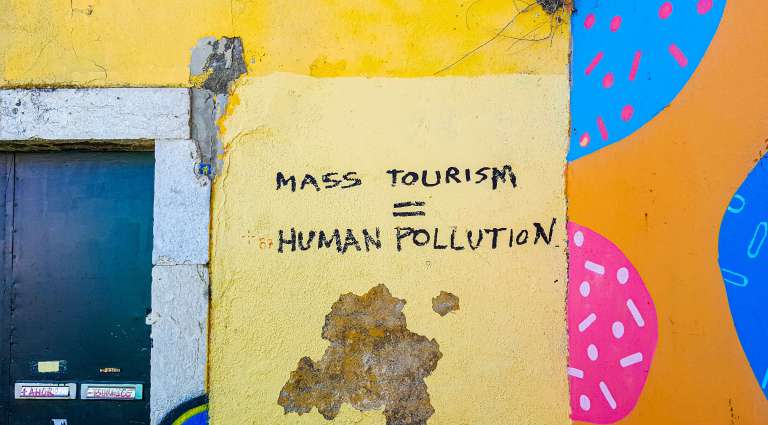
Mass tourism = human pollution

Why Overtourism Is a Capitalist Crisis

The tourist didn’t design the system that made travel a substitute for a life worth living.

A new form of environmental propaganda has quietly become mainstream.

Every week, another headline appears telling ordinary people they are responsible for climate change, then hands down the same list of penances. Drive less. Fly less. Stop buying this. Stop enjoying that. Recently, Le Monde highlighted that tourism accounts for around 9% of global CO2 emissions.

The number itself bothers me. It’s huge, and mass tourism is something I have no patience for.

The framing bothered me even more.

Once again, the spotlight was placed on ordinary people instead of the system that shapes almost every decision they make.

It’s becoming increasingly common to hear the same message.

You’re responsible.

You’re the polluter.

You’re destroying the planet.

Study. Work. Pay your bills. Repeat. But if you finally manage to save enough money for a vacation, you’re suddenly made to feel guilty for that too.

That is not environmentalism.

That is misdirection.

Anyone who reads my essays knows I take my environmental footprint seriously. The choices behind that, the minimalism, going vegan, the way I get around, weren’t picked up to look good or fit in. They came out of years of reflection.

I’ve been a minimalist for nearly a decade because endless consumption makes neither people nor the planet happier.

I’m vegan because I care about animals. I also recognize the immense environmental cost of industrial animal agriculture, from habitat destruction to food waste and greenhouse gas emissions.

I buy second hand exclusively and repair things before replacing them. I don’t buy new clothes. I’d rather walk or take public transportation than drive, and I’d rather borrow or share something than own it outright, because half the stuff we buy individually just sits there waiting to be used once a year. I’ve taken a nine hour bus instead of a forty five minute flight to the same destination, more than once, because the extra hours felt like a small price for the difference in footprint. I believe we should leave this world better than we found it.

None of that makes me exceptional. It just means I got lucky, or stubborn, enough to question habits most people never get the chance to question, because those habits get taught before we’re old enough to notice them.

Unlike wild animals, humans cannot realistically leave no trace at all. We build, consume, and transform our surroundings. But we can choose to leave as little trace as possible.

That responsibility matters.

What I reject is the idea that environmental collapse is primarily the consequence of millions of individuals making bad personal choices, as if those choices appeared out of nowhere.

They didn’t.

We’re born into a world that treats consumption as the default. Questioning it comes later, if at all, because most people spend their lives just trying to survive rent, survive the cost of food and shelter. Then, once that survival eases up even a little, we try to make up for lost time. We overconsume to compensate for what we never had, the same way anyone leaving poverty tends to, emulating the people who always had the means. “Treat yourself. You earned it. You worked hard for it.”

Individualism finishes the job from there. Look after your own happiness first, leave everyone else’s problems to someone else. That isn’t a flaw people are born with. It’s a job someone trained us for.

So yes, individuals are responsible for what they do. But the system is responsible for how most individuals were shaped to behave in the first place, and pretending otherwise lets the actual architects of the mess off the hook.

The system was built so individuals would fit inside it, and it worked well enough that the individual is now a piece of the machine that keeps breaking us. That’s what makes escape so hard. It isn’t one bad law or one greedy company standing in the way. It’s advertising, employers, housing, food systems, culture, and habit all pulling the same direction at once, thousands of small parts that don’t need to coordinate because they all reward the same behavior. No amount of individual willpower gets the masses out of a system built from that many interlocking pieces. You can opt out personally. The system barely notices.

Now, does tourism have environmental impacts?

Absolutely.

Mass tourism damages ecosystems. It strains local infrastructure. It raises housing prices. It pollutes coastlines. It turns historic neighborhoods into amusement parks. Entire cities are transformed into products designed for visitors instead of homes for residents.

These are real problems.

But they’re not caused by tourists wanting to see the world. They’re caused by an industry that’s turned that desire into something to sell as much of as possible, to as many people as possible, regardless of what the planet or the destination can absorb.

That distinction matters.

And here’s the part that should actually worry us. Right now, only a small share of the world’s population can afford to travel the way tourism gets discussed in Le Monde or anywhere else. If everyone on earth consumed the way the average French person does, we’d need close to three planets to sustain it. Live like the average American and the number climbs higher still.

The uncomfortable truth is that the planet is only holding together because most of humanity is still too poor to consume like the wealthy world does. As more of that population gets richer, and some of it will, that 9% doesn’t stay at 9%. It grows, the same way every other consumption metric grows when purchasing power spreads. We’re not looking at a stable number. We’re looking at a preview.

I also have for a long time questioned whether much of what we call tourism today is even about travel anymore. My work attests to that.

For many people, traveling is just another form of consumption.

They fly somewhere, stay in the same spots, eat at the same chain restaurants, shop in the same luxury stores, and return home with thousands of photos that exist mainly to prove they were there.

The destination changes.

The lifestyle doesn’t.

Social media has accelerated this transformation. Many destinations are no longer visited because they offer something meaningful. They’re visited because their images perform well online.

Travel becomes content.

Experiences become status symbols.

Places become backdrops.

This isn’t the industry malfunctioning. It’s the industry working exactly as designed. Travel companies exist to grow. Growth means selling more trips to more people more often, and the easiest way to do that is to sell travel as a reward, a treat, a thing you’ve earned and deserve, the same script used to sell everything else. Advertise the escape, not the destination. Call it self care. Call it living your best life. The vacation guilt the headlines produce and the vacation obsession the industry produces come from the same machine. One hand points the finger, the other hand keeps the conveyor belt running.

I think it reflects something much deeper than the shallowness of the masses.

Many people feel disconnected from their work, their communities, and even themselves. Life often revolves around earning enough money to repeat the same routine next week. Under these conditions, vacations become less about discovery and more about escape.

People aren’t always searching for another country.

They’re searching for relief.

Give people meaningful work. Give them stronger communities. Give them time with family. Give them parks, culture, nature, and purpose close to home.

Many would feel far less pressure to chase an escape valve on the other side of the planet every summer.

There will always be genuine explorers.

Some people are naturally driven to understand different cultures, ecosystems, languages, and ways of living. They travel to learn, to question their assumptions, and to return home with ideas worth sharing.

I’d guess that’s a minority. Watch how travel actually gets consumed, the itineraries, the photo spots, the same five restaurants recommended to everyone, and it’s hard to conclude that curiosity is the main thing driving most of it.

Historically, travel served the purpose of learning through exploration rather than consumption. People left home to study, exchange knowledge, observe other societies, and bring back innovations that improved their own communities.

Travel wasn’t simply about extracting something from a place.

It was about growing through them.

Today, too much tourism encourages the opposite. It treats landscapes the way it treats products, something to use up and move on from. It’s also flattening a diverse world into sameness.

That isn’t a failure of human nature.

It’s a predictable outcome of an economic system that turns everything into something to be bought and sold.

So yes, I oppose mass tourism. I absolutely do.

I oppose cruise ships that poison the oceans they sail through before dumping their waste in port cities and leaving.

I oppose short weekend flights taken simply because they’re cheap.

I oppose cities being redesigned for visitors while residents are priced out.

I oppose zoos and circuses that trade animal suffering for entertainment.

I oppose beachfront developments that sell the view and never mention what it cost to build.

I even oppose ecotourism, most of the time it’s just greenwashed tourism for the rich, another way to price out ordinary people while the outcome stays the same.

None of that makes the tourist the offender. An industry built to sell escape, and paid handsomely for doing it, is the one that turned a personal desire into an ecological liability.

The system is the culprit.

The environmental crisis will not be solved by making people feel guilty for taking a vacation. Most don’t even care.

It starts with education, teaching people to question the conditioning instead of just living inside it.

From there, it will be solved by degrowth. Not for the nation building its first hospitals or its first clean water system, that’s need. Degrowth is for the societies that already have what they need and keep manufacturing new needs anyway, the Emirates building another amusement park in the desert, Nevada building another casino with a golf course attached. One is need. The other is appetite dressed up as progress.

We already own enough clothes to dress the world for generations. The pile sitting in circulation right now would outlast most of us several times over, yet the fashion industry keeps manufacturing seasonal trends to convince us otherwise. That’s the target. That’s where degrowth should appear.

Less consumerism. Less unnecessary work. Eating plant based, living with less, minimalism as a norm rather than a lifestyle choice for the few. More shared economy and less of the individualism that trains us to treat our own comfort as the only thing worth protecting.

Degrowth looks like communities that function without a car and a credit card for every errand, hobbies that give something back instead of costing something, planting trees and cleaning rivers instead of shopping malls and card tables in casinos.

It looks like people who no longer need two weeks a year on the other side of the planet to remember they’re alive, because the other fifty weeks stopped feeling like a sentence.

Until we are willing to confront that reality, the headlines will keep telling you to fly less while the industry keeps telling you to fly more, and both of them profit from you never noticing it’s the same voice. Guilt won’t shrink a system built to keep expanding. Only pulling its foundations out will.

That’s the trip actually worth taking. And unlike the one on the brochure, nobody’s selling it to you.

Teekay

Neurons

The Age of Intention

Why the next technological revolution isn’t about better gadgets but about making them disappear.

For most of human history, technology has demanded our attention.

Every major communication technology has given us access to more information, more entertainment, and more convenience. At the same time, every one of them has become a new way for businesses to reach us.

That’s the pattern.

Newspapers didn’t simply inform us. They created mass advertising.

Radio made information immediate. It also gave brands a voice inside our homes.

Television added images, making entertainment more immersive and advertising more persuasive than ever before.

Then came the internet.

Information became interactive. We no longer consumed content aimlessly. We searched for it. We compared products. We booked vacations. We bought books without stepping outside.

The internet didn’t just connect people.

It connected consumers to businesses with almost no friction.

Then smartphones arrived.

Suddenly, the internet wasn’t somewhere we went.

It was everywhere.

At first, this felt like the final step. We had the world’s knowledge in our pockets. We could order dinner, book a flight, answer an email, and watch a movie from almost anywhere.

But after nearly two decades, something feels different.

The smartphone has become indispensable. It’s also becoming the bottleneck.

The friction we stopped noticing

Think about what happens every time you want to do something online.

You stop walking. You reach into your pocket. You unlock your phone. You find the right app. You type. You scroll. You compare. You scroll some more. You make your choice.

We do this hundreds of times every week without thinking about it. It’s become second nature.

But habit isn’t proof that something is final. People once felt exactly the same way about the desktop computer, right before the smartphone replaced it.

Every technological revolution has reduced friction.

We no longer wait for tomorrow’s newspaper. We don’t sit at a desktop computer to check our emails anymore. We don’t need a map folded inside the glove compartment.

People once marveled at electricity. Crowds gathered just to watch a light bulb turn on. Now we flip a switch without a single thought.

The internet is becoming the same kind of invisible, but the smartphone isn’t.

Artificial intelligence may become part of the solution.

The first technology that understands us

For decades, humans learned how to communicate with computers.

We memorized commands. We clicked buttons. We learned menus. We adapted ourselves to software.

Artificial intelligence reverses that relationship.

For the first time, computers are beginning to adapt to us.

They understand natural language, recognize context and remember previous conversations.

Instead of learning how to use a machine, we simply express what we want.

That’s a much bigger shift than most people realize.

But the real revolution isn’t AI itself.

It’s the interface AI makes possible.

From navigation to intention

For thirty years, the internet has been built around navigation.

We navigate websites, menus, search results and endless feeds.

Even shopping follows the same logic.

Imagine you need hiking shoes today.

You open Google. Type your query. Visit several websites. Read reviews. Compare prices. Filter by size. Filter by color. Maybe watch a YouTube review.

Eventually, you make a decision.

Now imagine asking this instead:

“Find me a pair of hiking shoes under 150 dollars”

You don’t even have to explain the rest. It already knows you hike in wet forests. It already knows you’d rather carry extra weight than replace a pair every season. You stopped over explaining the same way you stopped explaining directions to someone who already knows the way.

The AI searches thousands of products. It reads expert reviews, compares prices, checks availability, filters poor-quality options and most importantly understands your priorities because it already knows how you travel.

Then it shows you five choices. Not five hundred.

That’s the difference.

You don’t search anymore. You choose from a selection designed specifically for you.

That may sound subtle but it’s not. It’s a complete redesign of the internet.

Humans stop navigating information altogether.

AI becomes the navigator. Humans simply express intentions.

The smartphone after the smartphone

If conversation becomes our primary interface, what happens to the smartphone then?

I don’t think it disappears overnight. But I do think it becomes less central.

Today, almost every interaction begins by reaching for a screen. Tomorrow, many of those interactions won’t require one at all.

“Translate what they’re saying.”

“Book me the cheapest train tomorrow morning.”

“Reply that I’ll be there in fifteen minutes.”

“Summarize today’s news.”

None of these tasks need a display. They only need understanding, which raises a fascinating question: If we no longer need to hold a phone, what replaces it?

Voice alone won’t be enough. Humans are visual. If I’m buying a camera, I want to compare designs. If I’m choosing clothes, I want to see colors. If I’m watching a film, reading a map, or editing a photograph, I need images.

Conversation can replace search. It can’t replace vision. So whatever replaces the phone still needs a screen somewhere. It just won’t be one we hold.

My bet is glasses first. Not because they’re the most exciting option, but because they’re the least disruptive one. People have worn glasses for centuries. A display sitting in your field of vision while your hands stay free isn’t a hard sell. Navigation becomes effortless. Notifications appear naturally. Visual information follows your gaze instead of forcing you to look down.

Right behind them is a wearable version of the same idea, something clipped to a jacket or worn on our chest, invisible most of the time and only projecting a fuller hologram when there’s actually something worth seeing in detail. Earbuds handle the conversation. The projection handles anything that needs real screen space.

There’s a lighter version of that same idea too. An earpiece to speak into and listen, paired with a watch that flashes up a quick glance-sized visual, not a full display, just enough to confirm a choice or check a map pin. You already glance at your wrist without thinking about it, so it wouldn’t even feel like a new habit.

If all three of those stall, the dark horse is something closer to the eye itself, a lens or a retinal projection that skips the hardware entirely. I’d bet against it happening first, but not against it happening eventually.

Whichever one wins, the final device won’t be the most impressive one. It’ll be the one people forget they’re wearing.

The problem nobody has solved

That’s one reason I didn’t list earbuds alone as the next smartphone. In reality, they already handle a lot, just not on their own, since they still need to be tethered to another device to do it, and they can’t show you anything.

The engineering challenges are obvious. Batteries remain small. Independent internet connectivity requires more components. Processing advanced AI locally demands more power than today’s earphones can provide.

Technology will improve. It always does.

Whichever device ends up carrying the projector, the future almost certainly combines conversation with vision. Not one or the other. Both.

The next internet

Whenever we imagine the future, we usually stop at the next gadget. A better phone, better glasses, a smaller computer.

That’s not nothing, but it’s not the real shift either.

The real transformation isn’t the device. It’s the relationship.

For thirty years we’ve interacted with technology by learning its language. Menus. Buttons. Search bars. Apps.

Artificial intelligence reverses that. Technology is finally learning ours.

Once that happens, everything built around search, clicks, scrolling, and screens begins to change. Not overnight. But permanently.

Glasses, a wrist projector, or something else entirely, whichever device ends up carrying that shift matters less than the shift itself.

The future belongs to intention.

One day we’ll look back at pulling a phone from our pocket dozens of times a day the same way we look back at waiting for tomorrow’s newspaper. Not with nostalgia. With disbelief that it ever felt normal.

Teekay

man in the mirror

What Happens When You Stop Looking at Yourself

A trap or a starting point?

My wife and I spent a few months traveling Europe in our van in 2024. We had one mirror on board, small and retractable, and it barely got used. I’d flip it down to shave or put in my contacts, maybe twice a month. My wife used it even less.

I rarely thought about my appearance during that time. Between writing, working, hiking, upgrading the van and taking photos, my attention was usually somewhere else.

I’d think about a sentence I couldn’t get right, or the light on a trail I wanted to capture before it disappeared. I’d think about a client’s project or a strange noise coming from the engine. Some mornings, I woke up and had no idea what I looked like, and it didn’t cross my mind to check.

That’s what happens when you stop looking at yourself. Your attention doesn’t disappear. It just goes somewhere else.

The striking part is when we went back into a regular house.

Whenever we stayed with family or traveled without the van, we were suddenly surrounded by mirrors again. In the bathroom, the bedroom, the elevator, hotel lobbies and shopping malls. Within hours, I noticed myself looking into them without even realizing it.

Nothing about me had changed.

Only my environment had.

Every time that happened, I thought of something Fernando Pessoa once wrote.

“Man shouldn’t be able to see his own face. There’s nothing more sinister. The inventor of the mirror poisoned the human heart.”

The first time I read those words, they sounded ridiculous.

Now I’m not so sure.

Michael Jackson had a different read on the same object. “Man in the Mirror” was reportedly his favorite of his own songs, and its argument is the opposite of Pessoa’s. Look at your reflection not to admire it, but to change what needs changing. The man in the mirror isn’t just an image. He’s the one you’re accountable to.

Both men were talking about the same glass. One saw a trap. The other saw a starting point.

Vanity didn’t begin with the mirror. Humans have always cared about beauty and compared themselves to one another.

But the mirror changed our relationship with ourselves.

Before mirrors became common, the closest thing people had to a reflection was still water. Lakes, ponds and quiet rivers occasionally revealed a face looking back. The experience was fleeting. A ripple or a gust of wind was enough to erase it.

Even today, that’s usually how I see myself while hiking. Sometimes my reflection appears in a calm lake or a stream. I notice it for a second, then keep walking.

Water reflects.

It doesn’t invite inspection.

The mirror does.

For the first time, people could study themselves whenever they wanted. Every wrinkle, every expression and every imperfection became something to examine. Our face slowly stopped being something other people recognized and became something we managed.

Then the mirror evolved.

Today, it fits inside our pockets.

Every smartphone is a portable mirror. Every front-facing camera gives us another opportunity to check ourselves. Social media takes it one step further. It doesn’t simply encourage us to look at ourselves. It encourages us to compare ourselves.

The question quietly changes.

Not what am I doing?

But how do I look doing it?

Experiences become performances.

A meal becomes a photograph before it becomes lunch.

A mountain becomes a backdrop before it becomes a destination.

A sunset becomes content before it becomes a memory.

The image slowly replaces the experience.

The myth of Narcissus wasn’t really about self-love. It was about confusing reality with its reflection.

Perhaps we’ve built an entire culture around that confusion.

Capitalism couldn’t have asked for a better invention than the smartphone. A device that constantly reminds people they are incomplete is also a device that constantly sells solutions.

You don’t like your skin? Buy this.

Your clothes? Replace them.

Your face? Filter it.

Your life? Compare it to someone else’s until it feels inadequate.

The reflection no longer shows who we are. It tells us who we should become. We look to it for answers, but all it gives us back is a question.

I don’t think mirrors are the enemy. They help us shave, treat a cut or make sure there’s nothing in our teeth. Like every tool, they have a purpose.

The problem begins when they stop serving us and begin shaping us.

Living in the van hadn’t made me immune to vanity. It had simply removed thousands of small reminders to think about myself.

Returning to a conventional home reminds me how unusual that has become.

Modern life is designed to redirect our attention back toward ourselves. Not just through mirrors, but through advertisements, cameras, screens and algorithms that constantly ask the same question:

How do you look?

Far fewer things ask a more important one.

What are you paying attention to?

Maybe that’s why nature feels so restorative.

The forest doesn’t care what I’m wearing.

The mountains aren’t impressed by beauty.

A lake reflects my face for a moment before the wind carries it away.

Nature never asks me to perform.

It simply asks me to be present.

That’s the gift a mirror can’t give.

Pessoa was probably exaggerating.

The inventor of the mirror didn’t poison the human heart.

But he may have started a process that eventually led us here.

A civilization that spends more time looking at itself than at the world eventually mistakes appearance for reality.

Teekay

Rainforest

How to Read a Rainforest

On the plants, poisons and people who turn the jungle into a pharmacy, a grocery store and a home

I didn’t realize how little I knew about the forest until our guide started pointing things out.

Our trek through Taman Negara, near Kuala Tahan, covered around 8 kilometers. We started at 10 in the morning and got back around 5pm, with a break at Teras Waterfall before the boat ride back to town.

The trail demanded attention from beginning to end. Mud, wet rocks, exposed roots and shallow streams meant every step had to be placed carefully, and in several spots ropes were fixed to the hillside to help hikers climb or descend slippery slopes. Waterproof hiking shoes with good grip aren’t optional here. They’re the difference between enjoying the trek and spending the day sliding through the mud, if not something worse.

But the distance and the terrain weren’t what made the hike memorable. It was realizing that most ordinary-looking plants are much more than they let on. By the end of the day, I wasn’t seeing trees and bushes anymore. I was seeing functions.

Our guide walked us through plant after plant, and one stuck with me more than the rest. It was used to treat snake bites. When cut open, it’s applied directly to the wound. According to the guide, the inside of the plant would turn yellow as it absorbed the venom, and fresh pieces were applied until the inside stayed white, which is believed to mean no venom is left. Whether or not modern medicine backs that up, it’s a testament to thousands of years of people experimenting with what grows around them.

Other plants did other jobs. One relieved asthma. Another became shampoo, soap and mosquito repellent all at once. I didn’t catch its name, but all it took was rubbing a few leaves together with water before a rich, citrus-scented foam appeared in the guide’s hands. It smelled better than most commercial soaps I’ve used.

The forest also supplies drinking water. Those thick vines made famous by Tarzan actually hold water inside them, and so does bamboo. In a place where rivers aren’t always close, knowing which plants can quench your thirst can matter more than you’d think.

One of my favorite discoveries was the stingless bees. They build their nests inside hollow tree trunks, with only a narrow wax entrance reaching outside. The honey stays protected deep in the wood, out of reach of most predators. Seeing a colony hidden inside a living tree was something I’d never come across before.

There were still plenty of reminders that we were sharing the forest with wild animals. At several points, the guide stopped because he could smell them before seeing them. The scent, he said, likely came from monkeys or maybe elephants that had recently passed through. We also found deep claw marks running up the side of a tree, almost certainly left by a sun bear climbing toward a hollow trunk where bees had built their nest. As if that wasn’t enough, he showed us a recent photo of a local man who had survived a panther attack, a humbling reminder that this rainforest still belongs to its wildlife as much as its visitors.

After hours of humidity and sweat, reaching Teras Waterfall felt like a reward. The cold water washed away the heat before we made our way back to the river and boarded the boat home.

The boat dropped us off for the last stop of the day, and we walked up a slippery, muddy slope to reach the Batek camp. Right at the entrance sat a pile of freshly cut bamboo, maybe for a new hut. The camp itself had several huts, built entirely from bamboo with roofs made from local palm leaves, arranged around a central fire pit. One small hut off to the side served as the “shop” where they sell crafts to visitors. Off by one of the huts, a group of unmarried men sat together, just talking among themselves, in no hurry to be anywhere.

The Batek are one of the Indigenous peoples of Peninsular Malaysia and have lived in these forests for thousands of years. Physically, they reminded me of Papuan people, though generally taller. Their entire population today is only around 2000 people.

The camp felt almost entirely integrated into the forest. The only domestic animals I noticed were three chickens running around near the huts, apparently kept for special occasions rather than everyday meals, a small sign of how much even their world has started trading with ours.

One man showed us how they start a fire using nothing but what the forest provides. He worked in near silence, and it was over in maybe 20 seconds. The second he finished, he just sat back, calm, like he’d done it ten thousand times before, which he probably had.

Then came the blowpipes, and this is where hunting in the forest really came alive for me. The Batek still use these to hunt monkeys, squirrels and birds high in the canopy, and I was surprised by how sophisticated the weapon actually is. It’s made from bamboo, while the darts are carved from what they call water palm trees. Behind each dart sits a small piece of plant fiber that seals the tube, so the hunter’s breath pushes the dart forward with real force. At the mouthpiece is a black bulb that creates an airtight seal and makes the shot more efficient. The man demonstrating it was quiet, maybe shy, maybe just naturally calm. At one point he said something to me directly, but I didn’t catch it. Even Bahasa isn’t really their first language, let alone English.

I got to try it myself. Standing about 15 meters from the target, I took a deep breath and blew as hard as I could. The dart landed dead center, which I wasn’t expecting at all.

The darts get even more interesting once you learn how they’re prepared. Their tips are coated with poison collected from a tree. The bark is cut until a white sap starts to bleed out, then the dart is coated with the latex and left to dry. Rather than killing instantly, the poison weakens the animal over the next 15 minutes or so, and hunters simply follow their prey until it collapses.

Back at the village, the hunter presents the animal to the village leader, who carves another ring into the weapon. Over time, the blowpipe stops being just a tool and becomes a record of experience.

They told us how they live too. Unmarried men traditionally live together until they marry, often young. They don’t follow an organized religion but believe the forest is inhabited by spirits.

When someone dies, the body is placed high in a tree and the family leaves the camp to settle elsewhere.

The Batek have traditionally been nomadic, moving every few months, sometimes because food gets scarce, sometimes because predators like leopards make an area unsafe, sometimes because the death of a family member means it’s time to leave. Their movements follow the rhythms of the forest rather than property lines or borders.

Today they also host small groups of visitors and sell handmade crafts, among them miniature blowpipes and hunting sets, to supplement their income. It struck me that they’ve probably never had to think about whether those objects might get stopped by airport customs. In their world, they’re everyday tools. In ours, they’re something else entirely.

I was the last one to leave the camp, and for a moment I just stood there taking it in. These people would spend that night around the same fire pit, and the next night, and the one after that.

The view from the camp looked out over the river and the rainforest, and it hit me that this might be the oldest rainforest in the world, older than the Amazon, and these people have been living in it, exactly like this, the whole time.

Looking back, what stayed with me wasn’t any single plant or demonstration. It was realizing that the rainforest isn’t simply a collection of species. It’s a pharmacy, a grocery store, a hardware store, a source of clean water, a place of worship and a home, all at once. Without someone to interpret it, I would’ve spent seven hours walking through an endless sea of green. With a guide, I found out that almost every tree, vine and leaf had a story to tell.

This trip was a gift for my wife’s birthday. In the end, it turned into a gift for both of us, one more memory we’ll carry for a long time.

Thanks for reading.

Teekay

Cu Chi tunnels

The Bomb Craters That Became Bunkers Beneath Cu Chi

On the American War, working with nature and the remarkable ingenuity of the Vietnamese resistance

Of the three things I wanted to see around Saigon (Ho Chi Minh City), Cu Chi was the one I almost didn’t care about.

It was last on my list. It ended up being first in my mind.

I thought I knew the American War in Vietnam fairly well.

Turns out, I barely knew anything.

Cu Chi is a district outside Saigon where Vietnamese forces and civilians built a vast underground network during the American War. At its height, the tunnel system stretched for hundreds of kilometers beneath the jungle, allowing soldiers and civilians to live, move, fight and hide underground while American forces tried to destroy them from above.

Before I go any further, a special shoutout to our guide, Dragonking. Without his explanations, I would’ve walked away thinking I’d visited a fascinating historical site. Instead, I left with an entirely different way of looking at war, nature and human ingenuity.

The first thing he explained completely changed the way I looked at the tunnels.

Most people imagine that someone simply decided to dig more than 250 kilometers of tunnels beneath the jungle.

That’s not how it happened.

When American bombs carved enormous craters into the earth, the Vietnamese didn’t waste time filling them back in.

They used them.

A bomb crater became a bunker, built in a single night, without electricity, without machinery, without floodlights. The crater became the room. Trees, bamboo and clay hid it from above. Once the bunker was finished, they dug a tunnel to the next crater, then the next, then the next. Little by little, hundreds of isolated shelters became one of the most extraordinary underground networks ever built.

I kept waiting for Dragonking to move on to the next fact, the next date, the next number. He didn’t. He kept circling back to that same crater, that same night, as if the story wasn’t really about tunnels at all.

It wasn’t.

Along this trip, I realized I wasn’t learning about tunnels. I was learning about a completely different relationship with the world.

The deeper he went into the explanations, the more I noticed the same pattern repeating itself, over and over, in everything he described. Nothing existed on its own. Everything worked together.

The clay hid the entrances. The bamboo became pipes, supports and traps. The trees concealed the bunkers. Termite mounds inspired ventilation shafts that disappeared into the landscape. Some exits near the Saigon River even benefited from the natural movement of the tides to help circulate fresh air.

Smoke from cooking, something that could reveal an entire position, wasn’t simply vented into the air. It traveled through long underground channels before escaping so gradually that it blended into the morning mist rising through the forest.

None of it was borrowed and none of it was forced. Every part of the jungle already had a use, and they just had to notice it. Standing there, I couldn’t think of it as people surviving despite their surroundings. They were becoming part of them.

The tunnels themselves followed exactly the same philosophy. They weren’t designed to be comfortable. They were designed to favor the people who knew them.

Three underground levels housed kitchens, meeting rooms, hospitals, workshops, sleeping quarters and armories. Above them lay a maze of narrow passages, hidden doors and deadly traps. Punji stake pits, swinging spike traps and concealed trapdoors meant that even if an American soldier managed to enter, he had no idea where he was, where he was going or what waited around the next corner.

The jungle wasn’t protecting the tunnels. The tunnels were an extension of the jungle.

Then came the underground workshops, and this part genuinely left me speechless. When American bombs, artillery shells or rockets failed to explode, the Vietnamese collected them. They emptied the explosives to manufacture land mines. They cut up the steel to make traps. The enemy’s weapons became the tools of their own resistance.

Again, the same idea. Nothing was wasted. Everything was transformed.

By then, I stopped seeing individual examples. I started seeing a philosophy.

One side arrived with industrial warfare. Bombers. Napalm. Heavy machinery. The belief that overwhelming force could solve everything.

The other answered with clay, with bamboo, with rivers, with trees, with insects, with patience, with an intimate knowledge of the land they called home.

That’s probably why Cu Chi affected me so much. It wasn’t simply a story about winning a war. It was a story about understanding your environment so deeply that it becomes part of you.

Modern warfare usually leaves behind dead forests, poisoned rivers and landscapes stripped of life. Cu Chi tells another story. It reminds us that our greatest strength has never been our ability to dominate nature. It’s been our ability to work with it.

The Vietnamese didn’t separate themselves from the forest. They became an extension of it.

None of that erases what freedom cost here. No one should ever romanticize war, and nothing about those tunnels was easy or bloodless. But standing in them, one thing became impossible to ignore. The Vietnamese didn’t defeat a superpower by having more. They won by understanding something their enemy never truly could.

The land beneath their feet.

Thanks for reading.

Teekay

Backpacking

Backpacking lost its soul

On the ego that turned exploration into consumption.

People often ask why I spend weeks in one place when I could be crossing several countries off my list instead. I suppose I’ve never understood how moving more is supposed to mean seeing more.

I don’t travel to collect countries.

I travel to disappear into one.

Backpackers don’t stay anywhere anymore.

They arrive. They sleep. They photograph. They publish. They leave.

Then they repeat the process somewhere else until the trip ends and they return home exhausted, convinced they’ve seen the world because they were physically present in it.

They haven’t.

They’ve consumed it.

That’s what backpacking has become.

Not exploration.

Consumption.

Call me a gatekeeper if you want, but I don’t think making travel accessible to everyone was a good thing.

Some things deserve to remain difficult.

Difficulty isn’t just an obstacle.

It’s a filter.

Backpacking once demanded uncertainty. You hitchhiked because there wasn’t another option. You camped because you couldn’t afford hotels. You got lost because Google Maps didn’t exist. You depended on strangers because there was nobody else.

You didn’t stay three weeks because slow travel was fashionable.

You stayed because leaving wasn’t simple.

That difficulty selected people.

Not better people.

People with different motivations.

People who wanted to understand rather than display.

Then technology removed almost every barrier.

Flights became cheap.

Hostels multiplied.

Google Maps eliminated uncertainty.

Translation apps eliminated effort.

Social media eliminated the need to tell stories because photographs could pretend to tell them for you.

The filter disappeared.

The culture changed.

Today, travel isn’t sold as curiosity.

It’s sold as identity.

The tourism industry doesn’t ask what a country might teach you.

It asks who you’ll become once other people know you’ve been there.

Travel has become one of the cheapest ways to manufacture an identity.

You don’t need to become interesting.

You just need to stand somewhere interesting.

That’s why so many people return with bigger egos instead of broader minds.

Ask them what they learned.

Most will tell you what they saw.

Ask them about the people.

They’ll tell you about the monuments.

Ask them about the language.

They’ll proudly repeat the three words they learned after spending 90 days crossing six countries.

They’re collecting locations, not understanding and certainly not growth.

Tourism has become another branch of consumerism.

Countries are products.

Experiences are products.

Cultures are products.

Even people become products.

Everything exists to be consumed, photographed and replaced by the next destination.

The strangest part is how proud we are of this.

I’ve been to 25 countries.

Why is that impressive?

Wouldn’t it be more impressive to deeply understand one?

To speak its language.

To know its neighborhoods instead of its viewpoints.

To have friends instead of recommendations.

To return home with your certainties broken instead of your passport filled.

Movement has become confused with growth.

They’re not the same thing.

Most people don’t travel to become different.

They travel to confirm the person they already believe themselves to be.

Travel becomes evidence.

Proof that they’re adventurous.

Proof of their supposed open-mindedness, despite the racist behavior they display toward locals.

Proof that they’re successful.

It’s ego disguised as curiosity.

The environmental hypocrisy follows naturally.

People cry in front of ancient forests before buying products linked to deforestation.

They snorkel around coral reefs while financing industries that destroy them.

They admire wild animals, then return home and continue consuming the system driving those animals toward extinction.

Nature isn’t changing them.

It’s entertaining them.

People tell me tourism creates conservation.

I think that’s backwards.

Conservation is usually the bill we pay after treating the natural world like a warehouse.

The less we consume, the less there is to rescue.

The same thing happens with culture.

We’re constantly told cultural exchange is inherently beautiful.

Sometimes it is.

Sometimes it spreads destructive habits faster than wisdom.

The world is becoming culturally flatter.

Walk through enough cities and they begin to blur together.

The same cafés.

The same apartment blocks.

The same shopping streets.

The same influencers taking the same photographs.

We’ve mistaken imitation for development.

We’ve decided that progress means looking like whoever industrialized first.

Traditional architecture disappears because concrete and glass looks richer.

Buildings that evolved over centuries to suit local climates are demolished so cities can resemble places they were never meant to resemble.

I don’t call that progress.

I call it forgetting.

A yurt isn’t inferior because it doesn’t resemble a skyscraper.

An earth house isn’t backward because it isn’t made of concrete.

Architecture should answer the climate before it answers fashion.

A society should adapt to its environment before adapting to global trends.

That’s my definition of progress.

Better adaptation.

Not better imitation.

The same principle applies everywhere.

The easier photography became, the less people learned photography.

The easier publishing became, the less people learned to write.

The easier backpacking became, the more it became tourism.

Convenience doesn’t simply allow more people to participate.

It changes why they participate.

And once the reason changes, the activity changes with it.

That’s what happened to travel.

The greatest journeys aren’t measured by distance.

They’re measured by transformation.

You should come home questioning yourself more than the people you visited.

If all you brought back were photographs, opinions and a stronger sense of your own importance, then you didn’t really travel.

You consumed another place.

The tragedy isn’t that the world became accessible.

The tragedy is that accessibility turned one of humanity’s greatest opportunities for humility into another marketplace for ego.

Backpacking didn’t disappear.

Its soul did.

Thanks for reading.

Teekay